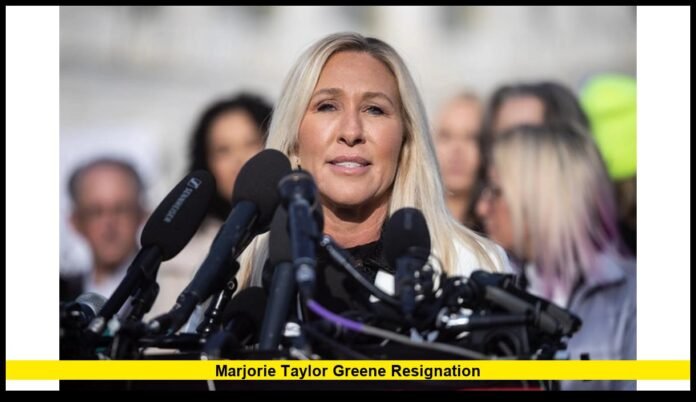

Marjorie Taylor Greene resignation has become one of the most discussed political developments in the United States as the outspoken Georgia Republican prepares to step down from Congress in early 2026. Her decision to leave office before completing her term marks a significant moment in modern U.S. politics, highlighting deep divisions within the Republican Party and raising questions about its future direction ahead of the 2026 election cycle.
Greene’s resignation is not a routine political exit. It comes after years of national attention, intense controversy, and shifting alliances at the highest levels of conservative politics. As one of the most visible members of Congress over the past several years, her departure carries consequences that extend far beyond her congressional district.
Confirmed Timeline of Greene’s Departure
Marjorie Taylor Greene will officially resign from the U.S. House of Representatives on January 5, 2026, ending her service as the representative for Georgia’s 14th Congressional District. She was reelected in 2024 but chose not to serve out the remainder of her term, triggering a vacancy that will require a special election.
Under Georgia law, the governor must call a special election to fill the seat once the resignation takes effect. Until a new representative is sworn in, the district will temporarily remain without representation in Congress. The special election will determine who completes the remainder of Greene’s term through early 2027.
This resignation is voluntary and unrelated to health issues or legal disqualification. Greene has confirmed that the decision was political and strategic, shaped by internal party conflict and her assessment of the current direction of Republican leadership.
From Party Insider to Political Outsider
Greene entered Congress in 2021 as a staunch ally of former President Donald Trump and quickly became one of the most recognizable figures in the House. Her aggressive rhetoric, willingness to challenge Democratic leadership, and unapologetic embrace of populist conservatism earned her a devoted base of supporters.
Over time, however, her relationship with Republican leadership — including Trump — deteriorated. Policy disagreements widened, particularly on issues related to government transparency, foreign policy, and internal party accountability. Greene increasingly positioned herself as independent from party leadership, criticizing decisions she believed contradicted core conservative principles.
These differences eventually became public and personal. The breakdown of trust between Greene and Trump transformed what was once a powerful alliance into a highly visible political split. That rift played a central role in her decision to step away from Congress.
Policy Disputes That Shaped the Exit
Greene has cited disagreements over policy priorities as a major factor behind her resignation. One of the most prominent issues involved her push for greater transparency related to sensitive federal investigations. She argued that withholding information from the public undermined accountability and damaged trust in government institutions.
She also expressed frustration with Republican leadership’s approach to foreign policy spending and domestic economic priorities. Greene has repeatedly stated that she felt the party had drifted away from its promises to reduce federal spending and focus on domestic concerns.
These policy disputes isolated her from powerful figures within her own party. As internal opposition grew, Greene faced the prospect of a high-profile primary challenge backed by national Republican leadership. Rather than engage in a divisive internal battle, she chose to resign.
Political Fallout and National Reaction
Reaction to Greene’s resignation has been swift and divided. Supporters describe her as a principled figure who refused to compromise her beliefs, even when it cost her political power. They argue her exit exposes deeper problems within the Republican Party, including intolerance for dissenting voices.
Critics, on the other hand, view her resignation as the conclusion of a polarizing congressional career. They point to years of controversy and argue that her departure may lower political tensions and open space for more traditional leadership within the GOP.
Across the political spectrum, lawmakers agree on one point: Greene’s exit is significant. Few members of Congress commanded as much media attention or influenced political discourse as consistently as she did during her tenure.
What the Special Election Means for Georgia
Georgia’s 14th Congressional District has been reliably Republican, but Greene’s resignation introduces uncertainty. The special election will attract multiple candidates, including those aligned closely with party leadership and others seeking to appeal to voters who supported Greene’s confrontational style.
Republican strategists see the race as a test of whether Greene’s brand of politics still resonates with voters or whether the district is ready for a different kind of conservative representation. Democrats are also expected to compete aggressively, viewing the race as an opportunity to measure shifting voter sentiment.
The outcome will offer early insight into broader national trends ahead of the 2026 midterms, particularly within districts shaped by ideological divisions inside the Republican Party.
Impact on the Republican Party
The Marjorie Taylor Greene resignation underscores a larger struggle within the GOP. The party continues to balance loyalty to established leadership with pressure from grassroots movements demanding change, transparency, and ideological purity.
Greene’s departure removes one of the most vocal critics of party leadership from Congress. While this may simplify internal dynamics in the short term, it does not resolve the underlying tensions she represented. Many voters who supported Greene remain skeptical of party leadership and may continue to demand candidates who challenge the status quo.
For Republicans, the resignation is both a warning and an opportunity. It highlights the risks of internal division while opening the door for new leadership styles to emerge.
A Polarizing but Influential Legacy
Greene’s time in Congress will be remembered for its intensity. She reshaped how individual lawmakers can use media, messaging, and confrontation to influence national debates. Her ability to dominate headlines made her a defining figure of her era, regardless of political alignment.
At the same time, her career was marked by controversy and sharp criticism. Supporters saw authenticity and courage; opponents saw division and disruption. That contrast defines her legacy and explains why her resignation has drawn such widespread attention.
As she steps away from Congress, Greene has not ruled out future political involvement outside the House. Her next moves remain unknown, but her influence on conservative politics is unlikely to disappear overnight.
What Comes After Greene Leaves Congress
Greene’s resignation closes one chapter but opens several others. For her district, it begins a competitive special election. For the Republican Party, it forces reflection on leadership, loyalty, and ideological diversity. For national politics, it marks the exit of one of the most polarizing figures of the past decade.
Whether viewed as a protest, a strategic retreat, or a turning point, her decision will continue to shape political conversations throughout 2026 and beyond.
How do you see this resignation shaping the future of U.S. politics and the Republican Party? Join the conversation and stay updated as events continue to unfold.