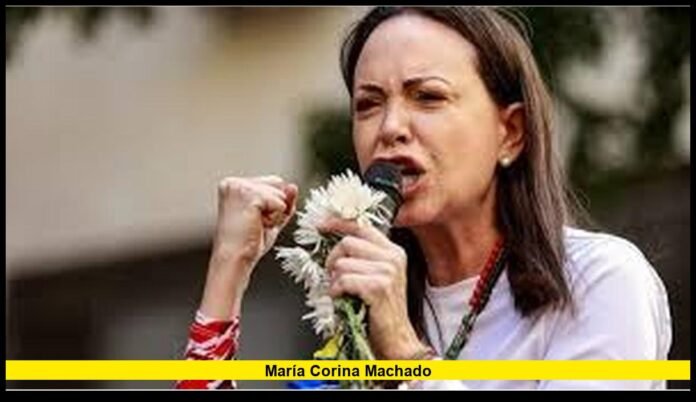

The Venezuelan opposition leader has been awarded the 2025 Nobel Peace Prize for her tireless efforts to restore democratic institutions, confront authoritarianism, and inspire millions inside and outside Venezuela. Her historic recognition signals a pivotal moment in the country’s political landscape and brings renewed international attention to its democratic crisis.
María Corina Machado has spent decades challenging the Venezuelan government, often at great personal risk. On October 10, 2025, her work received unprecedented international recognition when the Norwegian Nobel Committee announced she would receive the Nobel Peace Prize. The decision honors her role as a leading figure in the global fight for democracy, symbolizing both her leadership and the resilience of Venezuelan civil society.
This award places Machado among an elite group of world figures recognized for peaceful political advocacy. But more importantly, it shines a spotlight on Venezuela’s ongoing humanitarian, political, and economic crises — issues that have faded from global headlines in recent years.
WHO IS MARÍA CORINA MACHADO?
María Corina Machado was born on October 7, 1967, in Caracas, Venezuela. She trained as an industrial engineer before stepping into public life through civil society activism. In 2002, she co-founded Súmate, a non-governmental organization dedicated to promoting electoral transparency and citizen participation.
Her work with Súmate gained national and international attention when the group monitored the 2004 presidential recall referendum against then-President Hugo Chávez. The government accused Súmate of foreign interference, marking the beginning of Machado’s contentious relationship with Venezuela’s ruling regime.
In 2010, Machado was elected to the National Assembly, where she quickly became one of the most vocal critics of Chávez and, later, Nicolás Maduro. Known for her direct language, refusal to compromise with the government, and advocacy for a free-market economy, she became a central figure in Venezuela’s opposition movement.
Her time in the Assembly was cut short in 2014, when she was stripped of her seat after addressing the Organization of American States to denounce government repression. Since then, she has operated as a political leader, activist, and strategist outside traditional institutions, often under threat of surveillance, harassment, and detention.
WHY SHE WAS AWARDED THE NOBEL PEACE PRIZE
The Nobel Committee cited several key reasons for awarding María Corina Machado the 2025 Nobel Peace Prize:
- Persistent advocacy for democracy under extreme conditions: For over two decades, Machado has been at the forefront of Venezuela’s pro-democracy movement, facing political bans, detention, and intimidation while continuing to speak out.
- Leadership in uniting opposition forces: In a fractured political landscape, she has emerged as a unifying figure, bridging civic activism with electoral strategies.
- Nonviolent resistance to authoritarianism: Her approach has focused on peaceful political pressure, international engagement, and institutional reform, aligning with the Nobel Committee’s mission to honor advocates for nonviolent change.
- Global inspiration: Machado’s work has become a symbol of democratic resistance not just in Latin America but worldwide, inspiring activists facing similar authoritarian regimes.
The committee described her as “a leader who has shown that courage and persistence can bring the cause of freedom to the world’s attention.”
POLITICAL CHALLENGES AND PERSECUTION
Machado’s journey has been marked by intense political persecution.
In 2023, Venezuela’s Comptroller’s Office barred her from running for office for 15 years, citing vague allegations of corruption and foreign interference. Most analysts considered this a clear attempt by the Maduro government to neutralize its most popular opponent.
Despite the ban, Machado entered the 2024 opposition primaries and won overwhelmingly, demonstrating her widespread support among Venezuelans. When she was ultimately prevented from registering as a presidential candidate, she endorsed Edmundo González, unifying opposition groups behind a single figure in the presidential race — a rare achievement in Venezuelan politics.
Her growing popularity drew harsh responses. In early 2025, amid protests following Maduro’s controversial third-term inauguration, she was briefly detained by security forces, allegedly forced to record a coerced video. International condemnation was swift, leading to her release hours later.
Even after her release, Machado operated in near-clandestinity, frequently changing locations to avoid arrest, yet continuing to coordinate opposition activities.
GLOBAL REACTION TO HER NOBEL WIN
The announcement of the Nobel Peace Prize for María Corina Machado generated immediate international reactions.
- In Latin America, opposition leaders and human rights groups celebrated her recognition as a victory for democratic forces across the region. Several countries reiterated calls for free and fair elections in Venezuela.
- In the United States, lawmakers across party lines praised the decision. U.S. officials described it as a “message of hope to Venezuelans” and a “warning to authoritarian regimes.”
- European leaders emphasized that the award reinforced global solidarity with Venezuela’s democratic movement, promising renewed diplomatic engagement.
- Human rights organizations hailed the decision as overdue, pointing to her decades-long fight against one of the Western Hemisphere’s most entrenched authoritarian governments.
Machado herself issued a short statement from Venezuela, calling the award “a recognition of the courage of the Venezuelan people” and pledging to continue the struggle for freedom and dignity.
WHAT THIS MEANS FOR VENEZUELA
The Nobel Peace Prize comes at a crucial moment. Venezuela remains in the grip of economic collapse, widespread corruption, political repression, and mass migration. Millions of Venezuelans have fled the country in the last decade, creating one of the largest displacement crises in the world.
Machado’s recognition has several immediate implications for Venezuela:
- Renewed international pressure on Maduro’s regime: The award refocuses global attention on the Venezuelan crisis, which had faded from headlines as other geopolitical issues dominated the news.
- Strengthened opposition morale: For a movement often divided and demoralized, Machado’s recognition provides a rallying point and a morale boost.
- Potential retaliation from the government: Historically, the regime has responded to surges in opposition visibility with crackdowns, which could put Machado and her allies at further risk.
- Diplomatic leverage: The award gives her and the opposition greater legitimacy in international forums, potentially influencing negotiations, sanctions, and humanitarian aid strategies.
SIGNIFICANCE FOR THE UNITED STATES AND INTERNATIONAL POLICY
For U.S. policymakers, María Corina Machado’s Nobel Peace Prize is likely to reinforce the importance of Venezuela in foreign policy debates.
- It could strengthen bipartisan support for targeted sanctions and diplomatic initiatives.
- It may lead to increased humanitarian assistance for Venezuelan migrants and refugees.
- It provides a moral justification for continuing to pressure the Maduro government through multilateral organizations.
Additionally, Machado’s recognition may complicate any attempts at normalization between the U.S. and Venezuela if the regime continues to repress the opposition.
LOOKING AHEAD: THE ROAD TO OSLO AND BEYOND
The Nobel Peace Prize ceremony is scheduled for December 10, 2025, in Oslo, Norway. Machado’s participation in the ceremony will be closely watched.
Key questions now arise:
- Will the Venezuelan government allow her to travel to Oslo? If she is blocked, it will highlight the regime’s authoritarianism even more starkly.
- Will she use the platform to advocate for stronger international action? Her acceptance speech could shape future foreign policy approaches toward Venezuela.
- Can this recognition translate into political change? Awards alone do not topple governments, but they can reshape narratives and galvanize movements.
For Machado, this moment is both a personal triumph and a test of how she can leverage international attention to achieve tangible change at home.
CONCLUSION
The Nobel Peace Prize for María Corina Machado represents far more than a personal achievement. It’s a global acknowledgment of Venezuela’s democratic struggle, a validation of decades of civic resistance, and a rallying cry for renewed international solidarity.
Machado’s courage, persistence, and leadership have earned her one of the world’s highest honors. Now, all eyes are on how this historic moment will shape the next chapter in Venezuela’s quest for democracy.
What are your thoughts on María Corina Machado’s Nobel Peace Prize win and its impact on Venezuela’s future? Share your views in the comments below.