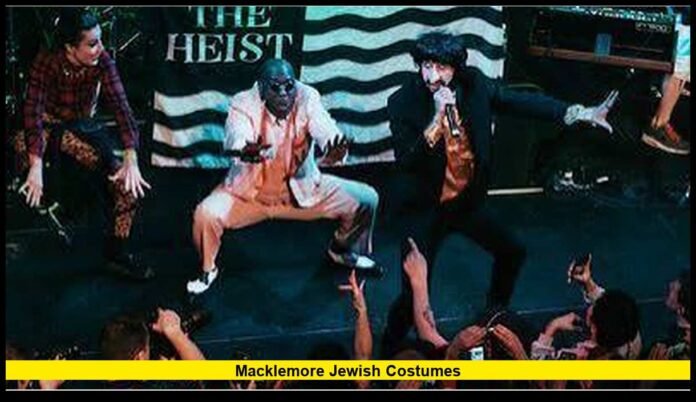

The macklemore jewish costume controversy dates back to 2014, when the Seattle rapper appeared at a surprise performance wearing a disguise that included a large prosthetic nose, dark wig, beard and dark clothing. Images of the appearance quickly spread online, prompting criticism from people who believed the look resembled an antisemitic stereotype. Macklemore later apologized and explained that he had not intended to portray Jewish people, saying the disguise had been created for a surprise appearance rather than as a statement about a particular ethnic or religious group.
More than a decade later, the incident continues to attract attention because Macklemore has remained a highly visible public figure and has become increasingly outspoken about political and humanitarian issues. Recent controversy surrounding his public support for Palestinians has caused renewed discussion of past incidents involving the rapper. However, the 2014 costume controversy and his later political activism are separate events and need to be considered in their own historical context.
What Happened in Seattle in 2014?
The controversy began during a surprise Macklemore performance in Seattle in May 2014. At the time, the rapper was enjoying enormous mainstream success following the release of his album The Heist, which he made with producer Ryan Lewis.
Macklemore appeared at an event associated with the opening of the “Spectacle: The Music Video” exhibition at Seattle’s Experience Music Project, now known as the Museum of Pop Culture.
The performance was designed to be a surprise. Macklemore used a disguise so that he could appear without being immediately recognized by attendees. His costume included several features that became controversial once photographs of the performance circulated online.
Among the most noticeable elements was an exaggerated prosthetic nose. He also wore a wig, beard and dark clothing. While Macklemore described the outfit as a disguise without a specific ethnic target, critics argued that the combination resembled a longstanding caricature of Jewish people.
The controversy quickly moved from the event itself to social media and news coverage.
Why Was the Costume Criticized?
The central criticism focused on the historical meaning associated with exaggerated facial features, particularly an oversized nose.
Antisemitic imagery has frequently portrayed Jewish people using exaggerated noses and other distorted physical characteristics. Such imagery has appeared in European propaganda, caricatures and political material for generations.
Because of that history, critics argued that Macklemore’s appearance could evoke an antisemitic stereotype even if he did not consciously intend to reference Jewish people.
This distinction became central to the discussion. Macklemore’s explanation focused on intent: he said he was simply trying to disguise himself. Critics focused on impact and the historical associations of the appearance.
The disagreement illustrates why controversies involving costumes can become complicated. A performer may see an outfit as humorous or harmless, while audiences familiar with its cultural symbolism can interpret it very differently.
Macklemore’s Explanation
After photographs generated criticism, Macklemore addressed the controversy publicly.
He said that he had not intended to dress as a Jewish person. His explanation was that the costume had been assembled to make him difficult to recognize during the surprise performance.
Macklemore also said he had not considered the historical associations connected to the exaggerated nose. According to his explanation, the costume was not intended as a commentary on Jewish culture or religion.
He nevertheless recognized that people could reasonably interpret the appearance differently from what he had intended.
Rather than dismissing the criticism entirely, Macklemore apologized to people who felt offended. His response became an important part of the controversy because it acknowledged the difference between an individual’s intention and the possible effect of an image.
The Role of the Anti-Defamation League
The Anti-Defamation League also became involved in the discussion.
The organization, which works to combat antisemitism and other forms of discrimination, addressed the controversy after Macklemore’s explanation and apology.
The ADL said it accepted his explanation that he had not intended to create an antisemitic caricature. The organization’s response provided additional context for the incident because it distinguished between the offensive potential of the imagery and an intentional act of antisemitism.
That distinction is still important when the 2014 incident is discussed today.
It would be inaccurate to state simply that Macklemore deliberately dressed as a Jewish stereotype when his own explanation was that the appearance was intended as a disguise and the ADL subsequently accepted his explanation regarding his intent.
At the same time, the criticism remains understandable because the visual elements of the costume had recognizable historical associations.
Why the Images Became a Major Story
Macklemore was already one of the biggest names in music when the controversy emerged.
His breakthrough had produced several internationally recognized songs, and his public profile meant that photographs of his appearance could reach a very large audience almost immediately.
The online environment also contributed to the controversy.
People who saw the images outside the original event did not necessarily have access to the full context surrounding the performance. A photograph could be viewed without knowing why Macklemore was wearing the disguise or what he had said about the costume afterward.
That made the image itself the focus of much of the discussion.
The controversy demonstrated how quickly an isolated photograph involving a celebrity can become a nationwide story, particularly when the image touches on sensitive subjects involving ethnicity, religion and historical discrimination.
Intent Versus Impact
One of the most enduring aspects of the incident is the question of whether intent should determine how an offensive image is judged.
Macklemore maintained that he did not intend to mock Jewish people. That position explains why the incident was not treated by the ADL as evidence of deliberate hateful intent.
But the reaction from critics demonstrated another side of the issue.
A person does not necessarily need to intend harm for an image to evoke a harmful stereotype. Cultural symbols can carry meanings that are not obvious to everyone who uses them.
The costume therefore became an example of how public figures can unintentionally cross cultural boundaries.
Macklemore’s subsequent apology suggested that he understood why people reacted negatively even though he said the stereotype had not been part of his original thinking.
How Macklemore’s Career Changed After the Controversy
The costume controversy did not define Macklemore’s career.
He continued releasing music and performing internationally. His career also developed beyond the commercial success that had made him famous in the early 2010s.
Macklemore became increasingly willing to speak publicly about social and political subjects. His work has addressed issues including drug addiction, recovery, racial inequality, LGBTQ+ rights and other social concerns.
That willingness to comment on controversial subjects has occasionally placed him at the center of public debate.
His political visibility has become especially relevant in recent years as he has spoken strongly about the war in Gaza and Palestinian rights.
Why the Old Controversy Has Returned to Public Discussion
The 2014 incident has received renewed attention in 2026 partly because of Macklemore’s current political activism.
Macklemore has been outspoken in support of Palestinians and has performed music connected to the issue. His public statements have generated both support and criticism.
During a 2026 appearance connected with Ed Sheeran’s tour, Macklemore used his platform to express support for Palestinians and criticism related to the war in Gaza. The remarks generated significant public reaction and contributed to broader debate about political expression by musicians.
As the newer controversy developed, some commentators revisited earlier incidents involving Macklemore, including his 2014 costume.
The renewed attention does not change the circumstances of the original event. It simply places an old controversy back into public discussion because Macklemore remains an active and politically outspoken celebrity.
The 2014 Costume and the 2026 Gaza Debate Are Different
It is important to keep the two controversies separate.
The 2014 incident involved a disguise worn during a surprise music performance. Macklemore said he did not intend to portray Jewish people, later apologized for the offense caused and received an ADL response accepting his explanation of his intent.
The more recent controversy concerns his political views and public advocacy surrounding Palestinians, Israel and Gaza.
Those subjects overlap in public discussion because both involve Jewish identity, antisemitism, Israel and Middle Eastern politics. However, the factual circumstances are different.
Combining them into one continuous incident can create a misleading impression about what happened.
The historical record surrounding the costume is best understood on its own, while Macklemore’s current political activity should be assessed based on his recent statements and actions.
Why Jewish Stereotypes in Entertainment Remain Sensitive
The reaction to Macklemore’s costume also reflects a larger issue in entertainment.
Jewish stereotypes have appeared in popular culture for generations. Exaggerated noses, facial hair, clothing and other visual characteristics have sometimes been used to portray Jewish characters in ways that reinforce negative assumptions.
Modern audiences are increasingly aware of those historical associations.
As a result, performers and entertainment companies can face criticism when costumes unintentionally resemble imagery associated with discrimination.
This does not mean every exaggerated nose or disguise automatically represents antisemitism. Context, intent, presentation and historical associations all matter.
The Macklemore controversy illustrates precisely why context is important.
Macklemore’s Apology Remains Central to the Story
Macklemore’s apology is one of the most significant facts surrounding the controversy.
Rather than continuing to insist that criticism was completely unreasonable, he acknowledged that people could view the costume as offensive.
He explained that he had not intended to create the stereotype and said he was sorry to anyone who had been hurt.
That response helped shift the discussion from whether he had deliberately attempted to offend Jewish people toward a broader conversation about cultural awareness and responsibility.
For many readers revisiting the controversy today, the apology is just as important as the original photograph because it demonstrates how Macklemore responded after learning how the costume had been interpreted.
What Is Known About the Controversy Today?
The basic facts remain straightforward.
Macklemore wore the costume during a surprise performance in Seattle in 2014. The appearance included an oversized artificial nose, wig, beard and dark clothing. Critics interpreted the combination as a Jewish caricature with antisemitic associations.
Macklemore rejected the claim that he intended to portray Jewish people. He said the outfit was a disguise created for the surprise appearance.
He later apologized and acknowledged that the appearance could reasonably cause offense.
The Anti-Defamation League accepted his explanation that the costume had not been intended as a hateful caricature.
The story has resurfaced because Macklemore remains a prominent musician whose political activism has generated renewed public debate.
Frequently Asked Questions
What was the Macklemore Jewish costume controversy?
It was a 2014 controversy involving Macklemore’s appearance at a surprise performance in Seattle. Critics said his disguise resembled an antisemitic Jewish stereotype.
Why did people criticize Macklemore’s costume?
The criticism focused particularly on the large prosthetic nose and the combination of the nose, wig and beard, which some observers associated with historical antisemitic caricatures.
Did Macklemore intend to offend Jewish people?
Macklemore said he did not. He described the costume as a disguise designed to conceal his identity before a surprise performance.
Did Macklemore apologize?
Yes. He apologized after the appearance generated criticism and acknowledged that people could interpret the costume as a Jewish caricature.
What did the Anti-Defamation League say?
The Anti-Defamation League accepted Macklemore’s explanation that he had not intended a hateful caricature and welcomed his apology.
Why is the controversy being discussed again?
Renewed attention has followed Macklemore’s more recent political activism and outspoken support for Palestinians. Those developments have prompted some people to revisit controversies from earlier in his career.
Is the 2014 incident connected to Macklemore’s current political statements?
The subjects have become connected in public discussion, but they are separate events. The 2014 controversy concerned a costume, while current criticism centers on political statements and activism.
Final Takeaway
The Macklemore costume controversy remains notable because it demonstrates how celebrity appearances can intersect with historical stereotypes and cultural sensitivity. Macklemore said the disguise was not intended to represent Jewish people, but critics argued that its visual elements carried associations he had failed to consider.
His subsequent apology and the Anti-Defamation League’s acceptance of his explanation are important parts of the historical record. The controversy has resurfaced because of Macklemore’s continuing prominence and his recent political activism, but the events should be judged according to their individual contexts.
For readers encountering the story again today, the clearest understanding comes from separating the documented 2014 costume incident from the much newer debates surrounding Macklemore’s political views and public advocacy.