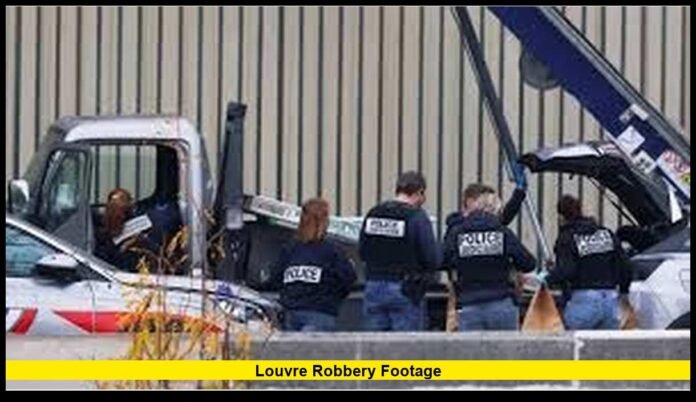

Surveillance-level louvre robbery footage has circulated globally, dramatically showing a masked thief using a power tool to cut through a glass display case in broad daylight. The footage captures the moment bright and clear: the theft that must now rank among the most audacious museum crimes in history.
The Heist in Detail
Shortly after 9:30 a.m. on October 19, 2025, the world’s most-visited museum—the Louvre Museum in Paris—was hit by a meticulously-executed robbery. Hidden among early visitors, a small criminal team entered using a stolen truck equipped with a basket lift and accessed a window along the Seine-facing facade. The footage shows two men arriving in construction-style safety vests, one wielding a small saw, the other standing guard.
- The target: the museum’s Galerie d’Apollon, home to parts of the French Crown Jewels collection.
- In under five minutes, the thieves smashed into two high-security display cases and exited via motor-scooter.
- Among the stolen items were the sapphire tiara, necklace and single earring belonging to former French royalty—all pieces of “inestimable heritage value”.
The astonishing speed of the raid shocked museum staff and security officials. The footage highlights how the thieves worked calmly—with no visible panic, despite multiple visitors nearby.
What the Footage Actually Shows
From the released video stills and CCTV glimpses:
- A yellow-vested suspect removes safety gloves, positions a battery-powered disc saw against a thick glass panel and begins cutting.
- Sparks fly briefly; the panel falls and the thief reaches in to remove multiple items.
- Two support personnel assist: one watches the corridor traffic, the other prepares the getaway route.
- The group abandons the lift and exits adjacent to the river bank—leaving the scene cleanly and professionally.
Crucially, the footage underlines that this was not an impulsive act of vandalism but a highly organised operation. The tools, timing, escape route—all point to a team braced for planned execution.
Why this Matters for U.S. Audiences
While the heist occurred in Paris, the significance of the louvre robbery footage is global—including in the United States:
- American institutions must study how one of the world’s most secure museums could be breached in broad daylight.
- The case spotlights how cultural-heritage theft affects not just national treasures but global heritage markets and repatriation efforts.
- U.S. travelers visiting major museums now face renewed awareness of vulnerabilities and the importance of institutional transparency.
- The footage provides a template for both preventive measures and investigative responses—relevant for any large-scale public-access venue.
Key Moments & Security Gaps Uncovered
Entry Route and Timing
The thieves entered using a cherry-picker basket truck parked beside the Seine, reaching a window in the Apollo Gallery zone. They exploited renovation access points and a rarely-used window rather than the main entrance.
Tooling and Tactics
Footage shows a circular disc saw in use—quiet, efficient, and deadly to standard museum glass. The case’s full breakdown took just seconds once the cut was finished.
Visitor Overlook & Escape
While other visitors were present, the gallery remained lightly monitored. The thieves exited swiftly on scooters, avoiding checkpoints and blending into rush-hour traffic.
Display-Case Breach
The display units were designed for high value but apparently lacked nimble response protocols. The footage shows cut-through glass and opened cases within moments, with alarms triggering only after the escape.
Post-Heist Movement
An abandoned lift and a stolen vehicle nearby suggest pre-staging. The footage underscores how external equipment was used to bypass internal security.
What Was Stolen
According to museum and government statements, the haul included:
- A sapphire tiara, matching necklace and a single earring from a set linked to French royalty.
- An emerald necklace and emerald earrings once worn by royal figures of the Napoleonic era.
- A large brooch and diadem tied to French imperial consorts.
- One crown associated with a French empress—found dumped, damaged, just outside the museum grounds.
Though one piece was recovered, most remain missing and could be dismantled or trafficked. The footage provides the only visual record of how those items were removed from the public space.
Response From Authorities
French law-enforcement and culture officials reacted swiftly:
- The museum closed immediately for forensic examination and remains partly shut while investigations proceed.
- High-ranking ministers condemned the theft as “an attack on national heritage”.
- International alerts have been issued via Interpol, with shipping hubs and gem-trade monitors activated.
- The footage is being circulated globally to art-crime units and jewel-industry regulators.
Lessons for Museums & Institutions
From the louvre robbery footage, several critical lessons emerge:
- Entry route vulnerability: external lifts may bypass internal controls.
- Tool threat management: power tools can be used quietly—even against “secure” glass.
- Crowd and staff burden: large-scale visitor flows may stretch oversight capacity.
- Escape planning: scooters, stairwells and river-adjacent exits go mostly unmonitored in many institutions.
- Asset vulnerability: even high-value items in locked cases remain at risk unless protocols match threat sophistication.
U.S. museum boards, security teams and cultural organisations must treat the footage as a cautionary case study.
What Happens Next
Officials are pursuing multiple leads:
- Full forensic review of window entry, lift truck and saw-tool assembly.
- Analysis of visitor-and-vehicle logs around the Seine frontage.
- Gem-industry tracking of unusual stones and offers overseas.
- Enhanced global alerts to auction houses, jewel-dealers and collectors.
- Museum-security reforms, with reinforced display cases, infrared motion sensors and stricter access-control zones.
Given the footage and evidence, one of two outcomes is likely: theft detection and recovery, or dispersed artefacts that may never surface intact.
Final Thought
The louvre robbery footage doesn’t just document a theft—it shines a spotlight on the faults in historic-treasure protection and the lengths criminals will go to siphon cultural value. Watching a thief calmly slice open a display case in broad daylight—and carry off national heirlooms—is a chilling reminder that even iconic institutions are not invulnerable.
What do you make of the footage and the heist? Share your perspective below and stay tuned for updates as investigators work to track down the stolen jewels.