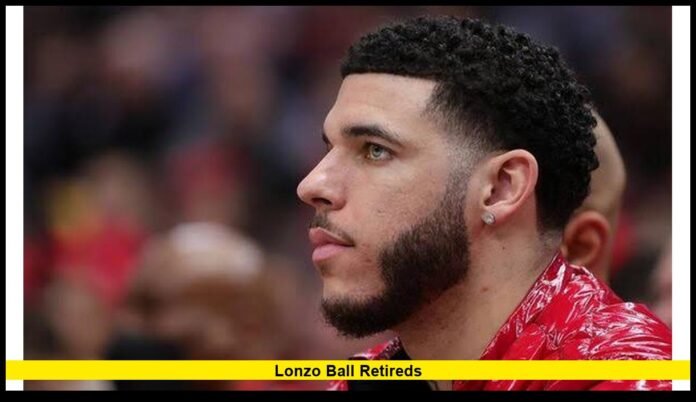

Lonzo Ball retired from professional basketball at age 28, ending a nine-year NBA journey that included a No. 2 overall draft selection, several promising seasons, major knee problems and a difficult comeback. Ball announced his decision on September 23, 2026, during an appearance on the Family Podcast, reflecting on what basketball had given him and saying he felt he had given everything he had to the game.
The decision closes the playing chapter of a career that once appeared to be heading toward a much longer NBA run. Ball entered the league in 2017 as one of the most closely watched prospects in basketball and eventually developed into a versatile guard capable of contributing as a passer, rebounder, defender and three-point shooter.
His career ultimately took a different direction because of persistent knee problems. After missing two complete seasons and undergoing multiple procedures, Ball managed to return to NBA action. However, he was never able to consistently recreate the form he showed before his injury.
A No. 2 Pick With Enormous Expectations
Ball entered the NBA after one season at UCLA, where his combination of size, passing ability and court vision made him one of the most recognizable prospects in college basketball.
The Los Angeles Lakers selected him with the second overall pick in the 2017 NBA Draft. The selection immediately placed enormous expectations on the young guard.
At 6-foot-6, Ball had unusual size for a point guard. He could push the ball quickly, find teammates in transition and rebound at a high level for his position. His defensive instincts also made him capable of affecting games without necessarily being the team’s leading scorer.
During his rookie season, Ball averaged 10.2 points, 6.9 rebounds and 7.2 assists per game. He was subsequently named to the NBA All-Rookie Second Team.
His shooting was inconsistent during his first NBA season, but his passing and defensive potential remained evident.
Development Away From Los Angeles
Ball’s time with the Lakers lasted only two seasons.
He was eventually included in the blockbuster trade that sent Anthony Davis to Los Angeles. The move sent Ball to the New Orleans Pelicans, where he had an opportunity to develop in a different environment.
His game began changing significantly in New Orleans.
Rather than being viewed only as a traditional pass-first point guard, Ball became increasingly comfortable shooting from outside. His three-point shooting improved, allowing him to play alongside other ball-dominant players.
During the 2019-20 season, he averaged 11.8 points, 6.1 rebounds and 7.0 assists per game while making 37.5% of his three-point attempts.
The following season was even more productive statistically.
Ball averaged 14.6 points, 4.8 rebounds and 5.7 assists during the 2020-21 season. His three-point shooting remained close to 38%, demonstrating how much his perimeter game had developed since entering the league.
That improvement helped increase his value around the NBA.
Chicago Bulls Became a Turning Point
Ball joined the Chicago Bulls in 2021 and quickly became an important part of their rotation.
The move appeared to provide the right environment for his skill set. Chicago needed a guard who could defend, move the ball, rebound and knock down open three-pointers.
Ball delivered in each of those areas during the early portion of the 2021-22 season.
Before his knee injury ended his campaign, he averaged 13.0 points, 5.4 rebounds, 5.1 assists and 1.8 steals per game. He also shot 42.3% from three-point range.
That three-point percentage represented the best mark of his NBA career for a full season.
His impact went beyond scoring. Ball helped create transition opportunities, defended opposing guards and wings, moved the ball quickly and provided another rebounding option.
At that point, his career appeared to be moving in a positive direction.
Then came the injury that dramatically altered his future.
The Knee Problems That Changed His Career
Ball’s left knee became the central issue of the final portion of his career.
He was initially sidelined after suffering a knee injury during the 2021-22 season. What followed became a prolonged rehabilitation process involving multiple procedures.
Ball eventually underwent several knee surgeries and later had a cartilage and meniscus transplant.
The recovery was extraordinarily lengthy.
He missed the entire 2022-23 season and remained out throughout the 2023-24 campaign. His absence meant that he spent roughly two years away from NBA game action during a period when most players are still developing physically and professionally.
The extended absence also created questions about whether Ball would be able to return at all.
For an NBA player whose game depended partly on movement, speed, defensive activity and quick changes of direction, a serious knee problem represented a particularly difficult challenge.
His Long-Awaited NBA Comeback
Ball finally returned to NBA competition during the 2024-25 season with Chicago.
His comeback was significant because he had gone more than 1,000 days between NBA appearances.
Although his production was below his pre-injury level, getting back onto the court represented an important achievement after such a lengthy absence.
Ball appeared in 35 games during the season and averaged 7.6 points, 3.4 rebounds and 3.3 assists.
The comeback also showed that his basketball career was not immediately over despite the severity of his knee problems.
However, the version of Ball who returned was different from the player Chicago had previously received.
He had to manage his physical limitations while finding ways to contribute through his passing, shooting and experience.
Move to the Cleveland Cavaliers
Ball’s next major career move came when he joined the Cleveland Cavaliers.
The opportunity gave him another chance to establish himself as a useful veteran guard.
His role was more limited than during his best period in Chicago, and his statistical production declined.
During the 2025-26 season, Ball averaged 4.6 points, 4.0 rebounds and 3.9 assists in 35 games. He shot 30.1% from the field and 27.2% from three-point range.
The numbers represented career lows in several categories.
Cleveland eventually moved Ball in a three-team transaction involving the Utah Jazz and Atlanta Hawks in February 2026. Utah acquired him along with two future second-round picks but waived him the following day.
That move made Ball a free agent.
He did not join another NBA team before making his announcement in September.
What Led to the Final Decision?
Ball’s latest comments indicate that his decision was connected to his long relationship with basketball and everything he had experienced throughout his career.
During his podcast appearance, he reflected on reaching the NBA and expressed gratitude for the opportunities the sport had provided.
At 28, he is much younger than many players who normally leave professional basketball. His age makes the announcement especially notable.
However, the timing follows several seasons in which injuries limited his availability and production.
Ball had already experienced one of the most difficult injury recoveries in recent NBA history. His return was itself a significant accomplishment, but maintaining a long-term role in the league proved increasingly difficult.
The combination of his physical history, free-agent status and changing role eventually brought his playing career to an end.
Career Numbers Tell Only Part of the Story
Ball finishes his NBA career with 322 regular-season appearances.
His career averages include:
| Category | Career Average |
|---|---|
| Points | 10.6 |
| Rebounds | 5.3 |
| Assists | 5.6 |
| Steals | 1.5 |
| Blocks | 0.6 |
| Field Goal Percentage | 39.2% |
| Three-Point Percentage | 35.5% |
| Free Throw Percentage | 60.3% |
Those numbers do not fully capture his impact during his healthiest periods.
Ball’s passing was one of his defining abilities. His size allowed him to rebound at a strong rate for a guard, while his defensive anticipation frequently created steals and transition opportunities.
His shooting development was also an important part of his story.
The player who entered the league with questions about his outside shooting eventually became a reliable three-point threat, particularly during his best stretch in Chicago.
The Four Teams He Represented
Ball’s NBA career included four organizations.
Los Angeles Lakers
The Lakers selected Ball second overall in 2017. His rookie season featured strong rebounding and passing numbers, although his shooting remained inconsistent.
New Orleans Pelicans
Ball’s time in New Orleans was important for his development. His scoring and three-point shooting improved, and he became a more complete two-way guard.
Chicago Bulls
Chicago produced arguably the most promising period of Ball’s career. His defense, passing, rebounding and perimeter shooting made him a valuable contributor before his knee injury.
Cleveland Cavaliers
Ball joined Cleveland after returning from his long injury absence. His role was more limited, and he eventually became part of a trade that sent him to Utah.
The Jazz waived him shortly after acquiring him.
A Career Defined by Both Promise and Resilience
Ball’s NBA career cannot be separated from the expectations that surrounded him when he entered the league.
Being selected No. 2 overall meant he arrived with expectations of becoming a major franchise player.
While he never reached that projected level, he developed into a useful NBA guard and demonstrated substantial improvement in several areas.
His career also became a story of persistence.
After missing two entire seasons, Ball continued working toward a return despite undergoing multiple procedures. Returning to an NBA floor after such a prolonged absence was a major personal milestone.
His final numbers were considerably different from those of his healthiest seasons, but his ability to return at all was notable.
What Happens Next?
Ball’s announcement ends his NBA playing career, but it does not necessarily mean that basketball will disappear from his life.
He has already established interests outside the court and has remained involved in basketball-related discussions through media appearances and his podcast.
Retirement also gives him an opportunity to focus on his family, business interests and life away from the physical demands of professional basketball.
His brothers remain connected to the sport, and the Ball family continues to have a prominent place in basketball culture.
For Lonzo, the next stage will take place away from the daily demands of an NBA roster.
Lonzo Ball Retired After Nine NBA Seasons
The latest update confirms that Ball has decided to walk away from professional basketball after nine seasons.
His career included a high-profile start with the Lakers, development with New Orleans, a promising run with Chicago and a difficult final chapter shaped by knee injuries.
He finishes with 322 regular-season games, career averages of 10.6 points, 5.3 rebounds and 5.6 assists, and four NBA teams on his résumé.
The most significant part of his final years was his determination to return after an extended absence. The comeback allowed him to play NBA basketball again after a period when his future in the league was uncertain.
At 28, his departure is earlier than expected for a player who entered the NBA as a highly touted second overall pick. Yet his nine-year career included meaningful development, strong individual stretches and a return from a serious injury that had kept him away from the game for two seasons.
Ball now moves into the next chapter of his life after spending much of his youth and adulthood pursuing professional basketball.