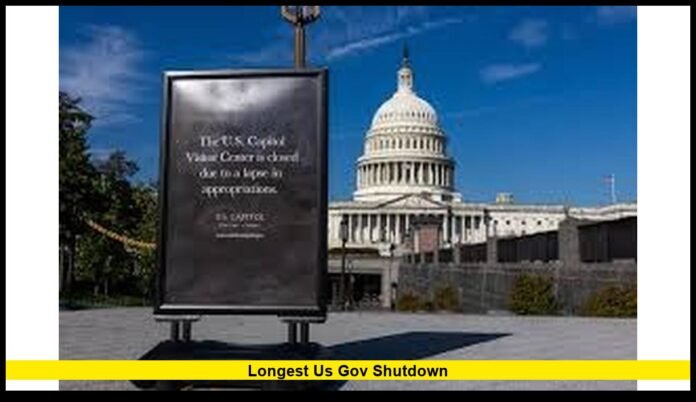

The longest US gov shutdown in American history has entered uncharted territory, surpassing all previous records and leaving millions of Americans caught in the crossfire of political gridlock. As of late October 2025, the federal government has been partially closed for more than three weeks, impacting services nationwide and shaking confidence in Washington’s ability to govern.
With no compromise in sight, the shutdown is affecting everything from airport operations to food assistance programs, marking one of the most consequential fiscal deadlocks the United States has ever faced.
What Triggered the Longest US Gov Shutdown
The shutdown officially began on October 1, 2025, when Congress failed to pass a spending bill to fund government operations for the new fiscal year. The stalemate centers around a bitter fight over federal spending priorities, healthcare subsidies, and foreign aid allocations.
Lawmakers in both parties have remained firm in their positions — one side pushing for major spending cuts, the other insisting on maintaining or expanding social programs. Without a budget agreement or even a short-term funding resolution, key government operations have ground to a halt.
The shutdown has now eclipsed the 35-day record set during the 2018–2019 government closure, officially making this the longest US gov shutdown in history.
Key Reasons Behind the Ongoing Stalemate
The 2025 shutdown is not simply a funding lapse — it’s a clash over the future direction of U.S. domestic and international policy.
Major sticking points include:
- Federal spending caps: Disagreement over how much to limit future government spending on non-defense programs.
- Healthcare programs: A proposal to alter subsidies for low-income Americans has sharply divided lawmakers.
- Foreign aid reductions: Cuts to global assistance programs have faced strong opposition from both domestic and international advocates.
- Immigration and border policy: Continued debates over funding for border infrastructure and enforcement have reignited partisan conflict.
Multiple short-term funding measures have failed in both the House and Senate, leaving the shutdown unresolved as federal agencies run out of funds.
Impact on Federal Workers and Services
The effects of the longest US gov shutdown have rippled through nearly every aspect of public life.
- Federal employees: More than 2 million federal workers have been impacted. Roughly half are furloughed, while the rest — including air traffic controllers, TSA officers, and federal law enforcement — continue to work without pay.
- National parks and monuments: Most have closed or drastically reduced operations, leaving iconic destinations shuttered and local tourism economies struggling.
- Air travel delays: Staffing shortages at airports have caused longer lines and minor flight delays at major hubs across the country.
- Food and housing programs: Nutrition and housing assistance programs for low-income families face severe disruptions as funds dry up.
- Small business contracts: Contractors and suppliers that depend on federal projects are reporting halted payments and mounting financial strain.
- Scientific research: Dozens of government-funded laboratories have suspended operations, delaying critical research in medicine, energy, and technology.
For many Americans, the effects are personal — missed paychecks, delayed benefits, and uncertainty about when normal operations will resume.
Economic Consequences of the Shutdown
Economists warn that this shutdown is beginning to carry serious economic consequences. Analysts estimate that each week the government remains closed costs the U.S. economy $1.5 to $2 billion in lost productivity and consumer spending.
If the shutdown continues into November, the total economic toll could exceed $10 billion, a loss comparable to a mid-sized recession.
Financial markets have shown signs of strain, and several credit-rating agencies have issued warnings about potential downgrades if Congress fails to restore normal operations soon. Meanwhile, small businesses that rely on federal contracts or grants are reporting widespread financial distress.
A Look Back: Comparing Past Shutdowns
While shutdowns have become a recurring feature of American politics, none have lasted as long or reached as deeply as this one.
| Year | Duration | President | Primary Issue |
|---|---|---|---|
| 1995–1996 | 21 days | Bill Clinton | Medicare and budget cuts |
| 2018–2019 | 35 days | Donald Trump | Border wall funding |
| 2025 (current) | 24+ days and counting | Current Administration | Federal spending and healthcare funding |
The 2025 shutdown not only exceeds the record length but also involves a wider range of agencies and a larger portion of the federal workforce.
How Congress Is Responding
Despite rising public frustration, Congress remains deadlocked. Both the House of Representatives and the Senate have introduced competing funding bills — each containing provisions the other side refuses to accept.
Negotiations over a possible short-term continuing resolution have failed multiple times, and partisan divisions show no sign of narrowing. Moderates in both parties have floated proposals for a temporary reopening of the government while talks continue, but leadership in both chambers has resisted, fearing political backlash from their respective bases.
Efforts by bipartisan working groups to craft a compromise have so far produced little progress.
Public Pressure Mounts on Lawmakers
As the longest US gov shutdown drags on, pressure from the public and federal employees is intensifying. Across the country, federal workers have organized protests demanding pay restoration and urging lawmakers to end the standoff.
Polls show that a majority of Americans blame both parties for the shutdown, though frustration is particularly aimed at congressional leaders for their inability to compromise. Public approval ratings for Congress have dipped to new lows, reflecting growing anger over Washington’s dysfunction.
Impact on National Security and International Relations
Beyond domestic consequences, the shutdown is also affecting U.S. global standing. Reduced staffing at the State Department and Defense Department has delayed diplomatic communications and military coordination.
Visa and passport services abroad have slowed dramatically, frustrating travelers and foreign nationals awaiting immigration decisions. International partners have expressed concern that the ongoing dysfunction could hinder America’s ability to respond to global crises.
Meanwhile, cybersecurity experts warn that furloughed IT staff across federal agencies could leave critical systems vulnerable to attacks.
Possible Scenarios to End the Shutdown
There are several ways the shutdown could end, though none are guaranteed to happen quickly:
- Short-term spending deal: Congress could pass a temporary funding bill that reopens the government for a few weeks while negotiations continue.
- Comprehensive bipartisan agreement: Lawmakers could reach a long-term deal that includes concessions from both sides on spending and policy priorities.
- Presidential action: The President could sign a compromise bill or invoke limited executive powers to redirect funds, though such actions would likely face legal challenges.
- Public and political pressure: As economic and social impacts worsen, growing public outrage may push leaders toward a deal.
Until one of these scenarios unfolds, agencies remain shuttered and the nation’s workforce continues to wait.
The Human Cost of the Shutdown
Beyond politics and economics, the human toll of the longest US gov shutdown is becoming clear.
- Families of federal workers are struggling to pay rent and mortgages.
- Military families awaiting reimbursements and benefits are facing financial strain.
- Students dependent on federal grants and research stipends have seen funding frozen mid-semester.
- Elderly Americans dependent on government aid programs fear further delays in essential services.
The longer the shutdown persists, the more difficult recovery will be. Even once funding is restored, federal agencies will face months of backlogs, delayed projects, and low employee morale.
The Road Ahead
If the shutdown extends into November, it will officially enter its second month — an unprecedented duration that would test the country’s economic stability and public patience. Analysts predict that the cost of recovery, once the shutdown ends, will run into tens of billions of dollars as agencies struggle to restart operations and clear backlogs.
Political analysts believe pressure from voters, especially as the 2026 election cycle approaches, may eventually force a compromise. However, the damage to public trust and institutional credibility may take far longer to repair.
In conclusion, the longest US gov shutdown has become a defining crisis of 2025, illustrating both the fragility and resilience of the American political system. While millions of Americans endure its effects, the nation watches anxiously for signs of leadership and unity in Washington. The longer it drags on, the deeper the impact — and the higher the cost for every American.
Thank you for reading — share your thoughts below on how this shutdown has affected your community and what steps Congress should take to resolve it.