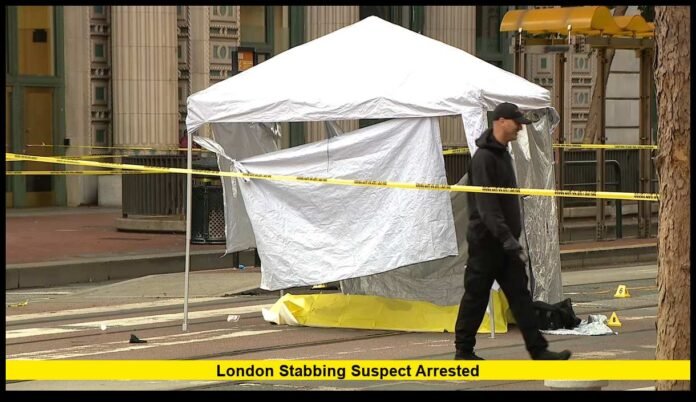

Police in South London have arrested the London stabbing suspect wanted for a fatal knife attack that left one man dead and two others seriously injured. The arrest followed a two-day manhunt that gripped the city and renewed concern over London’s rising wave of knife violence.
Metropolitan Police confirmed on Sunday, November 2, 2025, that a 29-year-old man was taken into custody in Peckham, roughly two miles from the crime scene in Brixton. Officers described the arrest as “swift and coordinated,” bringing relief to a shaken community still reeling from Friday night’s events.
How the Attack Unfolded
The violence broke out shortly before 11:40 p.m. on Friday, October 31, on Coldharbour Lane, one of Brixton’s busiest streets. The area is packed with restaurants, pubs, and late-night crowds.
When police arrived, they found three people suffering from stab wounds. A 33-year-old man, later identified as Marcus Bailey, died at the scene despite emergency treatment. A 27-year-old woman and a 29-year-old man were rushed to King’s College Hospital, where they remain in stable condition.
Witnesses described a scene of panic as people ran from bars and restaurants. “It was chaos,” said local resident Carla Jenkins. “People were screaming, and police cars came from every direction.”
Officers immediately sealed off the area, setting up large crime-scene tents while forensic specialists combed the street for evidence well into the morning.
How Police Found the Suspect
The London stabbing suspect was traced through hours of CCTV footage, mobile-phone data, and tips from residents. Police located the man at a flat in Peckham early Sunday morning and arrested him on suspicion of murder and attempted murder.
Detective Chief Inspector Claire Henson, who is leading the investigation, praised the teamwork behind the operation.
“This was a horrific and senseless attack. Our detectives worked around the clock to identify the suspect and bring him into custody. The victim’s family has been informed, and specialist officers are supporting them.”
Investigators believe the attack may have started as a dispute inside a nearby venue before spilling onto the street. Officers are still reviewing video footage from businesses along Coldharbour Lane to determine the full sequence of events.
Remembering Marcus Bailey
The victim, Marcus Bailey, was well known in the Brixton community. Friends say he worked in construction and was a devoted father of two young children.
Floral tributes and candles now line the pavement outside the restaurant where the attack took place. On Saturday evening, dozens of people gathered for a vigil, lighting candles and observing a moment of silence.
Local pastor Reverend Samuel Peters addressed the crowd:
“Marcus was loved and respected here. His death reminds us how fragile life is and how urgently we must come together to stop this violence.”
Knife Crime: A Growing Crisis
The Brixton attack is part of a wider pattern of knife-related violence that has plagued London in recent years. Despite government initiatives, knife offenses have continued to rise throughout 2025.
The Office for National Statistics (ONS) reports a 7 percent increase in knife crimes across England and Wales so far this year. London alone accounts for nearly one-third of those incidents.
Metropolitan Police figures show:
- Over 12,000 knife crimes recorded in London between January and October 2025.
- More than 80 homicides linked to knives this year.
- Victims most commonly aged 16 to 35.
The most affected boroughs include Lambeth, Southwark, Croydon, and Hackney—areas where poverty, unemployment, and social inequality remain persistent challenges.
Police Increase Patrols Across South London
Following Friday’s incident, the Metropolitan Police deployed extra patrols across South London. Officers have been stationed at nightlife hotspots, transport hubs, and high-traffic public areas.
Deputy Assistant Commissioner Neil Basu said the move is part of a broader effort to reassure residents and deter further violence.
“We’re stepping up visible patrols and working closely with local communities. Every knife removed from our streets represents a life potentially saved.”
Police are also urging witnesses to share any information or footage that might help investigators piece together what happened that night.
Government and City Reaction
London Mayor Sadiq Khan issued a statement offering condolences to Marcus Bailey’s family and promising continued action to curb violence.
“Every life lost to knife crime is a tragedy. We’re investing in youth services, community programs, and policing to make London safer for everyone.”
The national Serious Violence Reduction Programme, launched in 2024, continues to provide funding for Violence Reduction Units (VRUs) across London. These units pair police with social workers, educators, and youth mentors to tackle the root causes of crime rather than just its symptoms.
However, critics argue that years of budget cuts to youth centers and community programs have left a gap that policing alone cannot fill.
The Local Impact
For many Brixton residents, Friday’s stabbing has reignited fears about safety. Coldharbour Lane, once celebrated for its nightlife, now stands as a reminder of the community’s struggle against violence.
Restaurant owner Jason Li, whose café faces the crime scene, said business dropped sharply after the attack. “People are scared to come out late,” he said. “We need more police presence and community support to feel safe again.”
Community groups are organizing town-hall meetings this week to discuss local safety and how to protect young people from being drawn into violent situations.
Grassroots Efforts to Stop the Violence
While police handle enforcement, local charities continue their work on prevention.
Lives Not Knives, a South London non-profit, runs mentoring and employment programs for young people at risk of violence. Founder Eliza Jackson says their approach focuses on empowerment.
“We talk to teens about real-life consequences. Many carry knives out of fear, not aggression. When they find hope through education or work, they put the weapons down.”
Another group, Peace in the Streets London, hosts weekly workshops in schools and youth clubs. Volunteers share personal stories from families affected by knife crime to help young people see the long-term effects of violent decisions.
Court Proceedings Ahead
The London stabbing suspect remains in police custody as investigators finalize evidence. Under British law, police can hold a suspect for up to 96 hours without charge in serious cases such as murder.
Prosecutors are reviewing forensic results, witness statements, and digital evidence gathered from nearby CCTV cameras. Once charges are filed, the suspect will appear at Westminster Magistrates’ Court, before the case moves to the Old Bailey, London’s central criminal court.
The Metropolitan Police say updates will be shared publicly as the case progresses.
Expert View: Why Knife Crime Persists
Experts say London’s knife-crime crisis reflects deeper social problems. Criminologist Dr. Martin Evans of University College London explains that prevention must go beyond policing.
“Knife crime often grows out of poverty, social exclusion, and lack of opportunity. When people feel disconnected from their community, violence can fill that void.”
Dr. Evans supports a public-health approach to violence reduction—treating it as a social illness that requires education, intervention, and long-term care. This model, first implemented in Glasgow, helped reduce knife crime there by focusing on rehabilitation and employment rather than punishment alone.
A Community Searching for Healing
As Brixton recovers, residents continue to gather at the memorial for Marcus Bailey, leaving messages that read “Rest in Peace, Brother” and “No More Knives.”
Faith leaders and local activists have announced plans for a peace march later this month, starting from Brixton Hill and ending at Coldharbour Lane. Organizers hope the march will unite the community and call attention to the need for stronger youth engagement and mental-health support.
The Metropolitan Police have pledged to remain active in the area, hosting open forums with residents to discuss safety, policing, and ongoing challenges.
The Road Ahead
The arrest of the London stabbing suspect offers a sense of justice, but it also highlights the broader struggle facing London—how to end a cycle of violence that continues to claim lives each year.
Local leaders say the solution lies in partnership: communities, schools, charities, and law enforcement working together. While the investigation moves forward, the city’s focus remains on prevention, compassion, and rebuilding trust between residents and authorities.
The capture of the London stabbing suspect brings relief but also a stark reminder that true safety requires more than arrests — it demands unity, awareness, and lasting change. What do you think London needs most to stop the violence? Share your thoughts below and stay informed as this story develops.