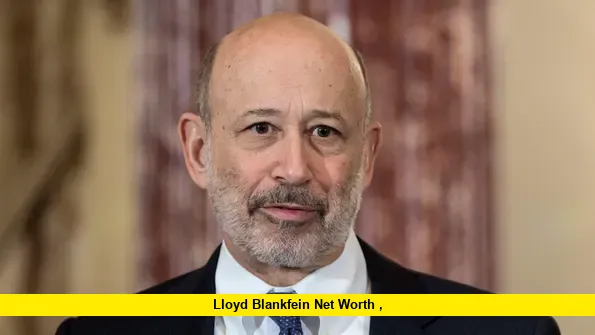

Lloyd Blankfein has never been the kind of man who fades quietly into the background. At 71 years old, the former Goldman Sachs chairman and CEO is back in the headlines — and so is the question that Americans keep searching: what exactly is lloyd blankfein net worth in 2026, and how did a kid from Brooklyn public housing end up with nearly $1.7 billion to his name?
The answer involves decades of disciplined climbing through one of the most demanding institutions in the history of global finance, a dramatic front-row seat to the worst financial collapse of the modern era, a cancer battle, and a legacy that Wall Street continues to debate to this day.
Stay with us — because this story is far from over.
A Net Worth Built One Trade, One Bonus, One Crisis at a Time
As of early 2026, Blankfein’s estimated net worth sits in the range of $1.6 to $1.7 billion, depending on daily market movements. His wealth is not static — it shifts alongside Goldman Sachs stock, which remains his primary financial asset. He accumulated millions of shares over his decades at the firm through bonuses, long-term incentive plans, and the windfall of Goldman’s IPO in 1999.
His compensation at the firm was, by any measure, extraordinary. In 2006 — his first full year as CEO — his total pay package reached $54.4 million, making him the highest-paid executive on Wall Street at the time. The following year, he earned nearly the same amount. When he stepped down as CEO in 2018, he received an exit package worth approximately $85 million. Add in years of six- and seven-figure annual salaries, stock grants, and the appreciation of Goldman Sachs shares over nearly two decades, and the math starts to explain how a postal worker’s son became a billionaire.
Beyond Goldman stock, his wealth includes a prestigious Manhattan condominium on Central Park West, a fine art collection, and a range of other investments. He sold a Hamptons estate in 2016 for $14 million — a property he had originally built in the early 2000s.
From Brooklyn Housing Projects to Harvard to the Top of Wall Street
The numbers are striking, but the backstory is what gives them real weight for an American audience. Lloyd Craig Blankfein was born in the Bronx on September 20, 1954, and raised in the Linden Houses — a public housing complex in East New York, Brooklyn. His father worked as a clerk with the U.S. Postal Service. His mother was a receptionist.
There was no family money, no prep school, no inherited advantage. What Blankfein had was relentless academic ability. He graduated as valedictorian from Thomas Jefferson High School in 1971, then attended Harvard College on scholarship, earning a degree in history. From there, he went straight to Harvard Law School and earned his law degree.
He spent a brief time practicing corporate law before pivoting to finance — a decision that would change everything. In 1982, he joined J. Aron & Company as a precious metals salesman. The firm had already been acquired by Goldman Sachs, and Blankfein’s career at one of the world’s most powerful financial institutions had quietly begun.
He made partner in 1988. By the mid-1990s, he was co-heading Goldman’s currency and commodities division. By 2004, he was president and chief operating officer. And in July 2006, when Henry Paulson left to become U.S. Treasury Secretary under President George W. Bush, Blankfein stepped into the CEO chair.
Steering Goldman Through the Storm of 2008
Almost immediately after taking the helm, Blankfein faced a once-in-a-generation crisis. The 2007–2008 financial collapse wiped out major institutions, ended careers, and rewrote the rules of American finance. Lehman Brothers collapsed entirely. Bear Stearns was sold off in an emergency deal. Washington Mutual failed. Merrill Lynch had to be absorbed by Bank of America.
Goldman Sachs did not collapse. Under Blankfein’s leadership, the firm accepted a $10 billion government bailout and converted from an investment bank into a bank holding company — a move that brought it under Federal Reserve oversight and opened access to emergency credit. Critics called it a retreat. Supporters called it survival.
The strategy worked. Goldman emerged from the crisis in a stronger competitive position than most of its rivals. Blankfein was named Financial Times Person of the Year for 2009. He also testified before Congress on Goldman’s role in the events that led to the meltdown — sessions that were tense, televised, and deeply watched by the American public.
His tenure was never without controversy. His remark that bankers were “doing God’s work” became one of the most mocked and analyzed quotes of the financial crisis era. His compensation drew outrage during a period of widespread economic suffering. But no credible argument could be made that he had failed to keep his firm alive.
The 2026 Headlines: A Memoir, a Market Warning, and a DEI Debate
In early 2026, Blankfein released a memoir covering his career and the lessons he took from four decades at the center of global finance. The book prompted a fresh wave of media appearances, interviews, and public commentary — and reignited interest in his story among a new generation of finance professionals.
Perhaps the most attention-grabbing moment came when he described his view of the current economic environment. He stated publicly that he could sense another major financial crash coming — comparing the current buildup of risk to dry kindling on a forest floor. The comment made headlines across financial media and sparked debate about how close markets may be to another serious disruption.
He also weighed in on the national conversation around diversity, equity, and inclusion programs. Specifically, he described Goldman’s prior DEI efforts as counterproductive — arguing that programs that label participants as needing special assistance end up doing more harm than good to the very people they intend to help. Rather than abandoning the idea of broadening opportunity, he suggested investing in broad-based professional development that benefits everyone, particularly those who start with fewer advantages.
His comments arrived in a moment when major corporations across the country have been scaling back DEI initiatives, making his voice one of the most prominent on Wall Street to join that debate in 2026.
What His Fortune Tells Us About Wall Street’s Biggest Rewards
Lloyd Blankfein’s net worth is not just a number. It is a data point in a larger American story about how wealth accumulates at the very top of the financial sector — through equity stakes, long-term compensation packages, and the compounding effect of decades spent inside institutions that generate enormous profits.
His trajectory from Brooklyn public housing to a $1.7 billion fortune is remarkable by any standard. It is the kind of story that draws both admiration and scrutiny — admiration for the discipline and intelligence it required, and scrutiny for what it says about the concentration of wealth in American finance.
At 71, he is still talking, still investing, still drawing attention. His memoir, his market warnings, and his views on the changing culture of Wall Street suggest a man who has no interest in stepping away from the conversation — and a public that has no interest in stopping to listen.
What are your thoughts on Lloyd Blankfein’s legacy, his billion-dollar fortune, and his warning about what’s coming next in the markets — share your perspective in the comments and keep following this story as it develops.