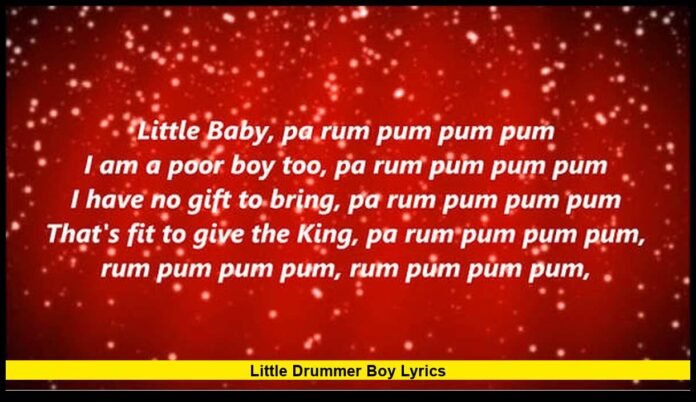

The little drummer boy lyrics remain a familiar part of the American Christmas season, built around a young musician who offers his drumming as a gift at the birth of Jesus. The song continues to appear in holiday performances and recordings, while its distinctive rhythm makes it one of the easiest Christmas songs to recognize.
Unlike many traditional carols, the song does not come from centuries-old folklore. Its origins date to the 20th century, and its journey from a relatively obscure choral composition to a major holiday standard involved several performers, arrangements and recordings.
The Story Told Through the Song
At the center of the song is a fictional boy who arrives at the Nativity scene. He sees that other visitors have gifts for the newborn Jesus, but he believes he has nothing of comparable value.
His answer is music.
The boy asks whether he can play his drum and then performs. The story presents that act as a sincere offering rather than a display designed to impress anyone.
That idea gives the Christmas song its emotional foundation. The boy does not need an expensive present. His personal ability becomes his contribution.
The narrative has remained accessible because the central conflict is easy to understand: someone wants to give but believes he has little to offer.
A Christmas Song With a Modern Origin
The composition was created in 1941 by American musician Katherine Kennicott Davis. Its original title was “Carol of the Drum.”
Davis wrote the piece for vocal performance, with the drum serving as a central musical and storytelling device. The work did not immediately become the internationally recognized Christmas standard it is today.
Its development took place over several years as different performers and arrangers encountered the composition.
The title eventually changed to “The Little Drummer Boy,” giving the song a name that directly identified its main character.
How the Familiar Version Emerged
The song’s path to mainstream popularity involved important recordings during the 1950s.
Performers experimented with choral arrangements that highlighted the repeated rhythmic vocal phrase. Those arrangements helped establish the sound audiences now associate with the composition.
The Harry Simeone Chorale’s 1958 recording became the defining breakthrough. It introduced the familiar title and brought the song to a much wider American audience.
The recording’s seasonal popularity helped turn the composition into a recurring Christmas favorite. Instead of being heard once and forgotten, it returned to holiday radio, records and performances year after year.
That annual exposure played a major role in establishing its long-term cultural presence.
Why the Drum Is So Important
The drum is more than a prop in the story.
Its rhythm is woven into the composition itself. The recurring vocal pattern imitates percussion and creates a sound that immediately separates the song from many other Christmas carols.
That technique also gives performers considerable flexibility.
A choir can emphasize the vocal rhythm. An orchestra can add percussion. A solo performer can create a more intimate interpretation. Modern productions can introduce entirely different arrangements without losing the song’s defining musical feature.
The result is a Christmas song that can change considerably from one recording to another while remaining recognizable.
Is the Drummer Boy a Biblical Character?
The answer is no.
The young drummer is a fictional creation rather than a person identified in the biblical accounts of Jesus’ birth. The song uses the Nativity as its setting, but its central character was created for the composition.
This distinction is important because the song has become so closely connected with Christmas traditions that some listeners may assume every part of its story comes from Scripture.
The biblical Nativity narratives include several important figures and events, but they do not describe a drummer boy performing for the infant Jesus.
The song should therefore be understood as a creative Christmas carol inspired by the Nativity rather than a direct retelling of a biblical passage.
The Meaning Behind the Christmas Classic
The song’s central message is generosity.
The boy initially focuses on what he does not possess. He lacks the type of gift he sees others bringing. His drum, however, gives him another way to participate.
That idea has broad appeal during the Christmas season.
The story suggests that a gift does not have to be expensive to matter. Time, effort, creativity and personal talent can also carry meaning when offered sincerely.
The message is especially easy for children to understand. A child who cannot purchase an elaborate present can still contribute through music, art, kindness or another personal ability.
That universal theme has helped the song remain useful for school concerts, community performances and holiday programs.
A Major Television Performance Added New Life
The song received another major cultural moment when Bing Crosby and David Bowie performed it together for a Christmas television special in 1977.
Their presentation combined the familiar Christmas song with “Peace on Earth,” creating a distinctive arrangement that differed from the standard performance.
The pairing became memorable because the two performers came from very different musical worlds.
Crosby represented an older generation of American entertainment, while Bowie was one of the defining artists of contemporary popular music at the time.
The resulting performance eventually became a widely recognized holiday recording and introduced another generation to the composition.
Why Different Recordings Sound Different
There is no single musical approach that defines every performance.
Some versions retain a traditional choral sound. Others use orchestral arrangements, pop production, children’s voices or contemporary instrumentation.
The basic melody and story remain familiar, but performers can change tempo, instrumentation and vocal style.
That adaptability is one reason the song continues to appear in new holiday recordings.
Listeners may therefore encounter noticeably different interpretations while still hearing the same central composition.
What People Should Know Before Publishing the Lyrics
The song’s age does not automatically place its complete lyrics in the public domain in the United States.
The original composition dates to 1941, and copyright considerations continue to apply. The underlying song, later arrangements and individual recordings can involve different rights.
That distinction matters to bloggers, publishers, video creators and other people producing online content.
Finding the complete words on a website does not by itself establish permission to reproduce them elsewhere. Anyone planning commercial or public use should determine what rights apply to the specific material involved.
For ordinary readers, this means that searching for the song’s lyrics and legally republishing the complete text are two different matters.
Important Facts at a Glance
| Detail | Information |
|---|---|
| Original title | “Carol of the Drum” |
| Year written | 1941 |
| Composer | Katherine Kennicott Davis |
| Current title | “The Little Drummer Boy” |
| Main character | A fictional young drummer |
| Setting | The birth of Jesus |
| Biblical origin | No |
| Breakthrough period | 1950s |
| Major recording | Harry Simeone Chorale |
| Notable later performance | Bing Crosby and David Bowie |
| Main theme | Giving through personal ability |
Why the Song Still Works for Modern Audiences
Christmas music changes with each generation, but some compositions continue to return because their basic ideas remain relevant.
This song combines a straightforward story with a memorable musical hook. The young drummer represents an ordinary person who wants to contribute despite feeling that his resources are limited.
That perspective gives the song a different emotional angle from Christmas songs focused primarily on celebration.
Its rhythm also makes it instantly identifiable. Even listeners who do not know every part of the story may recognize the distinctive percussion-inspired vocal pattern.
The result is a song that remains useful in traditional Christmas programs while also providing room for contemporary interpretations.
The Continuing Appeal of the Song
The enduring popularity of the composition comes from more than nostalgia. Its central idea remains easy to understand, and its musical structure gives performers a recognizable foundation for new arrangements.
From its beginnings as “Carol of the Drum” to its emergence as a Christmas standard, the song has undergone a remarkable cultural journey.
The fictional drummer continues to represent a simple idea: what someone gives does not have to be valuable in monetary terms to have meaning.
That message, combined with the song’s instantly recognizable rhythm, explains why it continues to return to American Christmas playlists and performances.
For many families and performers, the song remains a reminder that the most meaningful gift can be the one given sincerely.