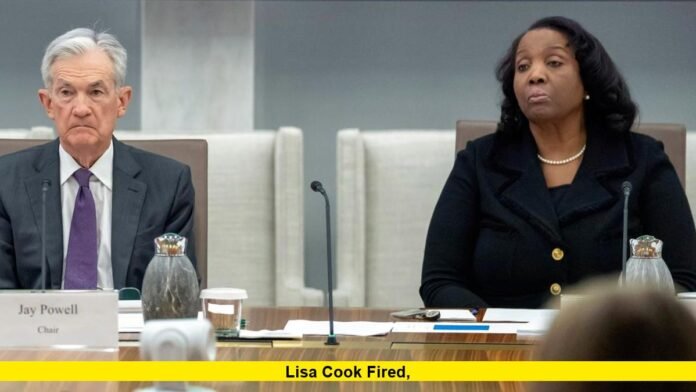

Lisa Cook fired by President Trump has triggered one of the most dramatic moments in the history of the Federal Reserve. On August 25, 2025, Trump announced that he had removed Federal Reserve Governor Lisa Cook from her position, citing allegations related to mortgage applications as the reason for dismissal. The move has instantly ignited debate over whether the president even has the legal authority to fire a sitting member of the central bank’s board.
Escalation at the Federal Reserve
The phrase lisa cook fired has now become a lightning rod in financial and political circles. Cook, who joined the Fed in 2022 as the first Black woman to serve on its Board of Governors, had a term running until 2038. Her abrupt removal is historic—no other sitting Federal Reserve governor has ever been dismissed by a president.
According to the administration, the firing was justified based on alleged misrepresentations involving two different properties claimed as primary residences. Critics argue that this reasoning does not meet the high legal standard of “cause” required for removal under the Federal Reserve Act.
Key Points Summary
◆ Lisa Cook fired by President Trump in a historic first.
◆ Allegations tied to mortgage applications for multiple residences.
◆ Cook refuses to step aside, preparing for legal action.
◆ Markets react with caution—yields rise, gold jumps, dollar slips.
◆ Legal experts warn of a constitutional showdown.
Fallout and Immediate Reaction
Lisa Cook has strongly rejected the president’s action, declaring that she will not resign and intends to fight the decision in court. Her legal team argues that the Federal Reserve’s independence is protected by law and that only a narrow set of circumstances justify removal.
The markets responded with caution. Treasury yields rose, futures slipped, and investors turned to gold as a safe haven. The reaction highlighted concerns that political interference could undermine confidence in monetary policy.
Politically, the backlash has been fierce. Critics describe the firing as a direct attack on the independence of the Federal Reserve, warning that it could set a precedent where central bank officials face removal based on political convenience rather than performance or integrity. Supporters of the move argue that no official should be above accountability if allegations of misconduct are credible.
Read also-Lisa Cook Federal Reserve: A Landmark Shake-Up in U.S. Monetary Policy
The Legal Battle Ahead
The situation now heads toward what could become a defining constitutional test. Courts will likely decide whether a president can unilaterally remove a Federal Reserve governor. If a judge rules in Cook’s favor, she could remain in her position while litigation continues. If not, the vacancy would give Trump an opportunity to appoint a replacement and shift the balance of influence inside the central bank.
What comes next may include:
- Court Filings: Cook’s legal challenge will likely seek an injunction against her removal.
- Judicial Ruling: A federal judge could decide whether she stays in her role during litigation.
- Supreme Court Review: Given the stakes, the case could escalate to the nation’s highest court.
- Monetary Policy Impact: Any shift in the Fed’s board composition could influence future decisions on interest rates, inflation control, and economic stability.
Broader Implications
This clash has already become larger than one individual. It touches the core principle of central bank independence—a feature designed to insulate monetary policy from political agendas. If the president’s action stands, it could dramatically expand executive power over financial institutions. If it is overturned, it will reaffirm the longstanding view that the Federal Reserve operates outside direct political control.
Lisa Cook fired marks a pivotal turning point in the relationship between the White House and the Federal Reserve. The outcome will not only decide her personal future but may also redefine the boundaries of American economic governance for years to come.
How do you see this showdown shaping the future of the Fed? Share your thoughts below and join the conversation.