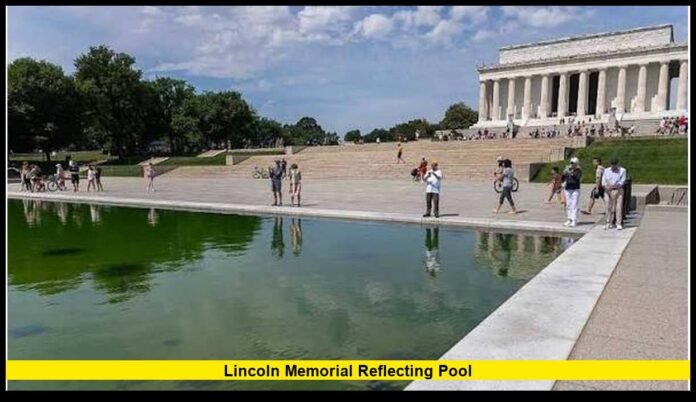

Lincoln Memorial Reflecting Pool remains closed for additional repairs in Washington, D.C., after a costly 2026 renovation produced algae problems and peeling coating just days after the water was restored.
The historic landmark has become the focus of renewed attention after a project intended to prepare the National Mall for the nation’s 250th anniversary celebrations ran into a series of unexpected problems. The work was designed to improve the basin, address leaks and give its bottom a new blue finish.
Instead, crews had to drain the pool again and inspect the newly treated surface.
As of August 13, 2026, the latest reported target is for the pool to reopen around September 10. That date remains subject to the progress of repairs and final safety checks.
The problems have also triggered a dispute over what caused the damaged coating. Federal prosecutors concluded that contractor installation errors played a significant role in the damage connected to a vandalism case involving former Olympic canoeist David Hearn. President Donald Trump has continued to argue that vandalism also occurred.
For visitors, the practical result is clear. One of Washington’s most recognizable public spaces remains affected by repair work.
A Major 2026 Renovation Took an Unexpected Turn
The latest renovation began as a fast-moving project connected to preparations for America’s 250th anniversary.
The administration wanted the historic pool to look fresh and improved ahead of July 4 celebrations. The work included repairs intended to address leaks and a new coating for the bottom of the basin.
The new finish received considerable attention because it was given a bright blue appearance described as “American flag blue.”
That represented a major visual change from the traditional appearance of the pool.
The original project was also promoted as relatively inexpensive compared with the eventual cost. The financial figure later grew dramatically as additional work and related expenses were included.
Recent reporting places the overall cost above $16 million, with some estimates approaching $20 million.
The growing price tag became one of the biggest controversies surrounding the project.
The schedule created another problem.
The renovation was supposed to be completed quickly enough to showcase the landmark during the 250th anniversary celebrations. Instead, the project remained unresolved well after the July 4 deadline.
The New Surface Quickly Developed Problems
The most visible trouble appeared soon after the pool was refilled.
Algae returned to the water despite the renovation’s goal of improving conditions that had contributed to previous algae outbreaks.
The water developed a green appearance, undermining the intended visual effect of the new surface.
Then another issue became apparent.
Sections of the new coating began peeling away from the basin.
The combination of algae and peeling material created a serious concern because the work had been intended to produce a durable, improved surface.
Crews subsequently removed water from the basin so they could inspect the surface and make repairs.
The repeated draining and refilling has extended the disruption for visitors.
It has also raised questions about how quickly the original work was completed and whether the compressed schedule contributed to the problems.
Why Algae Has Been Such a Persistent Challenge
Algae is not a completely new problem at the site.
The large outdoor basin has experienced algae outbreaks in the past, including after its major rehabilitation in the early 2010s.
The pool’s size, sunlight exposure, water conditions and biological environment create challenges for keeping the water clear.
The 2026 project was partly intended to improve those conditions.
Officials promoted updated technology and repair measures designed to reduce recurring water-quality problems.
The rapid return of algae therefore became particularly embarrassing.
Visitors had expected a dramatically improved landmark.
Instead, the water once again required attention only days after the latest renovation was completed.
Water treatment has become an important part of the continuing work.
Crews must maintain a balance between keeping the water clear and protecting the newly installed surface.
The Blue Color Became a Defining Feature
The new color was one of the most unusual aspects of the 2026 renovation.
President Trump selected the blue finish as part of the effort to give the pool a brighter appearance.
The choice immediately generated debate because the historic landscape had traditionally relied on a more restrained visual palette.
While the blue coating was highly noticeable when the basin was empty, the appearance changed once water covered the surface.
The water softened the color and restored some of the familiar reflective quality.
The central purpose of the pool, after all, is reflection.
Its long, shallow basin provides a visual connection between the Lincoln Memorial and the Washington Monument. The surrounding trees, pathways and open space complete the composition.
Any change to the bottom of the basin can therefore affect how visitors experience the entire landscape.
The new coating became much more than a maintenance detail. It became one of the most discussed features of the renovation.
The Project Became Entangled in a Vandalism Investigation
The repair controversy took another turn when officials reported damage that appeared to have been deliberately caused.
Investigators examined sections of the new coating after an incident reported in June.
David Hearn, a former Olympic canoeist, became the most prominent person accused in connection with the alleged damage.
Hearn denied intentionally damaging the pool.
His legal team maintained that he had been examining the site rather than deliberately destroying property.
The case later weakened after prosecutors reviewed additional evidence concerning the condition of the coating.
Federal prosecutors concluded that contractor errors were responsible for damage that had initially been attributed to vandalism.
That conclusion led prosecutors to seek dismissal of the criminal case against Hearn.
A federal judge subsequently dismissed the case without prejudice, leaving the legal dispute over whether future charges could be pursued unresolved.
Hearn’s attorneys have sought stronger protection against another prosecution.
The controversy remains significant because it changed the public explanation for why the newly renovated surface failed.
Trump Continues to Dispute the Contractor Explanation
The criminal case has not ended the disagreement over what happened.
Trump has continued to maintain that vandalism played a role in the damage.
He has criticized the decision by federal prosecutors to abandon the case against Hearn.
Administration officials have also argued that evidence supports the vandalism allegation.
At the same time, prosecutors have pointed to contractor workmanship as the explanation for significant damage to the coating.
The competing explanations have made the repair project unusually political.
For visitors, however, the technical issue remains more important than the dispute itself.
The coating must be repaired.
The basin must hold water.
The water must remain clear.
And the finished surface must withstand regular use and exposure to the elements.
Those practical requirements will determine when the landmark can return to normal operation.
The Pool Has Been Drained Again
The latest repair phase required another draining operation.
Removing the water allows crews to examine the basin directly rather than attempting to identify problems through the water.
Workers can then locate areas where the coating has separated, determine what needs to be repaired and prepare the surface for additional treatment.
The process takes time.
A large historic basin cannot simply be emptied, repaired and immediately returned to normal service.
Crews must complete the physical work, inspect the results and refill the pool.
Water quality also needs to be monitored after refilling.
That makes the reopening date dependent on more than simply finishing visible repairs.
The Reopening Target Is Now Around September 10
The latest reporting places a possible reopening around September 10.
The date represents another delay from the original goal of having the landmark ready for the nation’s July 4 celebrations.
Visitors should treat the September date as a current target rather than a guaranteed reopening.
Construction projects can change when crews uncover additional problems or when testing shows that further work is necessary.
The National Park Service has also used temporary closures and access restrictions to protect visitors while work continues.
Anyone planning a Washington trip specifically to see the pool should check current park conditions before arriving.
The Lincoln Memorial itself can remain an important destination even when portions of the surrounding landscape are affected by construction.
However, visitors expecting the classic uninterrupted water view should be prepared for possible restrictions until the repair program is complete.
Read More – Reflecting Pool Vandalism Grand Jury: Where the High-Profile Federal Case Stands After Charges Were Dropped
The Landmark Has a Long History of Repairs
The current problems are not the first major maintenance challenge involving the pool.
A substantial rehabilitation began in 2010.
That earlier project addressed structural and environmental concerns, including the water supply system, circulation and surrounding pedestrian areas.
The basin had suffered from leaks and other deterioration.
The earlier rehabilitation was completed in 2012, and the pool reopened to the public on August 31 of that year.
Algae returned soon after that reopening.
The recurring problem demonstrated how difficult it can be to maintain a large outdoor reflecting pool in Washington.
Additional repairs have also been necessary over the years.
The basin has been drained for maintenance and water-quality issues, while portions of the surrounding area have undergone separate work.
The 2026 renovation therefore represents another chapter in a long maintenance history.
What makes the current episode different is the combination of a major anniversary deadline, a new visual treatment, rapidly developing surface problems and a high-profile legal dispute.
Why the Location Is So Important
The pool occupies a unique position on the National Mall.
It sits directly east of the Lincoln Memorial and extends toward the Washington Monument.
The long axis creates one of the most recognizable views in the capital.
Visitors standing near the Lincoln Memorial can look across the water toward the Washington Monument.
From the opposite direction, the Lincoln Memorial rises at the end of the pool.
The water adds a second image through reflection.
That visual relationship explains why even relatively small changes to the pool can become highly noticeable.
A damaged surface or cloudy water does not simply affect the basin.
It changes one of the most photographed views in Washington.
The pool is also surrounded by broad pedestrian paths and rows of trees, creating a landscape that attracts visitors throughout the year.
The Pool Is More Than a Tourist Attraction
The landmark has played an important role in American public life.
The area surrounding the Lincoln Memorial has hosted major demonstrations, commemorations and national events.
The Reflecting Pool became especially associated with the 1963 March on Washington, when Martin Luther King Jr. delivered his “I Have a Dream” speech from the steps of the Lincoln Memorial.
The site has continued to serve as a gathering place for major public events.
That history adds another layer of importance to the current repairs.
The pool is not merely decorative infrastructure.
It forms part of a nationally significant civic landscape.
Maintaining its appearance is therefore closely connected to preserving the character of the National Mall.
What the Repairs Need to Accomplish
The current work has several goals.
First, crews need to correct areas where the coating has failed.
Second, the finished surface needs to remain securely attached to the basin.
Third, the water system needs to support clear water without another immediate algae outbreak.
Fourth, the repaired pool needs to function reliably after reopening.
Those requirements are especially important because the 2026 renovation was designed to address problems that had already existed.
A short-lived repair would not solve the underlying maintenance challenge.
The success of the project will ultimately be measured over months and years rather than by the appearance of the pool on its first day after reopening.
The Cost Has Become a Major Part of the Story
The financial side of the project has attracted significant scrutiny.
The original estimate was far lower than the eventual project cost.
As repairs expanded and additional work became necessary, the total rose to more than $16 million.
Some recent reports have placed the eventual figure even higher.
The project also drew attention because contracts were awarded without the typical competitive bidding process.
Officials cited the compressed schedule as a reason for moving quickly.
That decision became more controversial after the surface developed problems.
A project intended to deliver a quick improvement for a major national celebration instead required additional repairs and generated a much larger bill.
The final cost and long-term durability will remain important measures of whether the renovation achieved its intended purpose.
What Visitors Can Expect in the Coming Weeks
Visitors should expect conditions around the pool to remain changeable during August.
Repair crews need sufficient space to work safely.
Temporary barriers and restricted access can affect the normal walking routes around the basin.
The situation should improve as repairs move toward completion.
If the September 10 target holds, visitors could soon regain access to the full landscape and once again see the traditional view across the water.
That would mark a significant turning point after months of construction.
The reopening will also provide the first opportunity to see whether the repaired surface performs as intended.
A successful return would mean more than simply filling the basin.
It would restore an important part of the National Mall’s visual identity.
A Closely Watched Return to Normal
The coming weeks will determine whether the latest repairs can finally bring the project to a stable conclusion.
The pool has already gone through several stages in a short period: renovation, refilling, algae treatment, coating repairs, drainage and renewed inspection.
The next refill will be closely watched.
Visitors, preservation advocates and officials will want to see clear water, a stable coating and the familiar reflections that define the site.
The September reopening target offers a potential endpoint, but the real test will come afterward.
If the repairs hold, the controversy surrounding the project may gradually fade.
If additional failures appear, questions about the design, installation and cost are likely to continue.
For now, the landmark remains in an unusual state.
One of Washington’s most familiar views is temporarily interrupted while crews work to restore the landscape.
What Comes Next for the Historic Pool
The 2026 renovation has demonstrated how difficult it can be to update a historic public landmark while preserving its appearance and function.
The project began with the goal of creating a cleaner, more durable and visually striking pool.
Instead, it became a complicated repair effort involving algae, coating failures, rising costs and a high-profile legal dispute.
The focus now shifts back to the basic purpose of the landmark.
The water needs to remain clear.
The coating needs to remain intact.
The basin needs to operate reliably.
And the public needs to be able to enjoy the historic view without construction barriers.
A successful reopening around September would give Washington a chance to put the latest controversy behind it.
For millions of visitors, the ideal result is uncomplicated: a clean stretch of water, a clear reflection of the monuments and an uninterrupted view across one of America’s most recognizable public spaces.
What do you think about the latest repairs and the future of this iconic Washington landmark? Share your thoughts and stay tuned for further updates.