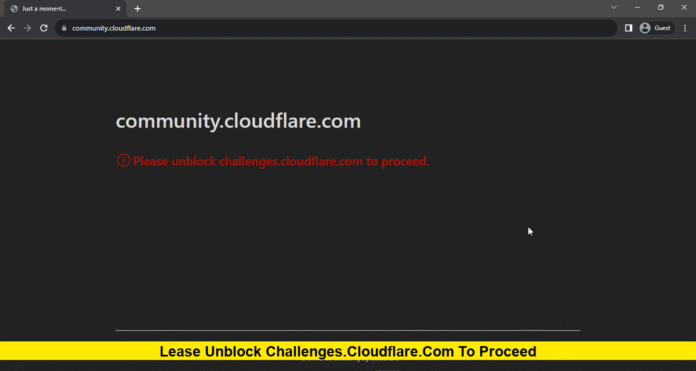

The message lease unblock challenges.cloudflare.com to proceed has appeared across countless websites today, creating confusion for users trying to reach their favorite platforms. This access interruption has become one of the most talked-about website errors of the day, especially in the United States, where a large portion of major platforms rely on the same internet security layer that generated the issue. As system checks failed during the early hours of the morning, websites that typically load within seconds became unreachable, leaving users searching for answers and workarounds.
The sudden surge in reports caught attention on social platforms, support forums, and business portals. With so many American users affected at once, the error quickly became a top-level concern for site owners, IT teams, and everyday visitors who assumed the problem was coming from their browser or device. The reality is far more complex, involving systems that operate well beyond individual networks.
What Triggered Today’s Disruption
The early morning began with a spike in unexpected traffic across several internet infrastructure layers. Systems that typically validate inbound connections experienced heavy load, which slowed the normal verification steps required for a website to confirm that a visitor’s request is safe. This slowdown led to access failures across many U.S.-based websites.
During this event, the challenge verification tool that many American websites rely on struggled to complete its standard process. Every time the system attempted to confirm a user’s access request, it either timed out or returned incomplete data. The incomplete challenge response triggered the familiar message telling users they needed to unblock the challenge domain to continue.
This error was not caused by individual user actions. It was linked directly to the network congestion that disrupted the verification tools. Since those tools are embedded into thousands of platforms nationwide, the impact spread rapidly. People trying to reach a news website, online service, transit information, productivity platform, or AI-powered tool experienced the same sudden barrier.
Why the Error Spread So Quickly Today
The United States relies heavily on distributed security and routing systems. When one of these core layers slows down, it affects everything upstream. Challenge verification is one of those layers. It checks whether a visitor is legitimate, prevents suspicious activity, and protects sites from automated threats.
Because this verification process is used by so many websites, its slowdown created a chain reaction:
- Websites could not complete initial checks
- Visitors were redirected to incomplete challenge pages
- The browser waiting for verification timed out
- Websites displayed the same standard error text
Under normal conditions, this message appears when a user’s browser or network blocks certain domains. Today, however, the cause was entirely external. Instead of individual firewalls or filters creating the error, the verification system itself failed to load, making the block appear universal.
That is why users on home Wi-Fi, office networks, mobile phones, public hotspots, and even clean browsers without extensions saw the same message at the same time.
How the Issue Affected U.S. Websites and Apps
Throughout the morning and early afternoon, American users reported difficulty loading:
- AI tools
- E-commerce portals
- Social platforms
- Outage monitoring sites
- Business dashboards
- Customer support portals
- Public service pages
Many websites could not load at all, while others displayed partial pages without scripts or interactive features. Some platforms that rely on API calls showed loading loops. Others presented challenge pages that never completed.
Even websites that were not directly impacted by the slowdown saw indirect effects. Platforms that rely on analytics, login authentication, or cloud-based routing tools experienced brief disruptions when certain verification components malfunctioned. This created moments when site elements loaded out of order or did not load at all.
The issue was particularly noticeable in industries where uptime is essential:
- Online retailers saw checkout delays
- News sites struggled with heavy refresh attempts
- Communication platforms became slow or unresponsive
- Developers reported dashboard timeouts
- Businesses using cloud-based tools lost connection during tasks
The shared experience across such varied industries highlights how interconnected modern online systems have become.
What U.S. Users Can Do When the Message Appears
While today’s issue did not come from individual devices, users may still benefit from simple troubleshooting steps. These steps do not fix the system-level problem, but they help rule out local conditions that could worsen the issue.
Helpful steps for users:
- Refresh the page after waiting for a short period
- Open the site in another browser
- Restart the current browser to clear background processes
- Switch between Wi-Fi and mobile data
- Disable privacy extensions temporarily
- Turn off VPN or proxy settings
- Clear cookies for the affected website
These actions create a clean connection attempt. If the verification system is beginning to stabilize, a fresh request may load successfully.
Users should also avoid making changes that alter deep system settings. The problem is not coming from personal firewalls or home networks today, so modifying those settings may introduce more issues.
What Website Owners Should Know
For site owners, the downtime created additional pressure. Many received messages from customers who believed the website was compromised or incorrectly configured. Responding to those concerns quickly helps reduce confusion.
Best practices for site owners during today’s issue:
- Avoid making structural changes while systems are recovering
- Temporarily relax strict challenge modes if they prevent all access
- Post a notice on a status page or social feed
- Verify that internal firewalls are not adding additional blocks
- Monitor performance changes as traffic stabilizes
- Avoid forcing users through repeated verification loops
It is important for site owners to communicate clearly, especially if many of their visitors rely on the platform for time-sensitive information. Even a short message explaining the general nature of the issue helps users understand that the disruption is broader than a single website.
How Long the Access Issues Lasted
Reports began early in the morning and intensified during the first hour. As more sites became affected, the error surged across the country. By late morning, the verification systems started improving. Sites began loading more consistently, although challenge pages still appeared in some cases.
By early afternoon, many platforms showed noticeable improvement. Still, full consistency remained uncertain, and some users continued seeing delays or repeated challenge loops. Systems of this scale usually require additional time to return to normal because they serve massive volumes of traffic.
Even when stability returns, small pockets of delayed access can linger. Sites that rely heavily on challenge tools may continue showing residual errors until all verification layers are fully restored.
Why This Error Matters for the Future
Today’s widespread interruption demonstrates how essential verification systems have become in the U.S. internet landscape. The message many users saw is usually a minor network-level notice. When tied to a system-wide slowdown, though, it becomes a major barrier.
Several lessons stand out:
- Large internet services must maintain strong redundancy
- Challenge verification tools are critical to traffic safety
- User access can fail even when personal networks are operating normally
- A small interruption in routing can create national-scale effects
- Website owners need communication plans for unavoidable outages
This event also reminds users that the internet depends on many unseen layers. While websites appear simple on the surface, they often rely on complex verification systems that protect visitors and platforms alike.
The Broader Picture of Today’s Event
Many users who encountered this message assumed they were being blocked. In reality, the verification system experienced an overload that prevented it from confirming safe traffic fast enough. The message did not indicate suspicious activity. It did not mean the visitor was restricted. It was simply a default notification triggered when a verification request went unanswered.
Understanding that distinction helps reduce frustration when the issue appears. It also helps site owners explain the situation to visitors without causing unnecessary concern.
As traffic levels return to normal, the verification process stabilizes. Websites begin loading properly again, scripts reconnect, and pages that were previously unreachable become fully functional.
Final Thoughts
Today’s widespread access issue shows how a single verification slowdown can ripple across thousands of U.S. websites at once. If you saw the message lease unblock challenges.cloudflare.com to proceed, you were one of many users affected during a complex system disruption. As services continue stabilizing, most platforms should return to normal access soon, with fewer challenge interruptions and fewer delays.
Share your experience below—your insights help others understand how widespread the issue was and how it affected different platforms across the country.