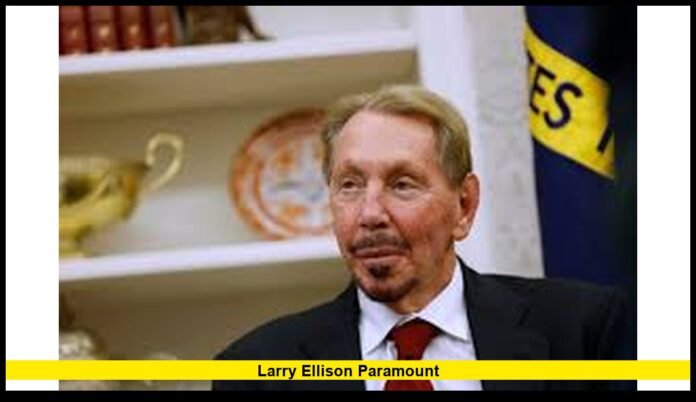

Larry Ellison Paramount entered a new phase as Oracle co-founder Larry Ellison delivered a decisive financial commitment that transformed Paramount Skydance’s takeover effort for Warner Bros. Discovery into one of the most closely watched corporate moves in U.S. media history. His personal $40.4 billion guarantee has shifted market perception, sharpened shareholder focus, and intensified debate over the future structure of American entertainment.
The decision did more than strengthen a bid. It redefined the balance of power in a contest involving legacy studios, streaming giants, and global investors. With this move, Ellison placed personal capital and reputation behind a deal that could reshape Hollywood for years to come.
A Financial Move That Changed the Conversation
The takeover effort by Paramount Skydance had already drawn national attention. The company offered an all-cash proposal valuing Warner Bros. Discovery at approximately $108 billion. While the offer appealed to many shareholders, concerns about financing certainty lingered.
Those concerns faded when Larry Ellison stepped in directly.
By issuing an irrevocable personal guarantee covering $40.4 billion of equity financing, Ellison eliminated doubts about capital availability. The guarantee cannot be withdrawn during the transaction process. That structure provides assurance rarely seen at this scale.
In response, Paramount Skydance maintained its cash offer, adjusted deal protections, and extended its timeline to allow shareholders more time to evaluate the proposal.
Why Ellison’s Role Matters Beyond the Numbers
Larry Ellison is not an ordinary investor. He is one of the most influential figures in American business, known for building Oracle into a global technology powerhouse and for making bold, high-confidence decisions.
His involvement sends several signals at once:
- Absolute confidence in the strategic value of the deal
- Willingness to assume personal financial exposure
- Long-term commitment to media as a core growth sector
- Alignment between ownership, leadership, and capital
Unlike traditional private equity or syndicated financing, this guarantee ties the transaction directly to Ellison himself. That distinction matters to markets, regulators, and competitors.
The Strategic Vision Behind Paramount Skydance
Paramount Skydance emerged earlier this year following the combination of Paramount Global and Skydance Media. The merged company operates across broadcast television, cable networks, film studios, and digital platforms.
David Ellison, chairman and chief executive, has outlined a strategy focused on scale, global reach, and content ownership. The pursuit of Warner Bros. Discovery fits squarely into that approach.
Warner Bros. Discovery brings:
- One of the deepest film and television libraries in history
- Global production and distribution capabilities
- Established cable and broadcast brands
- A powerful footprint in both scripted and unscripted content
Combining these assets with Paramount Skydance would create a company capable of competing across theatrical releases, linear television, and streaming on a global scale.
Why Warner Bros. Discovery Became the Centerpiece
Warner Bros. Discovery occupies a unique position in the media ecosystem. It controls iconic brands, valuable intellectual property, and long-standing relationships with advertisers, creators, and distributors.
At the same time, the company has faced challenges tied to debt management, streaming profitability, and long-term strategic clarity. Those pressures made it a target for acquisition interest.
Paramount Skydance’s cash offer appealed to shareholders seeking certainty. An all-cash structure removes market volatility from the equation and provides immediate value.
The competing proposal supported by Warner Bros. Discovery’s board relies on a mix of cash and equity. That approach offers upside potential but introduces exposure to stock performance and broader market conditions.
How Shareholders Are Evaluating the Choice
For Warner Bros. Discovery shareholders, the decision is complex but clearly defined.
On one side is a cash offer backed by a personal guarantee from one of the world’s wealthiest individuals. On the other is a board-endorsed transaction with a major streaming company that emphasizes long-term growth potential.
Key considerations include:
- Certainty versus future upside
- Speed of transaction completion
- Regulatory risk
- Strategic direction of the combined company
The extended tender period allows shareholders to assess evolving conditions, market reactions, and regulatory signals before making a final choice.
Market Reaction and Investor Sentiment
Following the announcement of Ellison’s guarantee, investor sentiment shifted noticeably.
Warner Bros. Discovery shares reflected increased confidence that the Paramount Skydance offer could proceed. Paramount Skydance stock also benefited from the clarity and strength of the revised financing structure.
Market participants interpreted the guarantee as a turning point. It removed a key objection and reframed the takeover attempt as a fully backed proposal rather than a conditional bid.
Volatility remains, but the underlying tone has become more constructive.
What This Means for the Streaming Landscape
The U.S. streaming market remains intensely competitive. Companies face rising content costs, subscriber churn, and pressure to deliver profitability.
A successful acquisition would create a content-rich organization with the ability to:
- Bundle premium film, television, and sports offerings
- Spread production costs across multiple platforms
- Leverage existing franchises more efficiently
- Strengthen negotiating power with distributors and advertisers
Such scale could alter competitive dynamics, particularly for smaller players struggling to keep pace.
Regulatory Scrutiny and Public Interest
Any transaction of this size will face close regulatory review in the United States.
Authorities will examine:
- Market concentration in film and television production
- Impact on competition in cable and streaming markets
- Effects on advertising pricing and distribution access
- Preservation of consumer choice
Because Warner Bros. Discovery includes influential news and information platforms, public interest considerations may also factor into the review process.
The presence of a strong, clearly defined financing structure may simplify some aspects of evaluation, but regulatory oversight will remain rigorous.
Leadership, Control, and Governance Questions
Beyond ownership, questions of governance and leadership will shape the outcome.
Paramount Skydance has emphasized operational integration, disciplined cost management, and long-term investment in content. Warner Bros. Discovery’s current leadership has focused on restructuring and balance sheet repair.
A combined company would need to reconcile these approaches while maintaining creative independence and financial discipline.
Larry Ellison’s involvement suggests a preference for decisive leadership and centralized strategic control.
The Broader Industry Signal
This takeover effort sends a message across corporate America.
It underscores that:
- Media assets remain highly valuable despite market volatility
- Individual investors can still play outsized roles in major deals
- Scale remains a dominant strategy in entertainment
- Capital certainty is a competitive advantage
The move also reflects a broader trend of technology leaders expanding influence into media and content ownership.
Key Developments to Watch Next
Several major milestones will shape how this takeover battle ultimately unfolds, and each one carries implications not just for the companies involved but for the wider U.S. media landscape.
First, shareholder participation during the tender period will be critical. With an extended deadline into January 2026, Warner Bros. Discovery shareholders now have additional time to evaluate the competing offers. Their willingness to tender shares to Paramount Skydance’s cash offer — especially now that it is backed by a substantial personal guarantee — could decisively tilt the balance. A higher level of participation in favor of the cash offer would strengthen Paramount’s position, while a preference for the board-endorsed alternative could blunt its momentum.
Next, regulatory feedback and review timelines will play a dominant role. Given the size and scope of the potential transaction, federal regulators are expected to examine the competitive effects of consolidating two major media entities. They will assess whether the combined company might lessen competition in key markets, including streaming, cable distribution, and content production. The pace and outcome of this review will either accelerate the path to a definitive result or introduce new requirements and conditions that could extend the process.
Another important area to watch is potential legal actions or procedural challenges. Either side may pursue litigation or procedural motions designed to influence timing, approval conditions, or shareholder voting outcomes. Lawsuits over disclosure, fiduciary duty, or tender mechanics can affect both strategy and timing, and they often unfold in parallel with regulatory review.
At the same time, market response to broader economic conditions will continue to intersect with these developments. Broader macroeconomic trends — including interest rate movements, credit market conditions, and investor risk appetite — can influence corporate financing costs and shareholder decision-making. If economic conditions shift significantly during the extended tender period, that could affect both the perceived value of the offers and the confidence of institutional and retail investors.
In combination, these factors will determine whether the transaction moves forward smoothly, encounters significant hurdles, or evolves into a different competitive dynamic. The way shareholders vote, the pace of regulatory review, any legal interventions, and market conditions together create a landscape in which the next set of developments could redefine strategic priorities for U.S. media companies well beyond the current year.er.
Why Larry Ellison Paramount Continues to Matter
The significance of Larry Ellison Paramount now extends well beyond a single takeover attempt and into the broader framework of how major media deals are structured in the United States. The most recent development — Larry Ellison’s decision to personally guarantee $40.4 billion in equity financing — has reshaped expectations around deal certainty and shareholder confidence. By converting earlier funding assurances into an irrevocable personal commitment, Ellison removed one of the central objections that had surrounded the offer and fundamentally changed how investors assess the proposal.
This move has elevated the role of individual conviction in large-scale corporate transactions. Rather than relying solely on traditional financing channels, the takeover effort is now anchored by direct personal backing from one of the most financially powerful figures in American business. That shift has influenced shareholder behavior, market sentiment, and boardroom strategy, forcing all parties involved to reassess assumptions about risk, credibility, and execution.
The development has also accelerated conversations about media consolidation. With traditional studios under pressure from streaming competition, advertising volatility, and global distribution challenges, the ability to secure firm, transparent capital has become as critical as content creation itself. Ellison’s involvement highlights how financial strength can drive consolidation momentum even when governance, regulatory, and strategic questions remain unresolved.
Beyond the immediate transaction, this episode reinforces a larger truth about the future of American entertainment. Studio leadership, creative output, and audience engagement still matter, but they increasingly operate within the boundaries set by balance sheets, capital access, and investor confidence. Whether the takeover ultimately moves forward or not, the actions surrounding Larry Ellison Paramount have already raised the bar for how large media deals are evaluated and how influence is exercised at the highest levels of the industry.
As the decision window narrows, the outcome will reveal whether certainty wins over strategy—or whether scale and ambition redefine the next era of Hollywood. Stay engaged and share your perspective as this landmark moment continues to unfold.