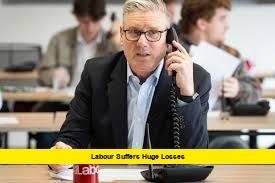

The United Kingdom’s political landscape has been dramatically reshaped following a seismic set of local elections, with Labour suffering huge losses across England while Nigel Farage’s hard-right Reform UK celebrated what many are calling a historic breakthrough in British politics.
A Crushing Night for Keir Starmer
Partial results from local elections across England delivered a devastating blow to Prime Minister Keir Starmer’s governing Labour Party, with gains flooding in for the hard-right Reform UK. The votes have been widely interpreted as an unofficial referendum on Starmer, whose popularity has plummeted significantly since he came to power less than two years ago.
Despite the scale of the defeat, Starmer refused to walk away. Addressing reporters, he acknowledged the results were “very tough” but insisted he had no plans to resign, saying his government needed time to deliver on its promises.
Reform UK’s Sweeping Gains
In what the BBC described as a sweeping victory, Reform UK won 677 seats — increasing their total councillor numbers to 804 and taking overall control of 10 local authorities. It marked the first time in the party’s history that it has controlled any councils in local government.
Led by Nigel Farage, Reform made dramatic inroads into working-class areas of England’s north, including Hartlepool, Durham, and Tamworth — towns that had been solid Labour strongholds for decades. In Hartlepool alone, Reform swept all 12 seats up for election, leaving Labour and Reform tied on the council.
Labour’s Red Wall Crumbles
Labour surrendered majorities in councils including Redditch, Tamworth, Tameside, Southampton, and Wandsworth. The results forced Labour into the prospect of governing through fragile coalitions or minority administrations in areas it once dominated comfortably.
Reform gained over 230 councillors in the early stages of counting, while Labour lost more than 170 seats. The results intensified fears inside the party that core voter support is collapsing less than two years after their historic return to government.
Adding to Labour’s woes, the leader of Labour’s group on Hull City Council openly called for Starmer to step down, stating that voters had repeatedly raised concerns about the Prime Minister on the doorstep during the campaign.
A Fractured Political Landscape
These local elections recorded the lowest ever average winner’s share of the vote in modern British history, at just 40.7%. Political analysts estimated that Reform would have won the majority of seats had elections taken place across the entire country, with an estimated 32% of the national vote. Labour came in second at just 19%, a sharp fall from 34% at the previous general election. The Conservatives also declined, dropping to 18%.
Professor John Curtice of the University of Strathclyde told the BBC that Britain is entering a new political era where none of the parties are very big, calling the results further evidence of the deep fracturing of British politics.
The Liberal Democrats continued their strong run, recording their eighth consecutive year of council gains, taking control of Stockport and Portsmouth. The Conservatives, while suffering more losses, managed to reclaim Westminster from Labour.
Farage Declares a “Historic Change”
A triumphant Farage wasted no time in claiming the scale of the moment. He declared a “historic change in British politics,” telling reporters that the old left-right divide was finished, as his party posted stunning vote percentages in traditional Labour heartlands. He compared his party’s breakthrough to clearing Becher’s Brook — the most notoriously difficult jump in the Grand National — suggesting the hardest part of Reform’s rise was now behind them.
Ahead of the results, Farage had predicted that a strong Reform showing would mean Starmer would be “gone by the middle of summer.”
What Led to Labour’s Collapse?
Since winning the 2024 general election in a landslide, Labour has faced mounting criticism for failing to deliver on its core economic promises, particularly around easing the cost-of-living crisis. Starmer’s government has struggled to generate promised economic growth, repair battered public services, and navigate a difficult global environment.
Further damage came from the controversy surrounding the appointment of Labour veteran Peter Mandelson as UK ambassador to the United States, given his known association with convicted sex offender Jeffrey Epstein. Mandelson was subsequently removed from the post, and British authorities arrested him in February on misconduct charges related to those ties — a saga that proved deeply damaging to the government’s reputation.
What Happens Next for Starmer?
Even if Starmer survives the immediate pressure, many political analysts doubt he will lead Labour into the next general election, which must be held by 2029. Potential leadership rivals are already being discussed openly, including Health Secretary Wes Streeting, former Deputy Prime Minister Angela Rayner, and Greater Manchester Mayor Andy Burnham.
Deputy Prime Minister David Lammy urged the party not to play “pass the parcel” with the leadership, warning that internal chaos would only benefit Reform. Labour loyalists pointed to historical precedent — Tony Blair lost 1,100 councillors in local elections in 1999 and went on to win a landslide general election victory in 2001.
One thing, however, is clear: British politics has entered a new and deeply uncertain era. Labour’s huge losses are not merely a mid-term protest — they represent a fundamental shift in voter loyalty, with Reform UK now firmly established as a major force challenging the very foundations of the traditional two-party system.
Stay updated with the latest UK political developments as counting continues and final results are declared.