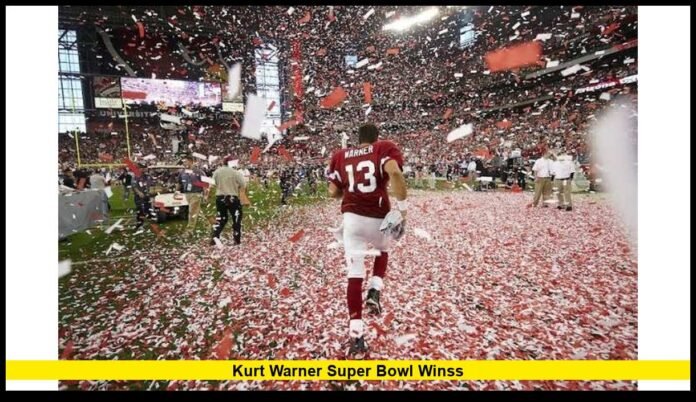

When discussing the greatest quarterback stories in NFL history, kurt warner super bowl wins are an important part of the conversation. Warner captured one Super Bowl championship during his career, but his path to that title was anything but ordinary. He played in three Super Bowls with two different franchises, earned Super Bowl MVP honors, won two regular-season MVP awards and eventually secured his place in the Pro Football Hall of Fame.
Warner’s championship came during the 1999 season, when he led the St. Louis Rams to a 23-16 victory over the Tennessee Titans in Super Bowl XXXIV. His performance in that game helped transform him from an unlikely NFL starter into one of the most recognizable quarterbacks of his generation.
Kurt Warner Won One Super Bowl
The simplest answer is that Kurt Warner won one Super Bowl during his NFL career.
His three Super Bowl appearances produced the following results:
| Super Bowl | Season | Team | Opponent | Result |
|---|---|---|---|---|
| Super Bowl XXXIV | 1999 | St. Louis Rams | Tennessee Titans | Won 23-16 |
| Super Bowl XXXVI | 2001 | St. Louis Rams | New England Patriots | Lost 20-17 |
| Super Bowl XLIII | 2008 | Arizona Cardinals | Pittsburgh Steelers | Lost 27-23 |
Warner’s overall Super Bowl record as a starting quarterback was therefore 1-2.
Although he did not collect multiple championship rings, reaching three Super Bowls with two franchises was a significant accomplishment. His appearances also came at very different stages of his career, beginning with his spectacular breakthrough in St. Louis and ending with an unexpected late-career resurgence in Arizona.
Super Bowl XXXIV Was the Defining Moment
Warner’s championship season remains one of the most remarkable single-season transformations in modern football.
Before becoming the Rams’ starting quarterback, Warner had only 11 NFL regular-season passing attempts. His professional journey had already included stops outside the traditional NFL pathway, including time in the Arena Football League and NFL Europe.
The Rams gave him an opportunity in 1999, and Warner quickly demonstrated that he was capable of running an elite NFL offense.
He finished the regular season with 4,353 passing yards and 41 touchdown passes, helping St. Louis finish with a 13-3 record. His production earned him the NFL MVP award and established him as the centerpiece of an offense that became known as the “Greatest Show on Turf.”
The Rams continued their outstanding run into the postseason and eventually reached the Super Bowl.
Warner’s Historic Super Bowl Performance
Super Bowl XXXIV was played on January 30, 2000, with the Rams facing the Tennessee Titans.
Warner delivered an extraordinary performance.
He completed 24 of 45 passes for 414 yards and two touchdowns. At the time, his 414 passing yards were a Super Bowl record. The performance was even more impressive considering the pressure of the championship setting.
St. Louis won 23-16, giving the franchise its first Super Bowl championship.
Warner was named Super Bowl MVP, making the accomplishment even more significant. He had already been named the league’s regular-season MVP, meaning he completed the season with both major MVP awards and a championship.
The game itself became famous for its dramatic conclusion. Tennessee reached the Rams’ territory during its final possession and had an opportunity to tie the game. Titans receiver Kevin Dyson caught a pass and raced toward the end zone, but Rams linebacker Mike Jones made the decisive tackle at the 1-yard line.
The Rams’ defense held, and Warner’s team became Super Bowl champions.
The Greatest Show on Turf Era
Warner’s championship cannot be separated from the offensive identity of those Rams teams.
St. Louis featured an explosive group of offensive players, including running back Marshall Faulk and wide receivers Isaac Bruce and Torry Holt. The combination of Warner’s aggressive passing style and the Rams’ collection of offensive talent produced one of the most exciting attacks of the era.
The team routinely attacked defenses through the air while also using Faulk as a major receiving threat.
Warner’s ability to make quick decisions and deliver accurate deep passes made him a perfect fit for the system.
The 1999 championship season became the foundation of his NFL legacy. It also changed the perception of what an overlooked quarterback could accomplish after receiving a genuine opportunity.
Warner Nearly Won a Second Championship
Two seasons after his first Super Bowl victory, Warner returned to the championship game.
The 2001 Rams were even more dominant during the regular season, finishing 14-2. Warner once again produced outstanding numbers, throwing for 4,830 yards and 36 touchdowns.
He won his second NFL MVP award and led St. Louis back to the Super Bowl.
This time, the opponent was the New England Patriots.
Super Bowl XXXVI became a turning point in NFL history because it marked the beginning of New England’s championship era under Tom Brady and Bill Belichick.
Warner threw for 365 yards and one touchdown, but the Rams ultimately lost 20-17.
New England’s Adam Vinatieri kicked the game-winning field goal as time expired, denying Warner his second Super Bowl title.
The defeat left Warner with one championship despite reaching the Super Bowl twice during his first several seasons as an NFL starter.
A Difficult Middle Chapter in Warner’s Career
After his early success with the Rams, Warner’s career encountered significant challenges.
Injuries affected his availability, and his position with the Rams eventually became uncertain. After leaving St. Louis, Warner spent a season with the New York Giants before finding another opportunity with the Arizona Cardinals.
At that stage, few expected Warner to make another Super Bowl run.
Instead, his career experienced another remarkable turnaround.
Warner Revived His Career in Arizona
Warner joined the Cardinals in 2005, but it took several seasons for the partnership to reach its full potential.
By 2008, Warner had re-established himself as one of the league’s most effective veteran quarterbacks.
He started all 16 games for Arizona that season and threw for 4,583 yards and 30 touchdowns. The Cardinals won the NFC West and entered the playoffs with an opportunity to accomplish something the franchise had never done before.
Arizona advanced through the postseason, defeating the Atlanta Falcons and Carolina Panthers before facing the Philadelphia Eagles in the NFC Championship Game.
Warner delivered another outstanding performance against Philadelphia, throwing four touchdown passes as Arizona won 32-25.
The victory sent him to his third Super Bowl.
Super Bowl XLIII With the Arizona Cardinals
Warner’s third championship appearance came against the Pittsburgh Steelers in Super Bowl XLIII.
The game was played on February 1, 2009, and became one of the most dramatic Super Bowls of the era.
Warner completed 31 of 43 passes for 377 yards, three touchdowns and one interception.
Arizona took a fourth-quarter lead, but Pittsburgh responded with a decisive touchdown drive. Steelers wide receiver Santonio Holmes made a remarkable touchdown catch in the corner of the end zone, helping Pittsburgh regain the advantage.
The Cardinals had one final opportunity to win.
Warner moved Arizona down the field, but the Steelers defense stopped the Cardinals before they could reclaim the lead. Pittsburgh won 27-23, leaving Warner with a second Super Bowl defeat.
Despite the loss, his performance was statistically exceptional.
Warner’s Super Bowl Numbers Remain Impressive
Warner’s overall Super Bowl statistics demonstrate how productive he was on football’s biggest stage.
Across three games, he completed 83 of 132 passes for 1,156 yards, six touchdowns and three interceptions.
His average passing total across those appearances was more than 385 yards per game.
Even more remarkable is that each of his three Super Bowl performances exceeded 350 passing yards.
His individual totals were:
- 414 yards against Tennessee
- 365 yards against New England
- 377 yards against Pittsburgh
That consistency helped Warner establish a unique place in Super Bowl history. He remains the only quarterback to throw for at least 300 yards in three separate Super Bowls.
His three individual passing performances also rank among the highest totals recorded in the championship game’s history.
Why Warner’s One Championship Still Matters
It can be tempting to measure quarterbacks solely by the number of Super Bowl victories they collect.
That approach does not fully capture Warner’s career.
His lone championship came during one of the most extraordinary quarterback breakout seasons in NFL history. He went from having almost no NFL experience to leading the league’s offense, winning MVP, reaching the Super Bowl and earning the game’s MVP award.
He then returned to the championship game two years later.
Years afterward, he led an Arizona franchise to its first Super Bowl appearance.
That combination makes his career unusual even among Hall of Fame quarterbacks.
Kurt Warner’s Career Accomplishments
Warner retired after the 2009 season with an impressive statistical résumé.
He finished his NFL career with:
- 32,344 passing yards
- 208 touchdown passes
- 128 interceptions
- 65.5% completion rate
- 93.7 career passer rating
- Four Pro Bowl selections
- Two NFL MVP awards
- One Super Bowl championship
- One Super Bowl MVP award
- Two First-Team All-Pro selections
He was inducted into the Pro Football Hall of Fame in 2017.
His career totals are particularly notable considering that he did not become an established NFL starter until he was 28 years old.
A Legacy Built on More Than Rings
Warner’s story continues to stand out because of how unconventional it was.
He was not a highly touted first-round selection who immediately became a franchise quarterback. Instead, he spent years trying to establish himself in professional football before getting his opportunity.
When the chance arrived, he turned it into a championship.
Later, when his career appeared to be winding down, he reinvented himself in Arizona and returned to the Super Bowl.
That resilience is one of the reasons Warner remains such a popular figure among football fans.
His career also provides an important reminder that postseason success cannot always be reduced to a championship count. Warner played exceptionally well in all three of his Super Bowl appearances, even though only one ended with a victory.
What Is Kurt Warner Doing Now?
Warner remains closely connected to professional football following his playing career.
He has worked as an NFL analyst and continues to appear in football coverage, where he offers insight into quarterback development, offensive strategy and the mental side of the position.
He has also remained involved in charitable and community work through initiatives connected to his family and foundation efforts.
His football journey has continued to attract attention because of its unusual combination of adversity, success and longevity.
The 2021 film American Underdog also introduced Warner’s story to a wider audience, focusing on his rise from an overlooked player to an NFL champion.
The Final Verdict on Warner’s Super Bowl Record
So, how many championships did Kurt Warner actually win?
The answer is one Super Bowl title.
Warner appeared in three championship games during his NFL career. He won Super Bowl XXXIV with the St. Louis Rams, lost Super Bowl XXXVI to the New England Patriots and later lost Super Bowl XLIII to the Pittsburgh Steelers with the Arizona Cardinals.
His kurt warner super bowl wins total stands at one, but that single championship represents much more than a number. It was the culmination of one of football’s greatest underdog journeys and the defining achievement of a quarterback who later earned a place among the sport’s all-time greats.
Warner’s three Super Bowl appearances, two MVP seasons and Hall of Fame induction ensure that his name remains part of the NFL’s historical conversation. His championship record may not match quarterbacks who collected multiple rings, but his ability to reach the Super Bowl with two organizations and perform at an elite level on football’s biggest stage makes his career particularly memorable.
What is your favorite Kurt Warner Super Bowl moment? Share your thoughts in the comments and keep checking back for more NFL history, player updates and championship stories.