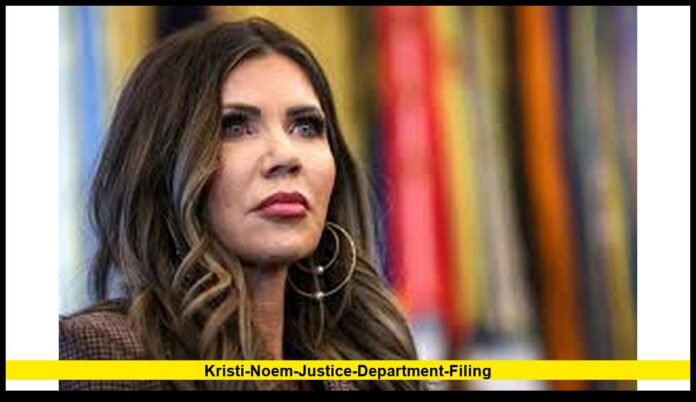

The kristi noem justice department filing continues to generate nationwide attention as new information brings greater clarity to how a set of controversial deportation flights in March 2025 unfolded. The latest filing outlines who made key decisions, why those decisions were made, and how the administration is defending its actions amid an active criminal contempt inquiry. As the legal debate intensifies, the case has become a major point of discussion in immigration policy, separation-of-powers issues, and the handling of emergency enforcement actions.
The filing is now central to understanding what the government considered lawful at the time and what the federal court must determine as it evaluates whether any official acted in defiance of a judicial order.
The Filing That Named Key Officials
In the newly detailed filing, Justice Department attorneys identify senior officials involved in decisions surrounding a series of deportation flights that departed U.S. soil during a period of legal uncertainty. The document states that Secretary Kristi Noem was the official who decided not to recall the flights once they were already airborne. That decision has become the focal point of the court’s review.
The filing also highlights the presence of multiple advisers who provided legal opinions during the brief but intense operational window in March 2025. It explains the chain of communication and how guidance shaped the final call to continue the flights.
What stands out is the level of specificity: names, job titles, advisory roles, and the exact operational circumstances are all laid out. It is this level of detail that allows the court to move forward with fact-finding and potential testimony.
Understanding the Legal Background
Before the filing was submitted, the legal environment surrounding the deportation flights was already complex. A federal judge issued an order that halted removals carried out under emergency authority. The order also instructed that certain flights returning migrants to custody should be brought back under U.S. jurisdiction if possible.
As the flights were en route, officials had only minutes to interpret the order, consult legal counsel, assess operational constraints, and decide what action to take. The central dispute is whether the order was binding on flights that had already departed and whether failing to recall them constituted disobedience.
The court is now reviewing whether the government’s actions represented a good-faith legal interpretation or whether the decision should be treated as a deliberate refusal to comply.
Why the Filing Changes the Landscape
The kristi noem justice department filing matters for several reasons:
- It identifies decision-makers directly, including agency heads and senior legal advisers.
- It outlines the government’s argument that the order did not apply once the flights had cleared U.S. airspace.
- It clarifies the legal reasoning offered to DHS at the moment the calls were being made.
- It gives the court a blueprint of the government’s internal decision process.
Prior to this filing, many questions centered on who had ultimate responsibility for the March flights. The government’s latest submission leaves little ambiguity about that.
Breakdown of What the Filing Reveals
The filing details several key points that shape how the court will move forward:
1. Decision Authority
Kristi Noem is identified as the senior official who decided not to recall the flights. The document emphasizes that she acted after receiving advice from the department’s legal leadership.
2. Legal Guidance
Advisers presented interpretations of the judge’s order, focusing on whether a verbal directive carried the same legal force as an injunction. They also discussed whether jurisdiction applied once aircraft had departed U.S. territory.
3. Operational Realities
The filing notes that aircraft were already in the air when the legal situation changed. According to the government’s argument, the timing limited the practical ability to reverse the flights.
4. Federal Court Review
With responsibility clearly assigned, the court now has a more direct set of witnesses to evaluate, enabling a more structured inquiry.
These factors collectively make the filing a defining moment in the broader legal dispute.
Timeline of Major Developments
A clear timeline helps explain how the situation evolved:
- Early March 2025: Federal authorities begin a series of fast-moving deportation operations.
- Mid-March 2025: A judge issues an order temporarily halting the removals and calling for any ongoing flights to be returned if possible.
- Shortly afterward: Flights carrying Venezuelan migrants depart U.S. soil and remain in the air as the order is issued.
- Moments later: Agencies consult internally to interpret the order, review legal authority, and determine operational feasibility.
- Decision is made: Flights continue toward their destinations.
- Months later: Courts begin reviewing whether officials acted appropriately under the judge’s order.
- Late November 2025: The kristi noem justice department filing documents the roles of officials involved and updates the court on the government’s position.
By placing these events in sequence, the filing allows the court to determine whether decisions were made in good faith or in disregard of court authority.
What the Court Is Deciding Now
The court is not reviewing immigration policy itself. Instead, it is determining whether any government official:
- Acted outside lawful authority,
- Misinterpreted a court order intentionally,
- Or willfully prevented enforcement of a judicial directive.
These questions go to the heart of the contempt probe.
The judge has broad discretion in contempt inquiries, and the filing’s clarity gives the court a fuller record. Depending on what additional testimony or evidence reveals, the court could take steps including requiring sworn testimony, demanding internal communications, or issuing further rulings.
The Broader Implications for Policy
The case now tied to the kristi noem justice department filing reaches beyond one decision or one department. It illustrates how immigration enforcement, legal interpretation, and operational speed can collide during rapid federal actions.
For immigration enforcement, the episode shows how agencies respond when court orders arrive mid-operation.
For federal oversight, it raises questions about how the judiciary ensures compliance with orders in time-sensitive situations.
For executive authority, it highlights how far an administration may act during emergency circumstances when laws allow broad discretionary power.
The national conversation surrounding these issues is growing louder as the court process continues.
Political Reactions and Public Debate
While the filing is a legal document, it has immediate political implications. Supporters of the administration argue that the decision was grounded in legal advice and operational necessity. They emphasize that the flights had already departed and that returning them would have introduced new uncertainties.
Critics, however, view the decision as evidence of overreach, claiming the administration placed enforcement goals above court authority. They argue that the filing demonstrates why clearer legal limits and stronger oversight mechanisms are needed in high-speed deportation operations.
The court’s handling of the case will shape the direction of that debate.
Key Questions That Continue to Shape the Case
1. Did the verbal order apply to flights already in the air?
This is the central legal issue the court must decide.
2. Was the decision made in good faith based on legal guidance?
This determines the potential for contempt findings.
3. Does the filing establish clear accountability?
Naming officials strengthens the court’s ability to assess responsibility.
4. How much authority should agencies have during emergency operations?
The outcome of the case will influence future policy and enforcement rules.
Each of these questions is part of a larger national conversation about how much control the judiciary has over enforcement actions carried out in real time.
How the Filing Shapes What Happens Next
With the filing now part of the legal record, the next phase is expected to include:
- Additional court hearings,
- Potential witness testimony,
- Requests for more information from the government,
- And continued evaluation of whether any action in March 2025 violated a direct order.
The court’s decisions in the coming weeks will determine whether the filing closes key questions or opens the door to more extensive scrutiny.
Conclusion
The kristi noem justice department filing marks a defining moment in an already high-profile legal dispute. By laying out who made critical decisions, how those decisions were interpreted legally, and why the department acted as it did, the filing offers the most complete account to date. As the court continues its inquiry, the nation is watching closely. This case has become a lens into how federal powers are used, interpreted, and reviewed — especially when time-sensitive operations collide with judicial authority.
Share your thoughts below — your insight helps shape the discussion as this major case continues to unfold.