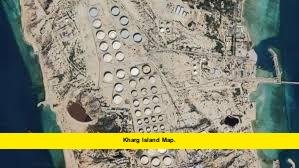

The tiny patch of coral rock known as Kharg Island has become the most talked-about stretch of land on any map of the Middle East. On March 13, 2026, President Donald Trump announced that U.S. Central Command carried out a massive bombing raid on the island, describing it as one of the most powerful strikes in the history of the region. Military targets on the island were destroyed, but the oil infrastructure was deliberately spared — at least for now. This is the story of why Kharg Island sits at the center of a conflict that every American should be paying close attention to, and what happens next could reshape the global economy for years.
👉 Stay informed — share this article with someone who needs to understand what’s really unfolding in the Persian Gulf.
A Small Island With an Outsized Role
Most Americans had never heard of Kharg Island before this week. That is about to change. This 22-square-kilometer coral outcrop in the northern Persian Gulf handles roughly 90 percent of Iran’s entire crude oil exports. At peak capacity, its massive storage tanks, deep-water jetties, and network of subsea pipelines can process up to seven million barrels of oil per day, loaded onto supertankers and sent primarily to markets in Asia.
No other major oil-producing nation on earth is so dependent on a single facility. That concentration of export power in one location makes Kharg both the financial engine of the Iranian government and its most glaring strategic vulnerability. Cutting it off doesn’t just hurt Tehran — it sends shockwaves through global energy markets almost immediately.
What Trump Announced on March 13
In a post on Truth Social, President Trump declared that U.S. forces had “totally obliterated every military target” on Kharg Island, calling it Iran’s “crown jewel.” He stated that he deliberately chose not to destroy the island’s oil infrastructure, citing decency as his reason — but made clear that decision was conditional. If Iran or any other party interferes with the free and safe passage of ships through the Strait of Hormuz, Trump warned, he would immediately reconsider.
The warning carries enormous weight. The Strait of Hormuz, through which roughly 20 percent of the world’s oil and gas normally flows, has seen commercial shipping grind to a near halt since the U.S. and Israeli-led military campaign — dubbed Operation Epic Fury — began on February 28, 2026. Iran’s new supreme leader, Mojtaba Khamenei, who took power on March 8 following his father’s death, has insisted the Strait must remain closed as a tool of pressure against the United States and its allies.
The Geography That Makes This Island So Dangerous to Ignore
Pull up any map of the Persian Gulf and the strategic logic becomes instantly clear. Kharg Island sits approximately 25 kilometers off Iran’s southwestern coast and about 483 kilometers northwest of the Strait of Hormuz. Its deep-water berths can accommodate the largest supertankers in operation — a geographic advantage no other point along Iran’s coastline can replicate.
Subsea pipelines connect the island to major oilfields across southwestern Iran, funneling crude from the country’s most productive fields to a single loading point before tankers carry it out through the Gulf. That network, built up over decades since the 1960s, is why Kharg became so dominant — and why Iran has never seriously developed a meaningful alternative.
The island is also one of the most tightly guarded locations in the country. Known among Iranians as the “Forbidden Island,” it is patrolled by the Islamic Revolutionary Guard Corps and accessible only to those with official security clearances. Ancient ruins and millennia of layered human history sit alongside one of the most modern and heavily fortified oil terminals on earth.
Oil Prices and the Economic Stakes for Everyday Americans
The impact of this conflict on U.S. consumers is already being felt. Brent crude oil futures closed above $100 a barrel for two consecutive days following the latest developments, and analysts at major financial institutions have warned prices could climb significantly higher if the oil infrastructure on Kharg is ever struck.
Economists warn that disabling the terminal would not just cut Iran’s revenue — it would trigger a chain reaction across global oil supply chains. Iran currently exports roughly 1.5 million barrels per day. Losing that supply, combined with the effective closure of the Strait of Hormuz, would create the largest oil supply disruption in the modern history of global energy markets. Americans would feel that at the gas pump almost immediately.
The Trump administration has publicly stated it expects oil prices to fall once the conflict concludes. But that outcome depends heavily on how quickly shipping through the Strait of Hormuz can be restored — and whether Kharg’s infrastructure survives the war intact.
The Historical Parallel That Haunts Military Planners
This is not the first time Kharg Island has been at the center of a major military conflict. During the Iran-Iraq War in the 1980s, Iraqi forces repeatedly bombed the island in an effort to cripple Iran’s oil revenues. The terminal suffered significant damage but never stopped operating entirely. Iran repaired the infrastructure and kept exporting throughout the war.
That resilience is something military and energy analysts keep coming back to. Even a large-scale strike on Kharg would not necessarily deliver a knockout blow to Iran’s economy permanently. Tehran has demonstrated the ability to rebuild and adapt. The question facing Washington today is not simply whether to strike the oil infrastructure — it is whether doing so would achieve lasting strategic outcomes or simply create a prolonged humanitarian and economic crisis.
The Ground Operation Question
Beyond the bombing campaign, discussions inside the Trump administration have reportedly centered on whether U.S. forces should attempt to physically seize and hold Kharg Island. Military geography experts estimate such an operation would require thousands of ground combat troops — a major commitment in a region where Iran’s territory is vast, mountainous, and deeply hostile to foreign forces.
Defense Secretary Pete Hegseth has refused to rule out deploying U.S. ground forces in Iran but has said the military will not get bogged down in the country. The Pentagon recently ordered approximately 2,500 Marines and an amphibious assault ship to the region, a move that signals preparation for contingencies without committing to a full ground campaign.
Experts also warn that seizing Kharg could backfire politically. Occupying Iranian soil would hand Mojtaba Khamenei, whose legitimacy is already contested within Iran’s clerical establishment, exactly the national emergency he needs to rally domestic support behind the regime. A U.S. flag over Kharg Island could transform the war’s narrative from one of regime dismantlement to one of territorial defense — a very different fight.
What the U.S. Navy Plans Next
Trump also announced that the U.S. Navy would soon begin escorting commercial vessels through the Strait of Hormuz, a significant development that signals Washington’s intention to reopen the world’s most critical oil shipping corridor by force if necessary. Restoring that passage is essential not just for Iran’s oil exports but for the entire global economy, including the Gulf Arab states that depend on the Strait to move their own energy exports to market.
The coming days will determine whether Iran’s military — significantly weakened by two weeks of U.S. and Israeli airstrikes — has the capacity to resist that effort, or whether Tehran will be forced to the negotiating table before the oil infrastructure on Kharg Island becomes the next target.
What do you think — should the U.S. protect Kharg’s oil facilities to keep global prices stable, or is economic pressure on Iran worth the cost at the pump? Leave your comment below and check back for the latest updates as this rapidly evolving story continues.