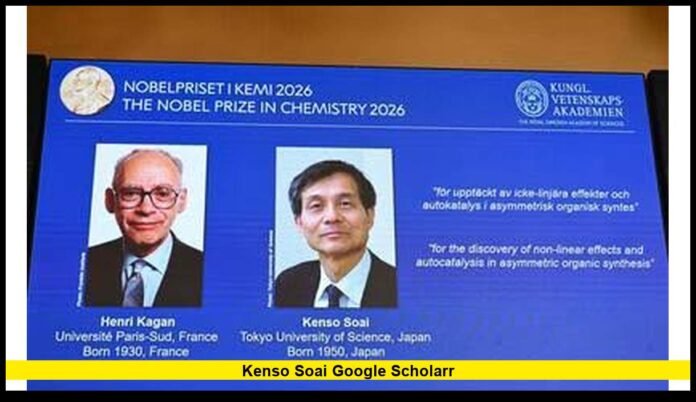

Kenso Soai Google Scholar searches are drawing renewed attention after Japanese chemist Kenso Soai received the 2026 Nobel Prize in Chemistry for groundbreaking work on nonlinear effects and autocatalysis in asymmetric organic synthesis. His research has helped scientists understand how chemical reactions can favor one mirror-image form of a molecule over another, an issue with major importance in chemistry, biology and pharmaceutical development.
The Nobel Prize was announced on October 7, 2026, with Soai sharing the award with French chemist Henri B. Kagan. The recognition highlights decades of research into chirality, asymmetric synthesis and autocatalytic reactions.
For students, researchers and readers discovering Soai’s work after the Nobel announcement, his academic publication record offers an important way to understand why his research became so influential.
Who Is Kenso Soai?
Kenso Soai is a Japanese organic chemist best known for his research into asymmetric autocatalysis and molecular chirality.
His academic career has been closely associated with Tokyo University of Science, where he conducted extensive research into asymmetric organic reactions. His work has examined how chemical systems can generate, reinforce and transfer molecular asymmetry.
That subject became particularly important because many molecules exist in two mirror-image forms.
These forms are called enantiomers. They contain the same atoms and have the same basic chemical formula, but their three-dimensional arrangements differ.
The distinction is critical in biological chemistry. Living organisms often interact differently with the two forms of a chiral molecule.
Soai’s research addressed one of the most challenging questions surrounding this phenomenon: how can a chemical system strongly favor one molecular orientation over another?
Why the 2026 Nobel Prize Matters
The 2026 Nobel Prize in Chemistry placed Soai’s research at the center of international scientific attention.
Soai and Kagan were recognized for discoveries involving nonlinear effects and autocatalysis in asymmetric organic synthesis.
Their work helped demonstrate ways of controlling chemical reactions so that one mirror-image form can become much more prominent than its counterpart.
This is not merely a theoretical chemistry problem.
The ability to control molecular handedness has practical importance in the development of medicines and other products that interact with biological systems.
A drug molecule with one configuration can produce a desired biological response, while its mirror image can behave differently.
The Nobel recognition therefore connects Soai’s fundamental research with a much broader field of chemical synthesis.
What Does Chirality Mean in Chemistry?
Chirality is one of the central concepts behind Soai’s research.
The easiest analogy is the human hand. A left hand and a right hand resemble each other closely, but one cannot be placed directly over the other to create a perfect match.
Molecules can display the same type of relationship.
A pair of chiral molecules may have identical chemical compositions while differing in their three-dimensional arrangement. Their mirror-image relationship can influence how they interact with other molecules.
This becomes particularly important in biological systems because proteins, enzymes and receptors have complex three-dimensional structures.
As a result, the body’s molecular machinery can distinguish between different molecular configurations.
Chemists therefore developed asymmetric synthesis methods to produce a preferred molecular form rather than an equal mixture of both.
Soai’s work represents a major development in that effort.
The Importance of the Soai Reaction
The reaction most closely associated with Kenso Soai is known as the Soai reaction.
It became a landmark example of asymmetric autocatalysis.
In an ordinary catalytic reaction, a catalyst helps another chemical transformation take place. In an autocatalytic process, the product itself can help promote the production of additional product.
The Soai system is especially significant because the chiral product can promote formation of more material with the same molecular handedness.
That creates a feedback mechanism.
A small initial imbalance can become increasingly significant as the reaction continues.
This amplification is one of the reasons the research became so important to scientists studying the origin of molecular asymmetry.
The 1995 Research Breakthrough
One of Soai’s most influential scientific achievements came in 1995.
Soai and his collaborators published research demonstrating that asymmetric autocatalysis could amplify a small initial enantiomeric excess.
The experiment involved a 5-pyrimidyl alkanol system and showed that an initial imbalance could be significantly enhanced through an autocatalytic reaction.
The finding addressed an important theoretical possibility that had existed for years.
Scientists had considered whether autocatalysis could amplify a tiny random imbalance between mirror-image molecules. Soai’s experiment provided direct chemical evidence that such amplification could occur.
The discovery subsequently became a major reference point in research involving asymmetric autocatalysis and molecular homochirality.
What Is Homochirality?
Homochirality describes the predominance of one molecular handedness in a biological system.
It is one of the most intriguing features of chemistry associated with life.
For example, naturally occurring proteins use amino acids predominantly in one configuration. Biological sugars also show strong preferences for a particular molecular orientation.
Scientists have long asked how these preferences developed.
If basic chemical processes can produce both mirror-image forms, why does biological chemistry overwhelmingly favor one?
Soai’s research does not establish a complete explanation for the origin of life.
Instead, his work demonstrates a mechanism through which a small molecular imbalance can be amplified dramatically.
That distinction matters.
The Soai reaction provides an experimental model for asymmetric amplification. It does not establish that the same reaction occurred during the emergence of life on Earth.
Kenso Soai’s Research and the Origin of Life
The connection between Soai’s work and origin-of-life research comes from the problem of molecular handedness.
Before biological systems developed, chemical reactions would not necessarily have had the strong molecular preferences seen in modern organisms.
Scientists have therefore investigated mechanisms that could transform a tiny asymmetry into a much larger one.
Asymmetric autocatalysis provides one possible chemical pathway for such amplification.
Soai’s research became particularly interesting in this area because the reaction can reinforce its own molecular preference.
A small difference can therefore become much larger through repeated chemical processes.
This concept has made asymmetric autocatalysis an important subject in studies of chemical evolution and the emergence of homochirality.
Soai’s Academic Publication Record
People searching for Soai’s research can find publications covering several decades of organic chemistry.
His academic work includes research on:
- Asymmetric autocatalysis
- Chirality
- Enantiomeric excess
- Asymmetric synthesis
- Chemical amplification
- Absolute asymmetric synthesis
- Chiral symmetry breaking
- Molecular homochirality
- Chiral crystals
- Origin-of-life chemistry
His publication record includes both original experimental studies and later review articles that explain the development of asymmetric autocatalysis.
One important review published in 2004 examined the discovery and development of asymmetric autocatalysis. Another substantial review published in 2019 examined asymmetric autocatalysis, chiral symmetry breaking and the origins of homochirality in organic molecules.
These publications provide useful context for understanding how Soai’s research developed over time.
Why Google Scholar Is Useful for Finding His Papers
Google Scholar is designed to index scholarly literature from universities, publishers, professional societies and repositories.
Researchers can use it to locate papers associated with a scientist’s name and research field.
For Soai, searches can reveal original research papers, reviews and later publications that cite his work.
The database can also show citation information for many academic publications.
However, citation totals should not be considered permanent figures.
Google Scholar’s database changes as new scholarly material becomes available. Different academic databases can also produce different citation totals.
For that reason, researchers interested in Soai’s influence should examine the individual publications and their research significance rather than relying on a single citation number.
Kenso Soai Google Scholar Searches After the Nobel Announcement
Interest in Kenso Soai Google Scholar is likely to remain elevated following the Nobel announcement because readers are now searching for the scientific work behind the award.
A basic search can identify papers published under Soai’s name. More targeted searches can make the results easier to navigate.
Useful research topics include:
- Kenso Soai asymmetric autocatalysis
- Kenso Soai chirality
- Kenso Soai Soai reaction
- Kenso Soai homochirality
- Kenso Soai asymmetric synthesis
- Kenso Soai chiral symmetry breaking
- Kenso Soai origin of life
Combining his name with a specific research topic can help separate his original publications from broader material about the Nobel Prize.
Researchers should also pay attention to publication dates and author lists because Soai collaborated with numerous scientists throughout his career.
The Role of Nonlinear Effects
The 2026 Nobel recognition also draws attention to nonlinear effects in asymmetric chemistry.
A nonlinear response means that a relatively small change in a chemical system can produce a disproportionately large outcome.
This idea is closely connected with asymmetric amplification.
In a chemical reaction involving two mirror-image forms, a small imbalance might initially appear insignificant. Under suitable conditions, however, chemical feedback can magnify that difference.
Such behavior is important because it provides a route from a small molecular bias to a strongly asymmetric result.
Soai’s work demonstrated how autocatalytic chemistry could contribute to this type of amplification.
Why the Research Matters to Pharmaceuticals
Asymmetric synthesis is particularly valuable in pharmaceutical chemistry.
Many drug molecules are chiral. Their different mirror-image forms can interact differently with biological targets.
Chemists therefore need methods that allow them to produce the desired configuration with high selectivity.
The discoveries recognized by the 2026 Nobel Prize contributed to the broader scientific understanding needed to control such reactions.
The importance extends beyond medicine.
Chiral compounds are also relevant to fragrances, flavors, agricultural chemicals and advanced chemical materials.
The ability to selectively produce one molecular form can improve the precision and efficiency of chemical manufacturing.
Soai’s Place in Modern Organic Chemistry
Soai’s work represents a bridge between fundamental chemical theory and practical synthetic chemistry.
His research began with questions about asymmetric reactions and eventually became closely connected with larger scientific questions about molecular evolution and biological homochirality.
That combination helped make the Soai reaction particularly influential.
It is unusual for a specialized reaction in organic chemistry to become relevant to discussions spanning pharmaceutical science, chemical evolution and the origin of biological asymmetry.
The 2026 Nobel Prize recognizes that broader importance.
What Researchers Should Look For in Soai’s Publications
Readers examining Soai’s academic record should focus on how his research developed.
Early publications provide insight into his work in asymmetric organic synthesis. Later studies explore asymmetric autocatalysis and amplification. Subsequent reviews place those discoveries within the larger problem of molecular homochirality.
This progression helps explain why his research has attracted attention for decades.
The 1995 experimental breakthrough is particularly important because it provided direct evidence that autocatalysis could amplify a small enantiomeric imbalance.
Later research continued to investigate the chemical mechanisms, applications and implications of asymmetric autocatalysis.
The Latest Status of Kenso Soai
As of October 7, 2026, Kenso Soai is a Nobel Prize-winning chemist after receiving the 2026 Nobel Prize in Chemistry alongside Henri B. Kagan.
The award recognizes their work on nonlinear effects and autocatalysis in asymmetric organic synthesis.
The Nobel committee’s decision has brought renewed attention to the scientific literature surrounding chirality and asymmetric chemical reactions.
For readers discovering Soai for the first time, his publication record provides a deeper understanding of the research behind the award.
His most influential work demonstrated that chemical systems can amplify molecular asymmetry through autocatalytic processes. That finding helped establish a powerful experimental framework for studying how one mirror-image form can become dominant.
The 2026 Nobel Prize now marks the culmination of decades of research into that problem.
Kenso Soai’s Nobel recognition has brought a once-specialized area of organic chemistry into the global spotlight, and his scientific publications offer the clearest path for understanding the discovery and its lasting importance.