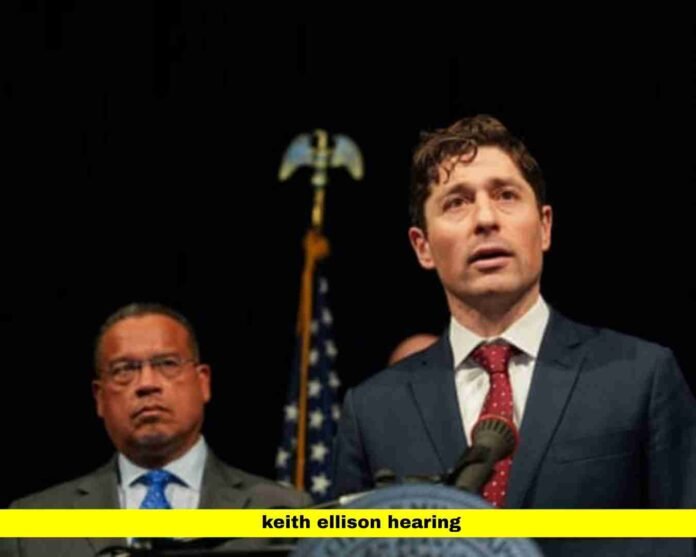

The recent Capitol Hill session involving Minnesota’s top legal official highlighted deep tensions over federal enforcement, civil liberties, and state authority.
The exchanges underscored how disputes between state leaders and federal agencies are shaping national legal and political debates.
The keith ellison hearing this week in Washington, D.C. turned into one of the most talked-about congressional events of the year, bringing a powerful mix of political tension, public policy debate, and intense questioning from lawmakers. At the center of the hearing was Minnesota’s top legal official, who faced fierce inquiries from senators and representatives over his handling of complex issues involving federal enforcement operations, public safety concerns, and broader disputes over state-federal authority.
The hearing unfolded against the backdrop of a controversial immigration enforcement surge in Minnesota that resulted in thousands of arrests, widespread protests, disruptions to daily life, and the deaths of two U.S. citizens. The session became a national focal point, with lawmakers questioning his decisions, his office’s actions, and the broader impacts of federal-state clashes. This article takes a detailed, factual look at the hearing, the topics discussed, and the significance of the exchanges heard in the chambers.
A High-Profile Hearing Amid National Debate
The hearing brought together a wide range of speakers, including state officials, federal immigration leaders, and legal experts. The atmosphere was charged as legislators sought answers about enforcement strategies that had unfolded in Minnesota, the legal challenges brought by state officials, and how conflicting forces could be resolved within the framework of federal and state law.
Unlike typical hearings focused on narrow technical issues, this session covered a broad spectrum of topics — from law enforcement conduct and civil liberties to intergovernmental cooperation and constitutional interpretation. The intense questions and sharp exchanges highlighted the hearing’s complexity and its impact on national discussions.
Federal Enforcement in Minnesota Under Scrutiny
One of the central points of discussion at the hearing was the aggressive federal enforcement campaign that had taken place in Minnesota since late 2025. Federal agencies deployed a large contingent of personnel into the Minneapolis-Saint Paul area under an operation that aimed to crack down on immigration violations, fraud, and public safety concerns.
The vast number of arrests, the highly visible federal presence, and the forceful nature of some operations drew immediate attention from residents, activists, and elected officials alike. The enforcement effort affected daily life in many neighborhoods, impacting businesses, schools, and community routines.
As lawmakers questioned witnesses and officials, they explored whether the scope of the federal operation was appropriate, whether safeguards were in place to protect civil liberties, and whether the actions taken aligned with constitutional boundaries. These discussions underscored the challenges of balancing enforcement authority with respect for local rights and public safety.
Legislators Press Ellison on Controversial Issues
During intense moments of the hearing, certain lawmakers focused their attention directly on the attorney general’s decisions and his office’s responses to recent events. One senator accused him of acting irresponsibly and even suggested legal consequences for his conduct — comments that drew gasps and strong rebuttals from both sides of the political aisle.
At times, the exchanges grew personal and heated, with lawmakers levelling harsh rhetoric and demanding answers about perceived inaction or controversial judgments. Despite the confrontational tone, the attorney general stood firm, challenging assertions and reiterating the legal basis for his actions.
Key issues raised included questions about governance, the role of state authority, and how his office interacted with federal agencies during enforcement operations. Lawmakers pressed him on whether his legal strategies had contributed to community tension or confusion, pushing for clarity on how state leadership balanced competing interests.
Examining Federal and State Powers
A major theme of the hearing was the tension between federal authority and state autonomy. Enforcement of national immigration laws traditionally falls under federal jurisdiction, but when actions occur within state borders, questions arise about how local legal frameworks intersect with national mandates.
The hearing delved into these knotty questions, with attorneys general, state leaders, and federal officials clarifying how different legal authorities can align or clash. Some lawmakers suggested that federal action had overstepped, while others defended the need for robust enforcement to protect borders and public safety.
In this context, the attorney general frequently referenced constitutional provisions and legal principles that guide state sovereignty. His arguments emphasized the importance of ensuring that federal actions respect individual rights and procedural norms.
Public Safety and Civil Liberties at the Forefront
Another important subject before the committee was the impact of law enforcement actions on ordinary residents. Members of Congress asked about reports of disruption to communities, including the impact on businesses, schools, and families living in areas where enforcement was highly visible.
The attorney general responded by explaining his office’s efforts to document firsthand accounts of enforcement actions from community members. Residents and advocates had been encouraged to report encounters that affected their daily lives, and this information became part of the legal records used to challenge certain federal activities.
These community impacts played a central role in shaping testimony and reinforcing why state leaders deemed it necessary to pursue legal remedies.
Deaths of Residents Highlight Stakes
Compounding the public response were the deaths of two U.S. citizens during encounters involving federal agents earlier in the enforcement surge. These incidents became flashpoints for debate, propelling questions about use of force, investigative transparency, and accountability.
Lawmakers raised these deaths during the hearing as they sought explanations and assurances about oversight mechanisms. The attorney general underscored his office’s pursuit of independent investigations and ongoing legal efforts to ensure that state residents are protected regardless of enforcement context.
These discussions resonated deeply with committee members and underscored the human cost behind policy disputes.
End of the Federal Surge Shifts Focus
By the time of the hearing, federal authorities had already moved to conclude the large-scale immigration enforcement operation in Minnesota. Border officials announced a phased withdrawal of officers after intense public pressure and legal challenges from state leaders.
This development shifted part of the hearing’s focus toward evaluating how the drawdown occurred and what lessons might be applied in future federal-state collaborations. Lawmakers debated whether the operation’s conclusion represented a victory for local resistance, a legal retreat, or a necessary recalibration of enforcement tactics.
The attorney general highlighted the importance of cooperation between federal and local agencies moving forward, underscoring the need for coordinated approaches that respect constitutional and community norms.
Broader Public Policy Implications
The hearing also served as a forum for broader discussion about public policy. Members of Congress and state officials used the opportunity to discuss how immigration enforcement intersects with civil rights, economic stability, and public trust.
Some emphasized the need for legislative reforms to clarify jurisdictions and protections. Others underscored the importance of ensuring that enforcement tools do not undermine the very communities they intend to protect.
This broader discussion reflected deep national divisions over how immigration policy should be shaped, enforced, and balanced with principles of justice and individual freedom.
State Initiatives Beyond Immigration
While the hearing’s spotlight was on enforcement and federal-state relations, the attorney general also shared updates on other major legal actions his office has taken in recent weeks.
One significant case involves a legal challenge to federal directives aimed at cutting millions in public health grants to multiple states, including Minnesota. Under his leadership, the state joined a multistate lawsuit arguing against the removal of critical funding used for disease tracking and public health infrastructure — a move his office says could have serious implications for community wellness and safety.
This litigation highlights his broader legal agenda, which extends beyond immigration disputes into areas such as public health protections and safeguarding essential government services.
Public Response and National Commentary
The hearing generated immediate reactions from audiences across the political spectrum. Supporters praised the attorney general’s resolute defense of what they see as constitutional principles and statewide protections.
Critics, on the other hand, interpreted some exchanges as evidence of greater political polarization — suggesting that the conflict between state leadership and federal law enforcement reflects deeper national divides over law, policy, and public trust.
Across social media and public forums, debates intensified as viewers dissected testimony, questioned motives, and interpreted the broader meaning behind heated exchanges on the Senate floor.
Looking Ahead: Legal and Political Uncertainty
As the hearing concluded, attention began shifting back to the courts and state capitals. Legal challenges related to federal enforcement actions remain active, and policymakers are watching closely for future developments.
For residents and leaders alike, the hearing underscored how legal authority, public safety, and political strategy intersect in high-stakes environments. The outcomes of ongoing litigation and future legislative sessions may determine how similar conflicts are resolved down the road.
How do you think state and federal agencies should balance public safety with individual rights? Share your perspective and stay informed as developments unfold.