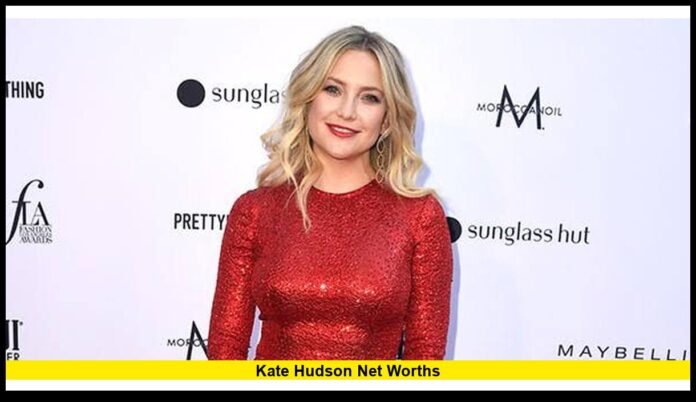

Kate Hudson has spent more than two decades building a career that reaches well beyond the movie business, and kate hudson net worth remains a closely searched topic as her acting career, entrepreneurial ventures, music projects, and investments continue to evolve. The actress first became a major Hollywood name with Almost Famous and later established herself as one of the leading stars of romantic comedies. In the years since, she has turned her celebrity profile into a broader business portfolio, most notably through her connection to Fabletics.
The latest widely reported estimate places Hudson’s fortune at approximately $500 million. That figure should be viewed as an estimate rather than a verified personal balance sheet because Hudson’s private investments, liabilities, taxes, property holdings, and the precise value of her stakes in privately held businesses are not publicly disclosed.
Her financial story is particularly interesting because acting is only one part of the picture. Hudson has participated in fashion, wellness, spirits, podcasting, music, and other commercial ventures. Fabletics, the activewear company she co-founded in 2013, has grown into a global business and remains central to discussions about her long-term wealth.
╔════════════════════════════════════════════════════════════════════╗
║ – Kate Hudson’s fortune is widely estimated at around $500 million in 2026. ║
║ – Her wealth has been built through acting, producing, entrepreneurship, and investments. ║
║ – Fabletics remains one of the most significant businesses connected to Hudson. ║
║ – The activewear company surpassed $1 billion in annual revenue and continues expanding internationally. ║
║ – Hudson has also developed businesses and creative projects in wellness, spirits, podcasting, and music. ║
╚════════════════════════════════════════════════════════════════════╝
What Is Kate Hudson’s Net Worth in 2026?
Current celebrity wealth estimates put Kate Hudson’s net worth at approximately $500 million.
The number is largely associated with her long career in entertainment and her ownership interest in business ventures. However, it is important to understand that celebrity net-worth estimates are not the same as financial statements released by publicly traded companies.
Hudson’s wealth cannot be calculated simply by adding up her reported movie salaries. A person’s net worth takes into account assets and ownership interests while also accounting for debts and other liabilities. Private-company stakes can make that calculation particularly difficult because there is no continuously updated public share price.
Fabletics illustrates the issue. The company has grown substantially, but it remains privately held. Consequently, the value of any ownership stake depends on the company’s valuation, the terms attached to the shares, and the percentage an individual actually owns at a particular time.
That means the $500 million figure is best understood as a widely reported estimate rather than an independently confirmed amount.
Kate Hudson’s Early Acting Career
Hudson was born into a family already familiar with Hollywood. Her mother is actress Goldie Hawn, while actor Kurt Russell helped raise her. Despite that background, Hudson developed a career of her own and quickly established an identity separate from her famous family.
She made her film debut in the late 1990s, appearing in movies including Desert Blue and Ricochet River. Her early compensation was relatively modest compared with the salaries she would command later.
Her breakthrough came with Cameron Crowe’s Almost Famous in 2000.
Hudson played Penny Lane, a charismatic young woman traveling with a fictional rock band. Her performance received widespread attention and earned her an Academy Award nomination for Best Supporting Actress.
The role transformed her professional standing. Within a few years, Hudson had moved from relatively small movie salaries to some of the industry’s more substantial paychecks.
The Rise of a Hollywood Leading Lady
Following Almost Famous, Hudson appeared in a succession of commercially successful productions.
Her role opposite Matthew McConaughey in How to Lose a Guy in 10 Days became particularly important to her career. Released in 2003, the romantic comedy became a major box-office success and helped establish Hudson as one of Hollywood’s most recognizable stars in the genre.
She later appeared in movies including Raising Helen, You, Me and Dupree, Bride Wars, Something Borrowed, and Fool’s Gold.
Hudson’s work was not limited to acting. She also became involved with producing, giving her opportunities to participate in projects from behind the camera.
Her compensation increased as her profile grew. Publicly reported figures have placed her salary for How to Lose a Guy in 10 Days at around $4.5 million and her reported compensation for Raising Helen and Bride Wars at approximately $7 million each.
Exact contractual arrangements, bonuses, backend participation, and deductions are not publicly available, so these numbers should not be interpreted as Hudson’s final personal earnings from those movies.
Glass Onion Added a New Chapter to Her Film Career
Hudson later demonstrated that her appeal extended beyond traditional romantic comedies.
In Glass Onion: A Knives Out Mystery, she played Birdie Jay, a wealthy fashion personality whose exaggerated lifestyle became one of the film’s comedic highlights.
The Netflix production featured a large ensemble cast led by Daniel Craig and included performers such as Janelle Monáe, Kathryn Hahn, Edward Norton, and Dave Bautista.
Hudson’s performance gave audiences another example of her ability to combine comedy and dramatic characterization. Reports have estimated that she received approximately $2 million for the role, although detailed contract terms have not been publicly confirmed.
The movie also demonstrated how established actors can continue generating significant entertainment income even as the traditional theatrical business changes.
Fabletics Became a Major Part of Her Business Career
For Hudson, one of the biggest financial developments of her career occurred outside the film industry.
She co-founded Fabletics in 2013, entering the rapidly expanding athleisure market at a time when consumers were increasingly wearing athletic-inspired clothing in everyday settings.
Hudson initially served as a highly visible representative of the company. Her celebrity profile helped introduce the brand to consumers, while the business developed a membership-driven model designed around recurring customers and personalized shopping.
Over time, Fabletics evolved from a digital-first company into a major retail and international brand.
The company reported more than $1 billion in revenue for 2025, marking a significant milestone. It also continued adding stores and expanding into international markets.
By 2026, Fabletics had more than 135 stores globally and more than 3 million active customers, according to company information. The company also announced plans to significantly increase its international retail footprint.
Those developments matter when considering Hudson’s financial position because she has remained associated with Fabletics as a shareholder after moving away from her earlier public-facing role.
Hudson’s Role at Fabletics Has Evolved
Hudson’s involvement with Fabletics has changed over the years.
Rather than continuing indefinitely as the company’s primary celebrity spokesperson, she transitioned into a strategic advisory role while retaining an ownership interest.
That distinction is important.
A celebrity endorsement can generate income through a contract, but an ownership stake can potentially appreciate as a company grows. If the underlying business becomes more valuable, the value of an owner’s stake may also increase.
At the same time, the opposite is possible. Private-company valuations can fluctuate, and ownership percentages can change because of investment rounds, restructuring, or other transactions.
Therefore, the exact contribution of Fabletics to Hudson’s personal net worth remains difficult for outsiders to calculate.
Fabletics Continues Its International Expansion
Fabletics entered 2026 with significant momentum.
The company has been expanding its physical retail presence while continuing its online and wholesale operations. Its international plans include additional markets across Asia, the Middle East, Latin America, and other regions.
The company has also emphasized technology and its membership program as important parts of its retail strategy.
This expansion is relevant to Hudson’s financial story because Fabletics represents a long-term business asset rather than a one-time entertainment paycheck.
The larger and more valuable the company becomes, the more significant its potential impact could be on the fortunes of its shareholders. But because Fabletics is privately owned, its precise valuation and Hudson’s current ownership percentage are not publicly transparent in the same way as shares in a publicly traded company.
INBLOOM Expanded Hudson’s Business Portfolio
Hudson’s entrepreneurial interests also extend into wellness.
She became associated with INBLOOM, a company focused on nutritional and wellness products. The brand was founded in 2019 and launched commercially in 2020.
INBLOOM offers products including nutritional powders, plant-based formulations, proteins, and other wellness-focused products.
The business fits naturally with Hudson’s broader interest in lifestyle and wellness. More importantly from a financial perspective, it provides another opportunity for her to participate in a consumer brand as an entrepreneur rather than simply earning money from entertainment work.
The exact amount Hudson has earned from INBLOOM has not been publicly disclosed.
King St. Vodka Added Another Business Interest
Hudson also entered the spirits industry with King St. Vodka.
The brand launched in 2019 and gave the actress another opportunity to participate in a consumer-products company.
Celebrity-backed alcohol brands have become a significant part of the entertainment industry’s business landscape, but Hudson’s approach has been to develop a product and brand rather than merely attach her name to an existing company.
As with her other private ventures, there is no reliable public figure showing exactly how much money Hudson personally receives from King St. Vodka each year.
Sibling Revelry Created Another Revenue Stream
Hudson has also turned her family relationships into a media project.
She and her brother Oliver Hudson launched Sibling Revelry in 2019. The podcast centers on family relationships and regularly features conversations with entertainers and other public figures.
Podcasting gives celebrities another way to monetize their audiences through advertising, sponsorships, partnerships, and other commercial arrangements.
Hudson’s exact annual income from Sibling Revelry has not been publicly disclosed. Nevertheless, the project adds another layer to her diversified career.
It also demonstrates how Hudson has increasingly used her personal brand across different forms of media rather than depending exclusively on film studios.
Music Became a New Creative and Commercial Venture
Hudson has also pursued music professionally.
Her debut album, Glorious, marked a significant new chapter because singing had long been an interest of hers. The album allowed her to build a separate identity in the music world while continuing her work as an actress and entrepreneur.
She has continued releasing music beyond the initial album cycle. Her music catalog also includes work connected with film projects.
Music is unlikely to represent the largest portion of Hudson’s overall fortune compared with her business interests and long acting career. However, it adds another source of potential income from streaming, sales, performances, licensing, and related activities.
Real Estate and Long-Term Assets
Real estate has also contributed to Hudson’s financial profile over the years.
Like many high-profile Hollywood entertainers, she has owned valuable residential property in California. Real estate can be an important component of celebrity wealth because property purchased years ago can appreciate substantially over time.
However, the value of a property does not automatically equal profit. Mortgage balances, taxes, maintenance, renovations, insurance, and transaction costs all affect the actual financial benefit of owning real estate.
Because Hudson’s complete property portfolio and current valuations are not publicly documented, real estate should be considered another potential component of her overall wealth rather than a precisely measurable figure.
Why Kate Hudson’s Wealth Is Difficult to Calculate
There is an important distinction between a reported net-worth estimate and a confirmed financial total.
For a publicly traded executive or investor, analysts can often examine disclosed shareholdings, securities filings, and market prices. Celebrity finances are different.
Hudson has private business interests, and the public does not have access to her complete tax records, bank accounts, investment portfolio, debts, or contractual arrangements.
That creates uncertainty around any exact number.
The commonly reported $500 million estimate is therefore useful as an indication of the scale of Hudson’s wealth, but it should not be treated as a precise accounting figure.
Is Kate Hudson a Billionaire?
There is no reliable public evidence establishing Kate Hudson as a billionaire in 2026.
Her estimated wealth of roughly $500 million would put her well below the billionaire threshold.
There has nevertheless been speculation about the possibility of her becoming significantly wealthier through Fabletics. The company has achieved more than $1 billion in annual revenue and continues to expand internationally.
Revenue, however, is not the same thing as company valuation or an owner’s personal wealth. Even a successful company can have substantial operating expenses, investment requirements, taxes, debt, and other financial obligations.
For that reason, predictions about Hudson eventually becoming a billionaire should be treated as speculation rather than an established financial fact.
What Makes Kate Hudson’s Financial Strategy Different?
Hudson’s career illustrates the financial advantages of diversification.
Her Hollywood work created her initial platform and provided substantial income. Instead of depending entirely on acting, she subsequently used her public profile to participate in businesses.
Fabletics gave her exposure to a scalable consumer company. INBLOOM moved into wellness. King St. Vodka entered the beverage market. Podcasting provided a media platform, while music created another artistic and commercial outlet.
This approach spreads income opportunities across several industries.
If one entertainment category slows down, another business can continue operating. At the same time, entrepreneurship carries its own risks, meaning business ownership does not guarantee a particular financial outcome.
Kate Hudson’s Career and Wealth at a Glance
Hudson’s journey can be divided into several major stages:
- Late 1990s: Began appearing in films.
- 2000: Delivered her breakthrough performance in Almost Famous.
- 2001: Received an Academy Award nomination for the film.
- 2003: Became a major romantic-comedy star with How to Lose a Guy in 10 Days.
- 2009: Combined acting and producing on Bride Wars.
- 2013: Co-founded Fabletics.
- 2019: Launched King St. Vodka and Sibling Revelry.
- 2020: Expanded into wellness with INBLOOM.
- 2021: Shifted into a strategic advisory role at Fabletics while retaining an ownership interest.
- 2022: Appeared in Glass Onion: A Knives Out Mystery.
- 2024: Released her debut album, Glorious.
- 2025: Fabletics passed the $1 billion annual revenue milestone.
- 2026: Continued expanding music and Fabletics activities internationally.
The Bottom Line on Kate Hudson’s Fortune
Kate Hudson’s financial success reflects a career that has evolved considerably since her breakthrough in Almost Famous. Acting provided the foundation, but entrepreneurship has become an increasingly important part of her professional identity.
The latest widely circulated estimate places kate hudson net worth at approximately $500 million. The figure reflects decades of movie work as well as business interests, particularly her connection to Fabletics.
Her involvement with Fabletics is especially significant because the company has grown from a startup founded in 2013 into a global activewear business generating more than $1 billion in annual revenue. Hudson’s other ventures in wellness, spirits, podcasting, music, and investments further demonstrate how she has diversified her income.
Still, her exact wealth cannot be confirmed from public information alone. Private-company valuations, ownership percentages, personal investments, taxes, liabilities, and property values can all change the calculation.
What can be established is that Hudson has successfully transformed a highly visible Hollywood career into a broader entrepreneurial portfolio, giving her financial interests that extend well beyond the movie screen.