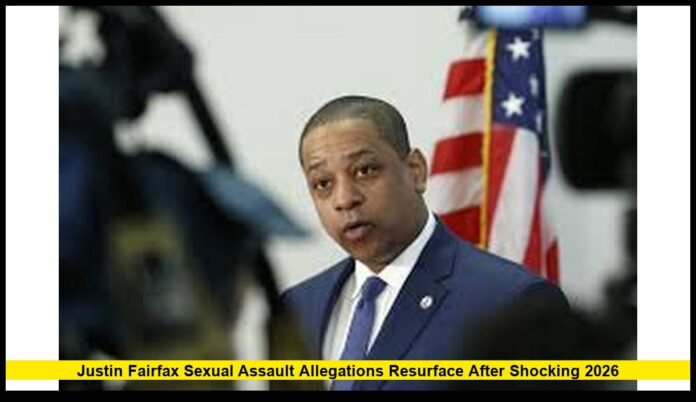

The justin fairfax sexual assault allegations have returned to the national spotlight in 2026, following a tragic and deeply disturbing incident that has prompted renewed discussion about his past, his political career, and the unresolved questions that followed him for years. What began as a major political controversy in 2019 has now become part of a broader conversation about accountability, leadership, and how personal history shapes public legacy.
This in-depth report takes a comprehensive look at the allegations, the responses, the political fallout, and why the story has resurfaced in such a significant way today.
After reading, consider how cases like this should be viewed years later—and what standards should apply to public figures facing serious accusations.
A Rising Political Career Interrupted
Justin Fairfax once stood among the most promising political figures in Virginia. Elected lieutenant governor in 2017, he brought a compelling background as a former federal prosecutor and a message focused on economic opportunity and fairness.
By early 2019, Fairfax appeared positioned for a historic rise. A separate controversy involving the sitting governor at the time created a scenario where Fairfax could have assumed the state’s top office. For a brief moment, he was at the center of national political attention.
That trajectory changed abruptly.
How the Allegations Emerged
In February 2019, Fairfax faced public accusations from a woman who alleged that he sexually assaulted her during the 2004 Democratic National Convention in Boston. She described an encounter that she said became non-consensual.
Days later, a second woman came forward with a separate allegation dating back to 2000, when both she and Fairfax were students at Duke University. She accused him of rape, describing a disturbing incident that she said had lasting emotional consequences.
The emergence of two allegations in quick succession transformed a rising political moment into a crisis.
Immediate National Reaction
The response was swift and intense.
Political leaders, advocacy groups, and members of the public reacted strongly to the allegations. Calls for Fairfax to resign came from within his own party as well as from outside it. The issue dominated headlines and became part of a broader national conversation about misconduct, power, and accountability.
The timing amplified the situation. Virginia’s political leadership was already under scrutiny, and the addition of these allegations created a moment of instability and heightened public attention.
Fairfax’s Defense and Public Statements
From the beginning, Justin Fairfax firmly denied all allegations.
He consistently maintained that:
- The encounters described were consensual
- The accusations were false
- The claims were politically motivated
Fairfax publicly called for investigations, including urging federal authorities to examine the matter. He expressed confidence that a thorough review would clear his name.
Despite mounting pressure, he did not step down from his position as lieutenant governor.
Legal Standing and Lack of Charges
A defining feature of the case is that it never reached a legal resolution.
- No criminal charges were filed
- No court proceedings determined guilt or innocence
- No official legal findings were issued
This left the situation in a complicated position. While the allegations were serious and widely discussed, they remained untested in a courtroom.
As a result, public opinion became the primary arena where the case was debated.
Political Fallout and Career Impact
Before 2019, Fairfax was widely viewed as a future leader within the Democratic Party.
After the allegations:
- His national political standing declined sharply
- Support from key allies weakened
- His public appearances became more limited
In 2021, Fairfax ran for governor of Virginia. The campaign, however, struggled to gain traction. He finished well behind other candidates in the Democratic primary, signaling that the controversy had significantly affected his political viability.
The shift was dramatic—from a potential governor to a candidate unable to regain broad support.
Public Debate and Divided Opinion
The case sparked widespread debate across the country.
Some argued that:
- Allegations of this nature must be taken seriously, regardless of timing
- Public officials should be held to high ethical standards
- Leadership requires accountability beyond legal outcomes
Others emphasized that:
- Accusations alone should not determine a person’s fate
- Due process is essential in evaluating serious claims
- The absence of legal action leaves important questions unanswered
This divide reflects a larger national conversation that continues today.
Efforts to Move Forward
In the years following the allegations, Fairfax attempted to rebuild his career and reputation.
He continued working in the legal field and remained publicly vocal about his innocence. He also addressed broader issues related to justice and fairness, often referencing his own experience as part of that discussion.
However, the shadow of the controversy remained. Opportunities in politics diminished, and his public image never fully recovered.
Why the Allegations Persist in Public Memory
The justin fairfax sexual assault allegations have remained part of the public conversation for several key reasons.
1. High Political Stakes
The allegations surfaced at a moment when Fairfax was on the verge of potentially becoming governor, raising the stakes dramatically.
2. Multiple Accusers
The presence of two separate allegations contributed to the intensity of the response and the level of scrutiny.
3. No Legal Closure
Without a court ruling or formal legal conclusion, the case never reached a definitive endpoint.
4. Broader Cultural Context
The allegations became part of a wider national reckoning around misconduct and accountability in positions of power.
2026 Incident Brings Renewed Attention
In April 2026, a tragic incident involving Fairfax brought his name back into national headlines.
Authorities reported that Fairfax fatally shot his wife at their home before taking his own life. The incident occurred while the couple was in the process of a divorce, and their children were present at the residence.
The shocking nature of the event has led many to revisit Fairfax’s life, including the earlier allegations that shaped his public career.
Reevaluating a Complicated Legacy
The intersection of Fairfax’s past allegations and the 2026 tragedy has created a complex and difficult narrative.
Observers are now grappling with questions such as:
- How should unresolved allegations factor into a person’s legacy?
- What role does public accountability play when legal conclusions are absent?
- How do personal crises intersect with public life in high-profile figures?
These questions do not have simple answers, but they continue to shape the conversation.
Impact on Public Trust and Leadership Standards
Cases like this influence how the public views leadership and accountability.
They highlight the challenges of:
- Balancing fairness with responsibility
- Evaluating credibility in the absence of legal outcomes
- Maintaining trust in public institutions
The Fairfax case, in particular, underscores how quickly a political career can change—and how lasting the effects of controversy can be.
The Broader National Context
Across the United States, discussions about misconduct allegations have evolved significantly over the past decade.
Public expectations have shifted, with greater emphasis on:
- Transparency
- Ethical conduct
- Responsiveness to allegations
At the same time, debates about due process and fairness remain central to these discussions.
The Fairfax case sits at the intersection of these evolving standards.
Where the Story Stands Today
As of now:
- The allegations from 2019 remain unresolved in court
- Fairfax consistently denied wrongdoing throughout his life
- His political career never recovered after the controversy
- The events of 2026 have brought renewed national attention
The story continues to resonate because it raises enduring questions about justice, leadership, and public accountability.
Conclusion
The trajectory of Justin Fairfax’s life and career reflects the powerful impact that allegations, public perception, and personal circumstances can have on a public figure.
While the legal system did not deliver a definitive outcome, the court of public opinion played a decisive role in shaping his legacy.
Understanding the full scope of events—from the initial allegations to the recent tragedy—provides important context for ongoing conversations about leadership and responsibility in America.
How do you think unresolved allegations should influence public careers? Join the discussion and share your perspective as this conversation continues to unfold.