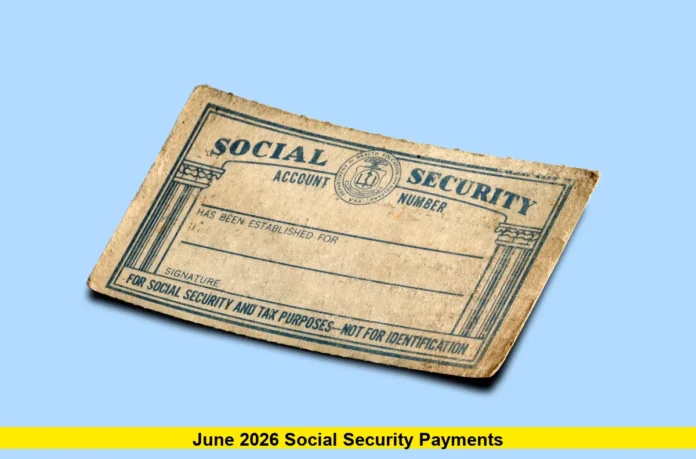

June 2026 Social Security payments will be sent on June 1 (SSI), June 3 (pre-May 1997 beneficiaries and some dual recipients), June 10, June 17, and June 24 based on beneficiaries’ birth dates, with average retirement benefits around $2,081 per month in 2026.
If you rely on Social Security benefits, knowing your exact payment date each month is essential for managing rent, utilities, groceries, and other expenses. June 2026 follows a clean, straightforward schedule — no holiday disruptions, no early payments — just the standard SSA calendar playing out exactly as planned. Here is everything you need to know about June 2026 Social Security payments, including dates, amounts, SSI timing, COLA details, and Medicare deductions.
Who Receives Social Security Payments?
More than 70 million Americans rely on Social Security benefits each month, making it one of the largest federal programs in the United States. These payments provide essential financial support to millions of individuals and families, helping cover everyday expenses such as housing, food, healthcare, and transportation.
The Social Security Administration (SSA) distributes benefits to several groups of eligible recipients, including:
- Retired Workers – Individuals who have earned enough work credits through years of employment and have reached the age at which they can claim retirement benefits.
- Disabled Workers (SSDI Recipients) – People who are unable to work because of a qualifying long-term disability and meet SSA work history requirements.
- Survivors and Family Members – Certain family members of deceased workers may qualify for benefits, including spouses, widows, widowers, dependent children, and in some cases dependent parents.
- Supplemental Security Income (SSI) Recipients – Individuals who are elderly, blind, or disabled and have limited income and financial resources may receive SSI assistance, which is separate from traditional Social Security retirement benefits.
- Dependents of Eligible Beneficiaries – Some spouses and children of retired, disabled, or deceased workers may also qualify for monthly payments under specific SSA rules.
Because of the enormous number of beneficiaries nationwide, the SSA does not issue all payments on a single day. Instead, it uses a structured payment schedule designed to distribute benefits efficiently and reduce processing delays. Since June 1997, most beneficiaries have received payments based on their birth date, with checks and direct deposits sent on different Wednesdays throughout the month. This staggered approach helps ensure millions of Americans receive their benefits accurately and on time each month.
June 2026 Social Security Payment Schedule
June 2026 is a straightforward payment month. All four payment dates fall on Wednesdays, meaning there are no weekend or federal holiday conflicts to cause any shifts in timing.
SSI Payment — June 1, 2026 (Monday)
Supplemental Security Income recipients receive their payment on the first of each month. Since June 1, 2026 falls on a Monday, there is no early adjustment — the payment processes on its standard date. Most recipients using direct deposit will see funds posted to their account on the same day, though individual bank processing times can vary slightly.
Social Security Retirement, Disability & Survivor Payments
For RSDI (Retirement, Survivors, and Disability Insurance) beneficiaries, payments are distributed on one of four Wednesdays based on birth date:
| Payment Date | Who Receives It |
|---|---|
| Wednesday, June 3 | Those who began receiving benefits before May 1997 · Those who receive both SSI and Social Security · Those who live outside the United States · Those enrolled in Medicare Savings Programs |
| Wednesday, June 10 | Beneficiaries born between the 1st and 10th of any month |
| Wednesday, June 17 | Beneficiaries born between the 11th and 20th of any month |
| Wednesday, June 24 | Beneficiaries born between the 21st and 31st of any month |
Important note: If you receive spousal or survivor benefits, your payment date is based on the primary earner’s birthday — not your own.
Why Does the SSA Use This Staggered System?
The Social Security Administration (SSA) uses a staggered payment schedule to efficiently manage the distribution of benefits to more than 70 million Americans each month. Prior to 1997, nearly all Social Security payments were issued on the third day of the month. However, as the number of beneficiaries continued to grow, processing millions of payments on a single day became increasingly difficult for both the federal government and the banking system.
To improve efficiency and reduce administrative burdens, the SSA introduced a birth-date-based payment schedule in June 1997. Under this system, most beneficiaries receive payments on different Wednesdays throughout the month, depending on when they were born. This approach helps spread out payment processing, reduces the risk of delays, eases pressure on financial institutions, and ensures a smoother flow of funds nationwide.
Individuals who began receiving Social Security benefits before May 1997 were grandfathered into the previous system and generally continue to receive their payments on the third day of each month.
How Much Will Your June 2026 Check Be?
The 2026 COLA Increase
The Social Security Administration announced a 2.8% cost-of-living adjustment (COLA) for 2026, which took effect with January 2026 payments. This applies to all Social Security beneficiaries — retirees, SSDI recipients, survivors — as well as SSI recipients, whose increase actually began on December 31, 2025.
The 2.8% COLA is slightly higher than the 2.5% COLA that was in effect for 2025, and represents the SSA’s ongoing effort to help benefits keep pace with inflation as measured by the Consumer Price Index for Urban Wage Earners and Clerical Workers (CPI-W).
Average Monthly Benefit Amounts in 2026
Based on SSA estimates and April 2026 data:
| Benefit Type | Estimated Monthly Amount |
|---|---|
| All retired workers (average) | ~$2,081 |
| Aged couple, both receiving benefits | ~$3,208 |
| Aged widow(er) alone | ~$1,919 |
| All disabled workers (average) | ~$1,630 |
| Disabled worker, spouse & child | ~$2,937 |
| SSI — individual (maximum federal) | $994/month |
| SSI — eligible couple (maximum federal) | $1,491/month |
Individual benefit amounts vary significantly based on your lifetime earnings history and the age at which you first claimed benefits. These are national averages and estimates — your actual check may be higher or lower.
Medicare Part B Deductions: What to Expect in June 2026
Many Social Security beneficiaries who are enrolled in Medicare Part B do not receive their full monthly benefit amount because their Medicare premium is automatically deducted before the payment is deposited. As a result, the amount that arrives in a recipient’s bank account is often lower than the gross benefit shown in Social Security records.
For 2026, the standard Medicare Part B premium is $202.90 per month, an increase from $185 in 2025. This deduction is applied automatically for most beneficiaries, eliminating the need for separate premium payments. While the process is convenient, some recipients may notice a smaller-than-expected deposit if they are unaware of the annual premium adjustment.
Fortunately, most retirees are protected by Medicare’s “hold harmless” provision, a safeguard designed to prevent Medicare Part B premium increases from reducing a beneficiary’s net Social Security payment from one year to the next. Because Social Security benefits received a cost-of-living adjustment (COLA) for 2026, the average increase in benefits is expected to more than offset the higher Part B premium for most recipients.
It is also important to note that not everyone pays the standard premium. Higher-income beneficiaries may be subject to Income-Related Monthly Adjustment Amounts (IRMAA), which increase Medicare Part B costs based on income levels reported to the IRS. Those affected by IRMAA could see significantly larger deductions from their monthly Social Security payments, resulting in a lower net benefit than recipients paying the standard premium. Understanding these deductions can help beneficiaries better plan their monthly budgets and avoid surprises when June 2026 payments arrive.
Payment Method: Direct Deposit vs. Direct Express
Today, nearly all Social Security beneficiaries receive their monthly payments electronically, making benefit delivery faster, safer, and more reliable than traditional paper checks. According to the Social Security Administration, approximately 99.6% of recipients receive their benefits through one of two electronic payment methods.
Direct Deposit to a Bank or Credit Union Account
Direct deposit remains the most popular option among beneficiaries. Payments are sent directly to a checking or savings account on the scheduled payment date, eliminating the risk of lost or stolen checks. Many financial institutions make funds available immediately, while some banks may credit deposits one or two business days early as a customer service benefit. However, early availability is determined by the bank and is not guaranteed by the SSA.
Direct Express® Debit Mastercard
For individuals who do not have a traditional bank account, the Direct Express® Debit Mastercard provides a convenient alternative. Monthly Social Security benefits are automatically loaded onto the prepaid card on the payment date, allowing recipients to make purchases, pay bills, withdraw cash, and access funds without needing a bank account.
What Happened to Paper Checks?
Paper checks are no longer the standard method for receiving Social Security benefits. Federal regulations require most beneficiaries to use electronic payments due to their increased security, efficiency, and lower administrative costs. In rare situations, the SSA may approve a waiver for paper checks, such as when a beneficiary lacks access to banking services or has a severe physical or cognitive impairment that makes electronic payment management difficult.
Beneficiaries who believe they qualify for a waiver can contact the SSA’s Treasury Electronic Payment Solution Center at 1-855-290-1545 to discuss their options. Choosing the right payment method helps ensure benefits arrive securely and on time each month.
What This June’s Payment Covers
One detail that often confuses beneficiaries is that Social Security benefits are paid one month in arrears. In simple terms, the payment you receive in June 2026 is actually compensation for your May 2026 benefit period, not June itself.
This payment structure has been part of the Social Security system for decades and applies to most retirement, survivor, and disability beneficiaries. As a result, benefits are issued after the month for which they are owed rather than at the beginning of that month.
The timing can be especially confusing for individuals who are newly approved for Social Security benefits. Many first-time recipients assume they will receive a payment immediately in the month their benefits begin. However, because payments are made after the benefit month has ended, there is typically a delay before the first deposit arrives.
For example, a beneficiary entitled to benefits for May 2026 would generally receive that payment in June 2026 according to the SSA’s payment schedule. Understanding this system can help recipients better plan their finances and avoid misunderstandings about when benefits are due.
Knowing that June’s payment represents May’s earned benefit is an important part of understanding how the Social Security payment calendar works and why payment dates may not align with the current month.
June 2026 SSI: No Double Payment This Month
Supplemental Security Income (SSI) recipients will receive their benefits on the normal schedule in June 2026, with payments arriving on Monday, June 1. Unlike certain months throughout the year, June does not qualify as a “double payment month,” meaning beneficiaries will receive only their regular monthly SSI benefit and can expect another payment on the standard schedule the following month.
Double SSI payment months occur when the first day of a month falls on a weekend or federal holiday. Because SSI benefits are never issued on non-business days, the Social Security Administration sends the payment early on the last business day of the preceding month. As a result, recipients may receive two SSI payments in one calendar month, followed by no payment during the next month.
For June 2026, no calendar adjustment is necessary because June 1 falls on a business day. Therefore, SSI beneficiaries will receive their payment as usual without any advance scheduling changes.
Looking ahead, several months later in 2026 are expected to trigger this calendar-related adjustment. July, October, and December 2026 are anticipated to include double SSI payment months, meaning recipients could receive two payments during those months while receiving no SSI payment in the immediately following month.
It is important for beneficiaries to remember that these double-payment situations do not represent extra benefits. They are simply early payments for the following month. Understanding the SSI calendar can help recipients budget effectively and avoid confusion when payment schedules shift due to weekends or federal holidays.
Tips for Managing Your June 2026 Payment
Receiving your Social Security benefit on time is important, but understanding how to manage and track that payment can help you avoid unnecessary stress and financial surprises. Here are several practical steps beneficiaries can take to ensure a smooth payment experience in June 2026.
Confirm Your Payment Date
Social Security payments are distributed according to a beneficiary’s birth date or benefit category. Make sure you know exactly which payment date applies to you and mark it on your calendar. Setting a phone reminder can also help you track when your deposit should arrive.
Check Your Bank Account Promptly
On your scheduled payment date, review your bank account or payment card balance to confirm the deposit has been received. If your benefit does not appear within one to two business days, contact your financial institution first, as many payment delays are caused by bank processing issues rather than problems with the Social Security Administration.
Keep Banking Information Updated
If you recently switched banks, opened a new account, or changed financial institutions, update your direct deposit details as soon as possible. Outdated banking information can delay payments and create unnecessary complications.
Budget Using Your Net Benefit Amount
Remember that Medicare Part B premiums and other deductions may be automatically withheld from your Social Security payment. Always base your monthly budget on the amount actually deposited into your account rather than your gross benefit amount.
Review Your Social Security Records Regularly
Checking your annual benefit statement and online account information can help you identify changes in benefits, deductions, or payment amounts. Regular reviews also allow you to quickly address any discrepancies before they become larger issues.
By staying informed, monitoring your account, and keeping your personal information current, you can ensure that your June 2026 Social Security payment arrives smoothly and supports your financial planning throughout the month.
Contacting the SSA
If you have questions about your June 2026 Social Security or SSI payment, need to update personal information, report a missing deposit, or verify your benefit amount, the Social Security Administration (SSA) offers several convenient ways to get assistance.
Online Services
The fastest and most convenient option is to access your “My Social Security“ account. Through the online portal, beneficiaries can view payment history, verify benefit amounts, update direct deposit information, download benefit statements, and manage many account-related tasks without visiting an office.
Telephone Assistance
For those who prefer speaking with a representative, the SSA provides toll-free customer service lines:
- English: 1-800-772-1213
- TTY/Spanish Assistance: 1-800-325-0778
Representatives are generally available Monday through Friday from 8:00 a.m. to 7:00 p.m. Eastern Time. Calling during non-peak hours, such as early morning or later in the afternoon, may help reduce wait times.
Visit a Local Social Security Office
Some issues, including identity verification, benefit applications, and certain appeals, may require in-person assistance. Beneficiaries can locate the nearest Social Security office using the agency’s online office locator and schedule appointments when necessary.
Before You Contact the SSA
To speed up the process, have key information readily available, including your Social Security number, benefit details, banking information (if applicable), and any notices or letters received from the SSA.
Whether you choose to go online, call by phone, or visit a local office, contacting the SSA promptly can help resolve payment concerns and ensure your June 2026 benefits are processed without unnecessary delays.
June 2026 Social Security Payment Schedule — Quick Reference Summary
For beneficiaries looking for a quick overview, here are the official Social Security and SSI payment dates for June 2026:
| Payment Date | Who Receives Payment |
|---|---|
| June 1, 2026 (Monday) | Supplemental Security Income (SSI) recipients |
| June 3, 2026 (Wednesday) | Beneficiaries who began receiving Social Security before May 1997, individuals receiving both SSI and Social Security, certain beneficiaries living outside the United States, and some Medicare Savings Program participants |
| June 10, 2026 (Wednesday) | Social Security beneficiaries born between the 1st and 10th of any month |
| June 17, 2026 (Wednesday) | Social Security beneficiaries born between the 11th and 20th of any month |
| June 24, 2026 (Wednesday) | Social Security beneficiaries born between the 21st and 31st of any month |
This schedule covers the vast majority of Social Security retirement, SSDI, survivor, and SSI beneficiaries. Knowing your designated payment date can help you plan your monthly budget, track deposits, and quickly identify any unexpected delays.
Frequently Asked Questions (FAQs)
Q: When will I receive my Social Security payment in June 2026? A: Your payment date depends on your birth date and benefit type. SSI recipients are paid on June 1. Those who started benefits before May 1997 or receive both SSI and Social Security are paid on June 3. All others are paid on June 10 (born 1st–10th), June 17 (born 11th–20th), or June 24 (born 21st–31st).
Q: Is there a Social Security payment on June 1, 2026? A: Yes — but only for Supplemental Security Income (SSI) recipients. June 1 is a Monday, so SSI payments go out on that date as scheduled. Standard Social Security retirement and disability payments do not go out on June 1.
Q: How much is the average Social Security check in June 2026? A: The average monthly retirement benefit as of April 2026 is approximately $2,081. This reflects the 2.8% COLA that took effect in January 2026. Your individual amount depends on your earnings history and the age at which you claimed benefits.
Q: Will there be an early Social Security payment in June 2026? A: No. All June 2026 payment dates fall on Wednesdays with no weekend or federal holiday conflicts. There are no early payment adjustments scheduled for this month.
Q: Why is my June Social Security check smaller than expected? A: The most common reason is the Medicare Part B premium deduction. In 2026, the standard Part B premium is $202.90 per month, automatically deducted from most beneficiaries’ checks. Higher-income recipients may pay additional IRMAA surcharges on top of that amount.
Q: What is the 2026 Social Security COLA increase? A: The 2026 cost-of-living adjustment is 2.8%, up from 2.5% in 2025. For the average retired worker, this translated to roughly $56 more per month beginning with January 2026 payments.
Q: Will there be a double SSI payment in June 2026? A: No. June 2026 follows a standard single-payment schedule for SSI on June 1. Double payment months for 2026 are expected in July, October, and December due to calendar conditions.
Q: How do I check if my Social Security payment has been deposited? A: Check your bank or Direct Express account on or after your scheduled payment date. You can also monitor your payment status through your “My Social Security” account at ssa.gov/myaccount. If your payment is missing, contact your bank first, then call the SSA at 1-800-772-1213 if the issue is not resolved.
Q: My birthday is on the 10th — do I get paid on June 10 or June 17? A: You would be paid on June 10. The June 10 payment group covers beneficiaries born on the 1st through the 10th, inclusive.
Q: Can I change my Social Security payment date? A: No. The SSA assigns payment dates based on birth date and benefit start date. You cannot request a different payment day. However, you can ensure your direct deposit details are up to date to avoid any unnecessary delays.
📢 If this breakdown helped you plan your June budget, drop a comment below to let us know — and bookmark this page for the updated July 2026 payment schedule coming soon!