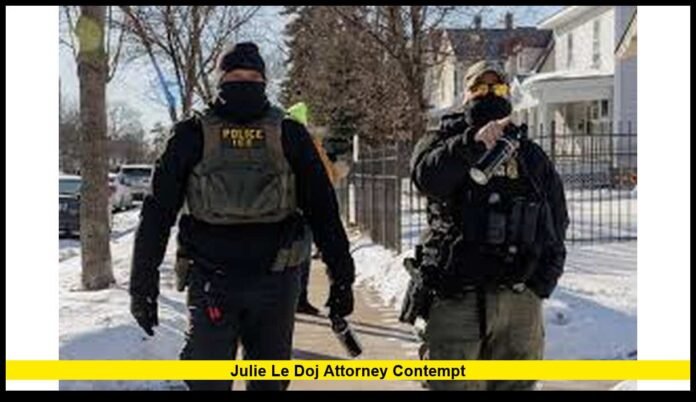

In a dramatic federal courtroom exchange that has quickly drawn national attention, julie le doj attorney contempt became a trending legal phrase after a Justice Department attorney openly expressed frustration during a high-stakes hearing in Minnesota. The exchange did not involve a formal contempt ruling against her, but her unexpected request to be held in contempt so she could rest highlighted growing pressure inside the federal legal system as immigration cases surge.
The moment unfolded before U.S. District Judge Jerry R. Blackwell during a hearing addressing repeated delays in complying with court orders requiring the release of immigration detainees. What followed was an unusually candid admission from a government lawyer grappling with an overwhelming workload.
A Tense Federal Court Hearing
The hearing centered on concerns that Immigration and Customs Enforcement had failed to promptly follow judicial orders mandating the release of certain detainees. The court examined multiple cases in which release directives were either delayed or not carried out as quickly as required.
Julie Le, who had been detailed to assist the U.S. Attorney’s Office in handling a surge of habeas corpus petitions, addressed the court directly. During the exchange, she described the strain placed on attorneys tasked with managing the growing volume of emergency filings.
In a striking moment, Le stated that the system was deeply strained and expressed personal exhaustion. She told the judge she wished to be held in contempt so she could get 24 hours of sleep. Her remarks stunned observers and underscored the intensity of the legal and logistical challenges facing federal attorneys.
Importantly, the court did not hold her in contempt. The statement was widely understood as an expression of frustration rather than an act of defiance.
The Backdrop: A Surge in Immigration Litigation
The courtroom exchange occurred amid a sharp increase in federal immigration enforcement activity that has triggered a flood of habeas corpus petitions. These petitions challenge the legality of detention and demand judicial review.
The sudden spike in filings has placed heavy demands on federal courts and government attorneys. Judges have emphasized that compliance with release orders must occur without delay, especially when constitutional rights are involved.
In the Minnesota district alone, dozens of cases required immediate attention. Court records indicate that multiple release orders had not been executed as swiftly as the judiciary expected. That pattern prompted closer scrutiny from the bench.
As judges pressed for answers, government representatives pointed to staffing shortages, administrative hurdles, and coordination challenges between agencies.
Judicial Frustration Over Compliance
Judge Blackwell made clear during the hearing that federal agencies must comply fully and promptly with court orders. The judiciary has consistently reinforced that no agency stands above the law.
When detainees receive release orders, courts expect immediate action. Delays can raise serious constitutional concerns, particularly in cases involving due process rights.
The hearing explored why compliance gaps occurred. Attorneys representing the government explained that the rapid pace of filings and operational constraints contributed to delays. However, judges stressed that workload challenges do not excuse failure to follow binding court directives.
This tension formed the heart of the exchange that led to the now widely discussed phrase julie le doj attorney contempt.
Who Is Julie Le?
Julie Le has experience representing Immigration and Customs Enforcement in legal proceedings. She volunteered to assist the U.S. Attorney’s Office as caseloads intensified in Minnesota.
Her role involved responding to emergency petitions and representing the government during federal court hearings. The sudden influx of cases required attorneys to work extended hours while navigating complex procedural requirements.
Le’s candid remarks reflected the strain facing government lawyers assigned to high-volume immigration litigation. Colleagues have described the workload as unusually demanding, particularly given the urgency attached to habeas proceedings.
Office Turnover and Staffing Pressure
The Minneapolis U.S. Attorney’s Office has experienced notable staffing challenges in recent months. Several attorneys have departed amid broader disagreements about immigration enforcement strategies and policy direction.
Staff reductions and reassignments have intensified pressure on those remaining. As case numbers climbed, attorneys found themselves managing multiple emergency filings simultaneously.
Legal professionals note that habeas petitions require rapid review because they challenge the legality of detention. Courts often schedule hearings within days, leaving limited preparation time.
This environment helps explain the emotional intensity displayed during the hearing.
Broader Legal Implications
The exchange highlights larger systemic questions about immigration enforcement, judicial authority, and interagency coordination.
Federal courts serve as a check on executive enforcement actions. When judges issue release orders, agencies must act swiftly to comply. Any breakdown in that process raises constitutional concerns.
At the same time, large-scale enforcement operations can generate administrative burdens. Transport logistics, detainee processing, and jurisdictional issues sometimes complicate implementation.
The hearing brought those competing realities into sharp focus.
Legal scholars emphasize that contempt findings are serious matters typically reserved for willful noncompliance. In this case, no contempt sanction was imposed on Le. The judge’s inquiry focused on ensuring future compliance rather than punishing individual attorneys.
Public Reaction and National Attention
The unusual courtroom exchange quickly gained national attention. Many observers viewed Le’s statement as a human moment that revealed the pressures faced by government lawyers. Others focused on the broader issue of compliance with judicial orders.
The phrase julie le doj attorney contempt began circulating widely as commentators debated the implications of the exchange.
Some legal analysts framed the moment as evidence of institutional stress within federal immigration litigation. Others argued it demonstrated the judiciary’s determination to enforce constitutional protections even amid operational strain.
Despite differing interpretations, the core facts remain clear: a federal judge questioned compliance delays, a DOJ attorney acknowledged system strain, and no formal contempt sanction occurred.
Immigration Enforcement and Judicial Oversight
Immigration enforcement remains one of the most legally contested areas of federal policy. Habeas corpus petitions serve as a critical safeguard, allowing detainees to challenge the legality of their confinement.
Courts reviewing such petitions often require detailed documentation and rapid agency responses. Delays can prompt additional hearings or compliance reviews.
Judges across multiple districts have reiterated that timely execution of release orders is essential to protect due process rights. The Minnesota hearing reinforced that principle.
Moving forward, federal agencies may face continued scrutiny regarding how quickly they implement judicial directives.
What Happens Next?
The court is expected to continue monitoring compliance in pending cases. Judges have authority to impose remedies if agencies fail to act in accordance with court orders.
Meanwhile, the Justice Department will likely review internal coordination procedures to address bottlenecks and staffing gaps.
For now, the julie le doj attorney contempt episode stands as a vivid example of the pressures confronting federal attorneys and the judiciary’s insistence on adherence to constitutional standards.
The exchange serves as a reminder that even routine procedural hearings can expose deeper structural challenges within the legal system.
As immigration litigation continues at a fast pace, courts and federal agencies must navigate the delicate balance between enforcement objectives and constitutional safeguards.
What are your thoughts on this courtroom moment and its broader impact? Share your perspective in the comments and stay tuned for further updates.