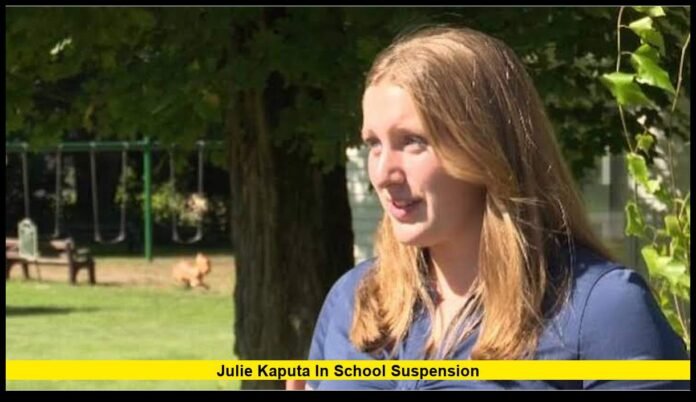

Julie Kaputa in school suspension became a notable school-policy story after a senior at Beaver River Central School received an in-school suspension for bringing coffee to class. The incident took place on September 3, 2026, the first day of the new school year, and quickly raised questions about a newly introduced restriction involving outside food and beverages.
The incident has since developed beyond the original classroom disciplinary action. Kaputa and her mother, MaryAnne Kaputa, questioned whether the school district had followed the required process when introducing the new rule. The district has acknowledged a problem with how an earlier public hearing was announced and has scheduled another hearing on the 2026-27 Student Code of Conduct.
As of September 13, the next major development is the public hearing scheduled for September 14. No final decision on the policy has been confirmed before that meeting.
What Happened on the First Day of School?
Kaputa, a senior at Beaver River Central School in Castorland, New York, arrived for the first day of the 2026-27 school year with a cup of coffee.
The coffee became an issue when she entered her first-period classroom.
Her teacher told her that she had several options. She could dispose of the drink, finish it immediately, or go to the school office. Kaputa chose to go to the office.
She then received an in-school suspension for violating the school’s new restriction on outside food and beverages.
The disciplinary action did not remove her from school for an extended period. Kaputa has also indicated that the suspension will not become part of her permanent record.
What initially appeared to be a relatively minor classroom-rule violation soon developed into a larger dispute involving the district’s policy-making process.
The New Rule at the Center of the Dispute
The 2026-27 Student Code of Conduct introduced restrictions concerning outside food and beverages.
The district has explained that the policy was created to help maintain a safe and distraction-free educational environment.
School officials have also pointed to concerns involving allergies and fairness among students.
Food and drinks can create practical challenges in classrooms. Spills can interrupt lessons, food can become a distraction, and some students may have allergies or sensitivities that require additional precautions.
Those considerations formed part of the district’s explanation for the new restriction.
Kaputa’s concern, however, moved in another direction. Rather than focusing only on whether coffee should be permitted, she and her mother began examining how the new requirement had been approved.
That question became the central issue surrounding the suspension.
Why Kaputa Questioned the Policy
Kaputa and her mother looked into the district’s meeting process after the suspension.
They questioned whether the community had received the proper opportunity to discuss the new conduct requirement before it became effective.
Their concern centered on a public hearing requirement connected to the Student Code of Conduct.
The family could not identify a properly announced public hearing that had taken place before the new restriction was enforced.
That prompted them to raise the issue with district officials.
The dispute therefore shifted from an individual student-discipline matter to a question about transparency and procedure.
Kaputa’s position has been that the process matters even if the district has legitimate reasons for establishing the rule.
Superintendent Addresses the Controversy
Beaver River Central School Superintendent Todd Green became involved as the questions surrounding the rule developed.
Green said the district had viewed its August Board of Education meeting as serving as the required public hearing.
He later acknowledged that the meeting had not been properly announced as a public hearing.
That acknowledgment was significant because it addressed the specific procedural concern raised by Kaputa and her mother.
The district has continued to explain the reasoning behind the outside food and beverage restriction while also moving toward a formal hearing on the Student Code of Conduct.
The response means the district is now addressing the policy through a publicly scheduled meeting rather than leaving the issue tied only to the original disciplinary incident.
Kaputa’s Suspension Was an In-School Suspension
The type of disciplinary action is an important part of understanding the case.
Kaputa received an in-school suspension.
She was not given an out-of-school suspension as a result of bringing the coffee to class.
Kaputa has also said the incident will not appear on her permanent record.
Those details put the disciplinary action in context.
The controversy is not centered on a severe disciplinary penalty. Instead, attention has focused on the new conduct rule, the circumstances surrounding its enforcement and whether the district followed the appropriate process before implementing it.
Kaputa has also said she is not angry with the district.
Her concerns have focused on making sure the school system follows the procedures expected when it introduces rules affecting students.
The Role of MaryAnne Kaputa
MaryAnne Kaputa became involved after her daughter raised concerns about the policy.
The two examined the district’s public meeting information and questioned whether the required hearing process had been properly followed.
Their concerns did not stop at the question of whether Julie should have been allowed to keep her coffee.
They wanted clarification about when the new rule had been presented to the public and whether students and families had been given a meaningful opportunity to comment.
That approach helped broaden the issue.
Instead of remaining a disagreement between one student and a teacher, the matter became a discussion involving the school district, its board and the public process surrounding student conduct rules.
The District’s Reason for Restricting Outside Drinks
The school district has defended the purpose behind the new restriction.
Officials have described the rule as part of an effort to create a safe and distraction-free learning environment.
Outside beverages can create classroom management issues. Teachers may need to address spills, interruptions or repeated requests involving food and drinks.
Allergies also create a concern in school settings.
The district has additionally cited fairness as a consideration. A consistent policy can establish the same expectations for students rather than allowing different classroom practices.
Those reasons explain why the district introduced the restriction.
They do not, however, resolve the separate question about the procedure used to adopt the policy.
That distinction remains central to the current dispute.
The September 14 Public Hearing
The Beaver River Central School District has scheduled a public hearing for September 14, 2026.
The hearing concerns the 2026-27 Student Code of Conduct.
The meeting is scheduled for 6 p.m. in the Choral Room during the regular Board of Education meeting.
The hearing represents the district’s next formal step after the questions surrounding the earlier process.
It also gives the school community an opportunity to address the conduct code.
Students are expected to have an opportunity to provide input as well.
For Kaputa, this is particularly relevant because her original concern involved the lack of a properly announced opportunity for public discussion.
What the Hearing Could Address
The hearing is expected to focus on the Student Code of Conduct rather than only on Kaputa’s individual suspension.
The outside food and beverage provision is likely to remain an important part of the discussion because it triggered the controversy.
Members of the school community may also raise broader questions about how conduct policies are introduced and communicated.
The board will have the opportunity to hear those concerns and consider the policy moving forward.
However, the outcome cannot be stated in advance.
As of September 13, there is no confirmed decision showing that the restriction has been permanently removed, changed or upheld.
Reporting a specific result before the hearing would therefore be inaccurate.
Why the Policy Process Matters
Student conduct codes establish rules that affect the daily school experience.
A change to such a code can influence what students can bring into classrooms, how teachers enforce expectations and how families understand school requirements.
That makes the process used to introduce those rules important.
Kaputa’s case highlights this distinction clearly.
The school district believes the restriction serves legitimate educational and safety purposes. Kaputa and her mother have questioned whether the district completed the appropriate public process.
Both aspects are now part of the story.
The September 14 hearing gives the district and community a formal setting in which to address the issue.
What Is Confirmed About the Case?
Several details are established as of September 13.
Kaputa is a senior at Beaver River Central School.
She received an in-school suspension after bringing coffee to class on September 3, the first day of the 2026-27 school year.
The disciplinary action followed enforcement of a new restriction on outside food and beverages.
Kaputa and her mother questioned whether the required public-hearing process had been properly followed.
Superintendent Todd Green acknowledged that an earlier district meeting had not been properly announced as the required public hearing.
The district has now scheduled a public hearing for September 14.
That hearing will address the 2026-27 Student Code of Conduct.
The meeting is scheduled for 6 p.m. in the Choral Room.
These details provide the clearest picture of the case before the scheduled hearing.
What Has Not Been Decided Yet
It is equally important to identify what remains unresolved.
There is no confirmed final decision as of September 13 about whether the outside food and beverage restriction will remain unchanged.
There is also no confirmed outcome from the September 14 hearing because the meeting has not yet taken place.
The district’s next decision could follow public discussion and consideration by the Board of Education.
Until that process is complete, claims about a permanent change to the rule should not be treated as established facts.
The available information supports a narrower conclusion: the district has acknowledged the earlier public-hearing issue and has scheduled a formal hearing on the conduct code.
Kaputa’s Return to Class
The dispute did not result in Kaputa remaining away from school.
After discussions surrounding the incident, she returned to class.
Reports about the situation have also indicated that she was later allowed to have her coffee.
That development reduced the immediate classroom conflict but did not settle the larger policy question.
The focus instead moved toward the Student Code of Conduct and the district’s public-hearing process.
This distinction is important because the original incident and the continuing policy discussion are related but not identical.
The coffee started the dispute. The policy process is now driving the public discussion.
The Broader Student-Policy Question
The situation at Beaver River Central School has drawn attention because it shows how a small classroom incident can expose larger questions about school policy.
For students, rules are part of everyday school life.
For administrators, those rules help establish consistent expectations.
For families, the process behind those rules can be just as important as the rules themselves.
Kaputa’s case brings those interests together.
The district has explained why it wanted limits on outside food and drinks. Kaputa has questioned whether students and families received the proper opportunity to discuss the change.
The upcoming hearing provides a chance to address that disagreement in a formal setting.
Latest Status Before the September 14 Hearing
As of September 13, 2026, the case remains unresolved.
Kaputa received an in-school suspension after bringing coffee to class on the first day of school. The incident involved the district’s new outside food and beverage restriction.
Her mother joined her in questioning whether the policy had been properly introduced.
Superintendent Green acknowledged that the district’s earlier meeting was not properly announced as the required public hearing.
The district has responded by scheduling a public hearing on the 2026-27 Student Code of Conduct for September 14 at 6 p.m.
That meeting is now the key next step.
Any final decision regarding the conduct rule should be reported only after the district formally addresses the matter.
For now, the case remains focused on a simple classroom incident that has raised a larger question about how student rules are created, communicated and reviewed.
Stay tuned for the next confirmed development in the Beaver River school policy dispute, and share your thoughts on the case in the comments.