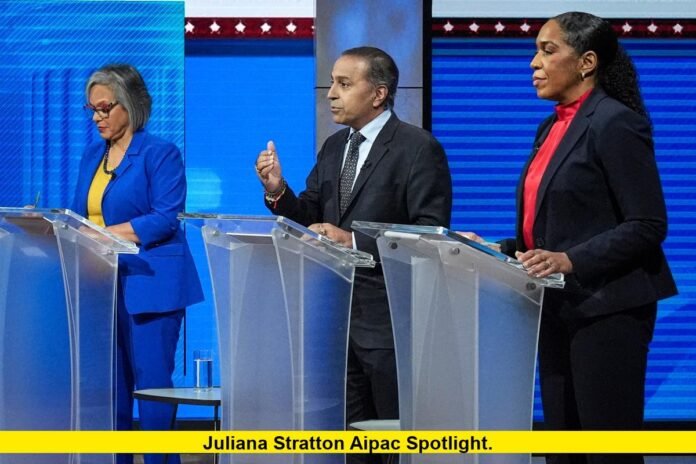

Illinois Lieutenant Governor Juliana Stratton pulled off one of the most closely watched primary upsets of the 2026 election cycle Tuesday night, defeating two sitting members of Congress to claim the Democratic nomination for the U.S. Senate. The race, defined from the start by questions about AIPAC donor money, super PAC flooding, and the future direction of the Democratic Party, ended with Stratton on a clear path toward Washington — and with a loud message sent to political operatives across the country.
Want to understand what this win really means for Illinois and for the national Democratic Party? Read on.
A Historic Win for Illinois
Stratton defeated Rep. Raja Krishnamoorthi and Rep. Robin Kelly in the Democratic primary to fill the seat being vacated by retiring Sen. Dick Durbin, one of the longest-serving members of the Senate. If she wins the general election in November — which is widely expected, given Illinois has not sent a Republican to the Senate since the 1990s — Stratton would become the sixth Black woman ever elected to the United States Senate. That milestone energized voters across Chicago and Cook County, where she ran up her margins and built an insurmountable lead.
Her Republican opponent in the general election is Don Tracy, the former Illinois Republican Party chair, who won his own primary Tuesday night.
The AIPAC Question That Dominated the Campaign
No issue followed Stratton through this race more persistently than her ties to donors connected to AIPAC — the American Israel Public Affairs Committee. While AIPAC did not formally endorse Stratton or spend directly in the Senate race, at least 27 major donors to the pro-Israel lobby contributed to her campaign, totaling more than $70,000 according to Federal Election Commission filings. Only a small number of those donors live in Illinois.
Perhaps more notable, Lee Rosenberg — a former AIPAC president, longtime political adviser to Gov. JB Pritzker, and a former adviser to President Barack Obama — sat on Stratton’s campaign finance committee. That detail put the question of AIPAC’s influence squarely into the race, even without a direct organizational endorsement.
Stratton’s campaign responded by emphasizing that AIPAC had neither endorsed her nor spent money on her behalf. When pressed about whether she would accept funds from an AIPAC-affiliated group, Stratton drew a clear line: she said she had not accepted money from the PAC itself. She also stated her support for a two-state solution for Israel and Palestine, positioning herself as a candidate capable of navigating the issue without endorsing either extreme.
$50 Million and Counting: The Super PAC Tsunami
Beyond the AIPAC questions, the Illinois primaries became a staggering showcase of outside money in American politics. More than $50 million in outside spending poured into Chicago-area congressional and Senate races, turning the state into a real-world laboratory for testing how much money can actually buy in a modern Democratic primary.
In the Senate race alone, Krishnamoorthi had raised roughly $30 million in campaign funds — one of the largest war chests among any federal candidate in the country this cycle. That money came in part from a crypto-industry super PAC with past ties to supporters of President Donald Trump, which drew sustained criticism from Stratton’s campaign. She hammered Krishnamoorthi repeatedly for taking what she called “MAGA-backed crypto PAC” money.
Meanwhile, the crypto industry’s super PAC Fairshake spent close to $10 million in direct attacks against Stratton. Gov. Pritzker, who served as both Stratton’s boss and one of her most powerful political allies, helped fund Illinois Future PAC, which spent heavily to boost her while targeting Krishnamoorthi. The combined outside spending across the race ran into the tens of millions from groups spanning the pro-Israel lobby, the cryptocurrency industry, artificial intelligence investors, labor unions, and progressive organizations.
How Stratton Actually Won
The turning point in the race came months before Election Day. A debate performance in January where Stratton went sharply on the offensive against Krishnamoorthi shifted the momentum in her direction. She positioned herself as the most progressive candidate in the field without hesitation — calling for the abolition of ICE, Medicare for All, and a $25 federal minimum wage. She also made clear she would not support Sen. Chuck Schumer continuing to lead the Senate Democratic caucus, telling voters the moment called for “fighters, not folders.”
Sen. Elizabeth Warren stumped for Stratton in the final days of the race, rallying supporters with a pointed message about super PAC money threatening the integrity of Illinois elections. Warren called the state a national test case for whether big-money interests could still buy their preferred outcomes in deep-blue Democratic primaries.
The answer, at least in the Senate race, came back as a firm no.
AIPAC’s Broader Night in Illinois
While Stratton’s victory drew the most national attention, AIPAC had a complicated night across the state. The organization and its affiliated PACs — operating through groups with deliberately low-profile names like “Elect Chicago Women” and “Chicago Progressive Partnership” — spent more than $22 million across multiple House primaries in and around Chicago. Their results were mixed. In some races, AIPAC-backed candidates won. In others, heavily funded challengers fell short despite the financial advantage.
After Stratton’s win was called, AIPAC publicly congratulated her — a notable moment given the tension her campaign had maintained throughout the race over her association with the group’s donor network.
What November Looks Like
With the Democratic primary decided, Stratton heads into the general election as the heavy favorite. Illinois Democrats have dominated Senate elections in the state for decades. The combination of her historic potential — becoming the sixth Black woman ever elected to the Senate — and a deeply Democratic state electorate makes her path to victory in November a straightforward one.
She will carry with her a progressive platform built on healthcare, immigration, and worker protections, and a campaign narrative defined by her willingness to fight both establishment money and Republican attacks head-on.
The general election is set for November 3, 2026.
Do you think Stratton’s progressive platform will strengthen or complicate her path in November — and what does this race tell us about the future of Democratic politics? Share your thoughts in the comments below and keep following this story as it develops.