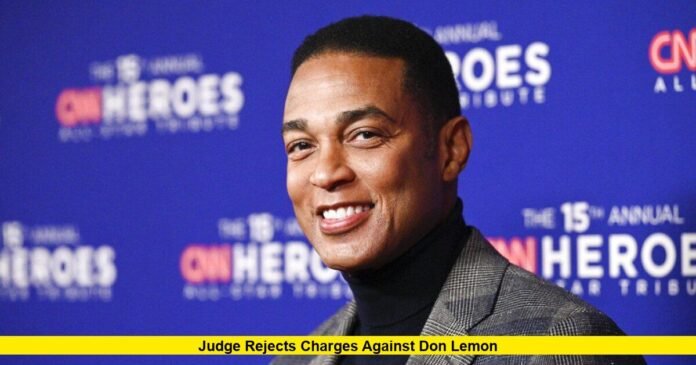

A federal magistrate judge has ruled that judge rejects charges against Don Lemon in connection with a high-profile protest inside a Minnesota church, blocking prosecutors from moving forward and triggering a nationwide debate over press freedom, protest rights, and the limits of government authority.
The decision, issued this week in St. Paul, halted an attempt by federal authorities to pursue criminal charges against the veteran journalist following his presence at, and live coverage of, a disruptive protest during a Sunday worship service. The ruling is being closely watched by legal scholars, civil liberties advocates, and media organizations because of its rare procedural outcome and its broader implications for journalists covering politically charged events.
The Incident That Sparked the Case
The controversy began when a group of demonstrators entered a church in Minnesota during a Sunday service to protest immigration enforcement practices. The demonstration targeted the church because one of its leaders also serves in a senior regional role with federal immigration authorities.
The protest centered on public outrage following a fatal law enforcement encounter involving an immigration officer and a Minnesota resident earlier this month. Activists said the location was chosen to draw attention to what they described as the blending of religious leadership and federal enforcement power.
Don Lemon, who has transitioned into independent journalism after years as a national television anchor, attended the service and livestreamed the unfolding events. His footage showed chanting, verbal confrontations, and church members attempting to continue the service amid the disruption.
Law enforcement later arrested several protest organizers. Prosecutors then sought to include Lemon in a federal complaint, arguing that his actions inside the church went beyond reporting and constituted participation in an unlawful disruption of religious services.
Why the Judge Rejected the Charges
In federal misdemeanor cases, prosecutors must present evidence to a magistrate judge to establish probable cause before charges can move forward. In this instance, the judge declined to approve the complaint.
Such refusals are uncommon. Magistrate judges routinely authorize complaints when prosecutors present sufficient documentation. A rejection typically signals that the court does not believe the legal standard for probable cause has been met.
By refusing to sign the charging document, the judge effectively blocked the case at its earliest stage. Without that approval, the government cannot proceed unless it pursues an alternate legal route, such as seeking an indictment from a grand jury.
Legal analysts note that the decision suggests the court found the evidence insufficient to show that Lemon committed a prosecutable offense under federal law.
Press Freedom at the Center of the Debate
A key issue in the case was whether Lemon’s actions constituted journalism or participation in the protest itself.
Lemon has maintained that he was present solely to document a newsworthy event. His legal team argued that he did not organize the protest, direct participants, or interfere with law enforcement. Instead, they said, he performed the same function journalists routinely carry out at demonstrations, political rallies, and public disturbances across the country.
The court’s decision to reject the charges has been widely interpreted as an affirmation of the principle that journalists cannot be criminally targeted simply for being present at controversial events, provided they are engaged in newsgathering rather than unlawful conduct.
This distinction is critical in modern media, where livestreaming and real-time reporting blur traditional lines between observer and participant. The ruling underscores that proximity to protest activity does not automatically equate to criminal liability.
Religious Freedom and Public Protest
The case also raised complex questions about the right to worship without disruption versus the right to protest in spaces associated with public officials.
Church leaders said the demonstration interfered with their congregation’s ability to hold a peaceful service and argued that federal law protects religious assemblies from obstruction. Prosecutors initially explored whether the protest violated statutes related to interference with civil rights and freedom of religious exercise.
However, the judge’s refusal to authorize charges against Lemon indicates that, at least in his case, the legal threshold for criminal responsibility was not met.
What Prosecutors Can Still Do
Although the complaint was rejected, the decision does not permanently bar prosecution reminder. Federal authorities retain several options:
- They may present evidence to a grand jury and seek an indictment.
- They could submit a revised complaint with additional evidence.
- They may focus prosecution efforts solely on the individuals accused of organizing and leading the protest.
Whether they pursue any of these paths remains uncertain. The judge’s ruling, however, represents a significant setback and signals judicial skepticism about the strength of the case against a journalist acting in a reporting capacity.
Political and Legal Reactions
The ruling has intensified discussions in Washington and beyond about how aggressively the government should pursue cases arising from protests, particularly when journalists are involved.
Civil liberties advocates argue that attempts to prosecute reporters for covering demonstrations threaten the First Amendment and could deter journalists from reporting on contentious issues such as immigration, policing, and civil rights.
Supporters of stronger enforcement, meanwhile, contend that religious services deserve heightened protection and that disruptions should carry consequences regardless of who is present.
The court’s decision places the judiciary squarely in the role of arbiter between these competing principles, emphasizing the need for clear evidence before a journalist can be drawn into criminal proceedings.
Don Lemon’s Position
Following the ruling, Lemon reiterated that he was present in a professional capacity and that his goal was to document an event of public interest. He emphasized his long career covering protests, court proceedings, and government actions, and said that journalism depends on the ability to observe and report without fear of prosecution.
His legal team welcomed the judge’s decision, describing it as a reaffirmation that reporting on controversial events is protected activity under the Constitution.
Broader Implications for Journalists
The outcome of this case may influence how law enforcement and prosecutors approach future situations involving media coverage of protests in sensitive locations such as courthouses, government buildings, and places of worship.
With the rise of independent journalism and livestreaming, reporters are increasingly embedded in the very events they cover. Courts are now being asked to draw precise lines between observation and participation.
The ruling in this case suggests that judges will closely scrutinize efforts to cross that line, particularly when the evidence does not clearly demonstrate criminal intent or action by the journalist.
A Rare Judicial Check on Prosecution
It is unusual for a magistrate judge to halt a case at the charging stage. Most complaints are approved with minimal procedural friction. That is why the decision that a judge rejects charges against Don Lemon has drawn such widespread attention.
The ruling highlights the judiciary’s role as a gatekeeper, ensuring that criminal cases meet constitutional and evidentiary standards before individuals are subjected to prosecution.
In a climate of heightened political polarization and frequent protests, this decision may serve as a reference point for future cases involving the press, public demonstrations, and federal authority.
What Comes Next
The legal process surrounding the church protest is still unfolding for those who were arrested at the scene. Their cases will proceed separately through the courts.
As for Lemon, the immediate threat of federal charges has been removed, though prosecutors retain theoretical options. For now, the judge’s refusal stands as a decisive moment that reinforces protections for journalists operating in contentious environments.
The case is expected to be cited in ongoing discussions about the balance between civil liberties, religious freedom, and the public’s right to know.
The legal spotlight is far from fading, and this ruling ensures the conversation about protest, press rights, and accountability is only just beginning—share your thoughts and stay tuned for what happens next.