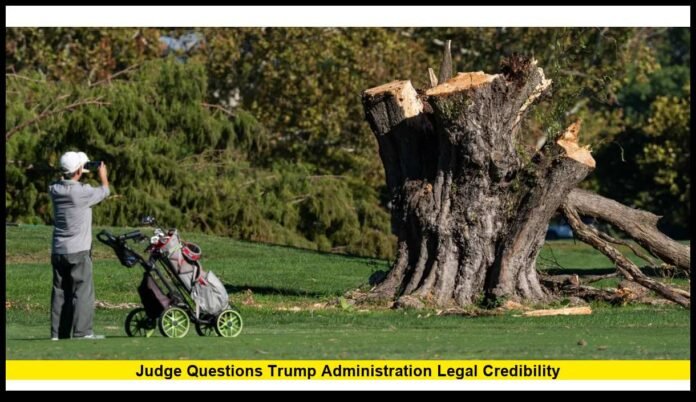

The judge questions trump administration legal credibility as a high-profile federal court dispute over the redevelopment of East Potomac Golf Links in Washington, D.C., draws attention to government transparency, judicial independence, and the limits of executive authority. The case centers on the removal of hundreds of trees from a historic public golf course, conflicting explanations about the work, and a legal challenge to the administration’s plans for the property.
U.S. District Judge Ana C. Reyes has pressed government lawyers to explain whether the tree removal was genuinely separate from President Donald Trump’s proposed renovation plans. Her scrutiny has intensified as the administration defends its actions and challenges the judge’s continued involvement in the case.
The dispute raises questions that extend beyond a golf course. It highlights the importance of accurate representations in federal court, compliance with judicial instructions, and the procedures government agencies must follow when pursuing changes to public property.
Why the East Potomac Golf Course Dispute Is Attracting Attention
East Potomac Golf Links occupies a prominent location in Washington, D.C., on a peninsula surrounded by the Potomac River and Washington Channel. Its public recreational facilities and historic landscape have made it an important part of the capital’s outdoor environment.
The Trump administration has pursued plans to improve and transform the golf facility, presenting the project as an opportunity to create a more prestigious golfing destination. Supporters of the proposal argue that upgrades could improve the property and attract greater attention to the course.
Opponents have raised concerns about the scope of the proposed changes, the removal of trees, and the potential consequences for a historically significant public landscape. Their legal challenge seeks to ensure that the administration follows the rules governing the property before making changes that could be difficult or impossible to reverse.
The controversy escalated when hundreds of trees were removed while litigation was underway. That development prompted questions about the relationship between the tree-cutting work and the larger redevelopment proposal.
The court’s involvement has made the distinction between routine maintenance and work connected to a broader construction project particularly important. The administration maintains that the tree removal had a separate justification, while the judge has scrutinized whether that explanation accounts for the timing and scale of the work.
The resulting legal dispute now involves more than the future appearance of the golf course. It concerns the evidence supporting the government’s decisions and whether the administration has adequately followed the requirements imposed during the litigation.
Judge Ana Reyes Examines the Government’s Explanation
Judge Ana C. Reyes, who serves on the U.S. District Court for the District of Columbia, has questioned government attorneys about the administration’s account of the tree removal.
The administration has argued that the work was supported by a 2019 National Park Service landscape report addressing trees that were dead, dying, or hazardous. Under that explanation, the removal was associated with existing landscape-management concerns rather than being solely an element of the proposed golf course renovation.
Reyes has questioned whether that account adequately explains the extent of the work and its timing.
The judge has also examined the relationship between statements made publicly by Trump and the position presented by government lawyers. The president has spoken about the proposed transformation of the golf course, while attorneys for the administration have maintained that the formal redevelopment plan had not been finalized because agency review remained incomplete.
That difference has become a central issue in the proceedings.
There can be legitimate distinctions between a president’s announced policy objectives and a project’s formal status under federal administrative procedures. A public announcement does not necessarily mean that every permit, environmental review, or agency approval has been completed.
However, when a court is asked to evaluate whether work has proceeded lawfully, those distinctions must be explained clearly and supported by evidence.
The judge’s questions therefore focus on whether the government’s legal account is consistent with the facts available to the court. They do not, by themselves, establish that government officials knowingly provided false information.
What Happened During the October 19 Hearing?
The October 19, 2026, hearing marked a significant point in the dispute. Judge Reyes questioned government representatives about the removal of more than 500 trees and the status of the proposed redevelopment.
The lengthy hearing reflected the complexity of the issues facing the court. The parties had to address the justification for the tree removal, the relationship between the work and the proposed renovation, and the requirements governing actions taken while the litigation remained active.
Reyes sought clarification about why the government characterized the redevelopment as unfinished when the president had publicly described plans to move forward with improvements.
The administration’s lawyers defended the government’s position. They maintained that the tree removal was connected to an earlier landscape report and argued that the formal redevelopment process had not been completed.
The court must distinguish between evidence of a possible inconsistency and proof of a legal violation. A judge may question a party’s explanation, request supporting documents, or express doubts about an argument without issuing a final finding of misconduct.
That distinction is essential to understanding the current status of the case.
The October 19 hearing did not resolve every question concerning the golf course project. Instead, it brought the disagreements into sharper focus and left the underlying legal dispute to be addressed through further proceedings and court decisions.
Why the Justice Department Asked the Judge to Recuse Herself
The controversy took another turn when the Justice Department sought Reyes’s recusal, asking her to withdraw from the case.
The administration argued that the judge’s conduct and comments demonstrated bias against the government. The request raised a separate legal question: whether the judge’s handling of the proceedings provided a sufficient basis for disqualification.
On October 19, Reyes rejected the recusal request. She concluded that the administration had not demonstrated the legal grounds necessary to remove her from the case and criticized the government’s reliance on selected portions of her remarks.
The decision means that Reyes remains responsible for the litigation unless a subsequent legal development changes the situation.
Recusal is an important safeguard in the federal judicial system. Judges must avoid situations in which their impartiality could reasonably be questioned. At the same time, a party cannot ordinarily obtain a different judge simply because it disagrees with the court’s questions, decisions, or interpretation of the evidence.
The relevant standards require an assessment of the circumstances under applicable law rather than a determination based solely on political disagreement.
The rejection of the recusal request does not settle the legality of the redevelopment or establish whether the government violated an earlier order. It addresses the separate issue of whether Reyes should continue presiding over the case.
Trump’s Criticism and Concerns About Judicial Independence
President Trump has sharply criticized Reyes over her handling of the dispute, using personal insults to attack the judge and questioning her approach to the case.
The president has defended the administration’s renovation plans and argued that improvements to the property are justified. His public comments have added a political dimension to the legal proceedings.
During the October 19 hearing, Reyes also disclosed that she had received reports of death threats connected to the case. The disclosure underscored the personal risks that can accompany highly contentious litigation involving prominent political figures.
Judicial independence depends on judges being able to make decisions according to the law and evidence without intimidation. That principle applies regardless of whether a judge’s decisions favor or disadvantage a sitting president.
Public officials remain free to criticize judicial rulings through lawful channels, including appeals and formal legal arguments. However, criticism does not replace the legal process, and threats against judges raise serious concerns about the safety of the judicial system.
The same standards of fairness must apply to the administration and the judge. Trump’s criticism does not establish that the judge is biased, just as Reyes’s skepticism about the government’s explanation does not establish that the administration acted unlawfully.
The case must ultimately be resolved through evidence, legal arguments, and judicial decisions.
The Legal Issues That Could Shape the Outcome
Several interconnected questions could influence the next stages of the litigation.
Compliance With Court Orders
One major issue is whether the administration followed the court’s instructions regarding advance notice before making significant changes to the property.
Court orders are legally binding. Government agencies must understand their requirements and ensure that their actions comply with them while litigation is pending.
The precise wording of the relevant orders, the actions taken by officials, and the evidence about when decisions were made will be important in determining whether a violation occurred.
Environmental and Historic-Preservation Requirements
The dispute also involves concerns about environmental review and the protection of historic resources.
Federal projects can be subject to procedural requirements designed to ensure that agencies evaluate potential consequences before proceeding with certain actions. Which requirements apply depends on the project’s circumstances, the agencies involved, and the relevant legal framework.
The plaintiffs must establish the legal basis for the relief they seek, while the administration must explain why its actions comply with the applicable requirements.
The Relationship Between Tree Removal and Redevelopment
The government’s explanation that the tree removal was based on a 2019 landscape report is another important issue.
The court must evaluate whether the report adequately supports the work that occurred and whether the timing and scale of the removals are consistent with the administration’s stated rationale.
If the evidence supports the government’s account, that could strengthen its position. If important inconsistencies emerge, the court may consider whether additional explanations, restrictions, or other remedies are appropriate under the law.
Executive Authority and Agency Responsibilities
The administration also maintains that it has the authority to improve the golf course.
That argument must be considered alongside the responsibilities of the agencies managing the property and any applicable legal limitations. Executive authority does not eliminate the need to comply with statutory requirements or valid judicial orders.
The ultimate outcome may depend on how the court interprets those responsibilities and evaluates the evidence concerning the work already completed.
What the Case Means for the Trump Administration
The dispute illustrates the practical difficulties that can arise when an administration pursues a major project while facing an active legal challenge.
Government officials may have a clear policy objective, but they must still follow the procedures that govern the project. If a court imposes restrictions or requires advance notice, officials must take those obligations into account before proceeding.
The controversy also demonstrates the importance of consistency between public statements and formal court representations.
Presidential announcements often communicate broad objectives, while legal filings describe a project’s procedural status in more specific terms. Those accounts do not automatically conflict, but differences can become significant when a court must determine whether government actions were lawful.
For the administration, credibility depends on providing accurate explanations, producing evidence that supports its claims, and demonstrating compliance with judicial requirements.
For the plaintiffs, success depends on establishing that the challenged actions violate applicable law and that judicial intervention is justified.
The court’s task is not to decide which side has the stronger political message. It is to determine the legal rights and responsibilities of the parties.
Latest Status and What Happens Next
As of the latest verified information available on October 21, 2026, the dispute remains unresolved.
Judge Reyes rejected the Justice Department’s recusal request on October 19 and continued examining the administration’s explanations concerning the tree removal and redevelopment plans.
Restrictions on additional tree removal were reported to remain in place until at least October 26, subject to any subsequent court order. That makes the next stage of the proceedings important for determining what work, if any, may proceed while the legal challenge continues.
The administration continues to defend its position, while opponents seek safeguards against further changes that could cause irreversible harm to the property.
The available reporting does not establish a final judicial finding that the administration deliberately misled the court. The judge’s questioning, the recusal decision, and the underlying legal claims should therefore be treated as distinct developments.
Further proceedings could clarify the status of the redevelopment proposal, the government’s compliance with court instructions, and the legal requirements governing future work.
For now, the dispute remains a closely watched test of how federal courts handle challenges involving executive action, public property, and compliance with judicial oversight.
Why This Legal Dispute Matters Beyond Washington
The East Potomac case has broader significance because it highlights a basic principle of the American legal system: government authority operates within legal boundaries.
Presidents and federal agencies can set priorities, propose projects, and defend their decisions. When those decisions are challenged in court, however, the government must respond to the legal issues presented and comply with valid judicial orders.
The proceedings also illustrate why accurate reporting matters. Questions about credibility are not equivalent to a final finding of dishonesty, and a judge’s skepticism does not automatically establish a violation of law.
The phrase judge questions trump administration legal credibility reflects the central tension in the case: whether the government’s explanations can withstand judicial examination as the court evaluates the evidence surrounding the tree removal and proposed redevelopment.
The coming developments may help clarify the limits of the administration’s authority over the property and determine what safeguards are required while the lawsuit proceeds.
Stay informed as this federal court dispute develops, and share your thoughts in the comments: should government redevelopment projects face stricter judicial oversight when historic public spaces are at stake?