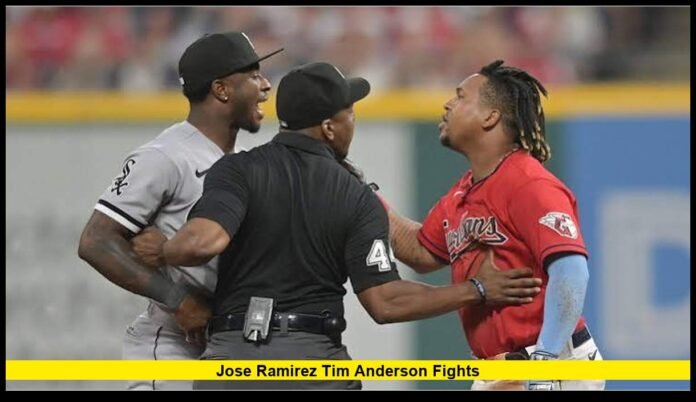

The jose ramirez tim anderson fight became one of the most talked-about incidents in Major League Baseball when a dispute at second base turned into a physical confrontation between the Cleveland Guardians third baseman and Chicago White Sox shortstop on August 5, 2023. The clash interrupted a divisional matchup, brought players and coaches rushing onto the field, and prompted disciplinary action from the league.
Although the game continued after officials restored order, the confrontation quickly became the main story. Its significance extended beyond the punch that knocked Anderson to the ground, raising questions about player conduct, competitive tension and the consequences of losing control during a professional game.
A Routine Baseball Play Turns Confrontational
The incident unfolded during the sixth inning at Progressive Field in Cleveland, Ohio. Ramírez hit an RBI double and slid into second base, where Anderson attempted to complete the tag.
After the play, Ramírez and Anderson exchanged words. The argument intensified as the players stood near the base, with an umpire attempting to keep the situation from escalating.
Anderson dropped his glove and adopted a boxing stance. He threw a punch, but Ramírez avoided it and responded with a right hand that sent Anderson to the ground.
Players from both dugouts and bullpens immediately ran onto the field. What began as a dispute between two infielders developed into a broader confrontation involving multiple members of both teams.
Why Tension Had Been Building Between the Teams
The disagreement did not emerge in isolation. Frustration had developed during the teams’ meetings, with earlier exchanges contributing to an increasingly uncomfortable atmosphere.
A disputed play at second base during the previous day’s game had already created tension. Cleveland manager Terry Francona was ejected during that contest after arguing about the situation.
During the August 5 game, Anderson was also involved in verbal exchanges with Cleveland players. The argument with Ramírez became the point at which the accumulated frustration turned physical.
The exact wording of every exchange was not publicly established, and the players’ interpretations of the disagreement differed. However, the sequence of events made clear that the confrontation involved more than the mechanics of a single tag.
The incident also illustrated how repeated matchups between division rivals can intensify emotions. Teams see one another regularly throughout the season, and disagreements can carry over from one game to the next.
The Fight Leads to a Bench-Clearing Incident
Ramírez’s punch did not immediately end the disturbance. Teammates rushed to separate the players, while other arguments developed around the infield.
White Sox players worked to move Anderson away from the confrontation. Cleveland players also attempted to restrain teammates as officials tried to restore order.
The managers became involved in a heated exchange, adding to the disruption. Guardians closer Emmanuel Clase and other participants also had to be separated from the developing confrontation.
The incident resulted in six ejections: Ramírez, Anderson, Francona, White Sox manager Pedro Grifol, Clase and Cleveland third-base coach Mike Sarbaugh.
The delay attracted widespread attention because baseball fights rarely progress from an argument to a direct exchange of punches in such a short period. Video of the confrontation spread rapidly, making it one of the most recognizable on-field incidents of the season.
Chicago Wins Despite the Disruption
Once the field was cleared and the game resumed, the White Sox maintained their advantage and defeated Cleveland 7-4.
Chicago’s offensive production included a two-run home run from Elvis Andrus, along with solo home runs from Andrew Vaughn, Luis Robert Jr. and Oscar Colás.
White Sox pitcher Michael Kopech had also carried a no-hitter into the sixth inning before Cleveland began producing hits and runs.
Ramírez’s RBI double contributed to Cleveland’s scoring, but the Guardians could not complete a comeback. The final result gave Chicago the victory in a game that became more famous for its confrontation than its statistical achievements.
The outcome remained official despite the ejections and delay. Neither team’s performance after the incident erased the league’s responsibility to review the conduct of those involved.
MLB Issues Suspensions and Fines
Major League Baseball announced penalties following a review of the altercation. Anderson initially received a six-game suspension, while Ramírez was given a three-game suspension.
Other participants also faced consequences. Clase, Grifol, Francona and Sarbaugh each received a one-game suspension. Additional players, including Kopech and Cleveland’s Gabriel Arias, received fines.
Both Anderson and Ramírez appealed their initial suspensions. The appeals process resulted in reduced penalties: Anderson’s suspension was lowered to five games, while Ramírez’s was reduced to two.
Anderson began serving his suspension on August 18, 2023. Ramírez served his penalty during Cleveland’s series against Tampa Bay later that month.
The league’s response underscored its position that physical confrontations can carry consequences for everyone involved, not only the players who exchange punches. Managers and coaches can also be disciplined when their conduct contributes to an incident.
Anderson and Ramírez Respond After the Incident
The aftermath included public comments from both players. Anderson apologized for his behavior in a statement shared on Instagram, addressing the White Sox organization, his teammates, coaches and fans.
He acknowledged that his emotions had affected his actions. He also recognized that frustration during competition did not excuse his conduct.
Ramírez expressed regret about the way the disagreement escalated and indicated that he wanted to apologize to Anderson personally.
The responses offered a different perspective on the event from the footage itself. While video showed the physical exchange, the subsequent statements highlighted the consequences that followed for the players and their organizations.
The confrontation did not end either player’s baseball career, but it became a defining off-field talking point associated with their time in the American League Central.
Where the Players’ Careers Went After the Brawl
Ramírez continued as a central figure for Cleveland, maintaining his reputation as an accomplished switch-hitter and one of the Guardians’ most important offensive players. His wider career has included sustained production, power, speed and a prominent role in the team’s lineup.
Anderson’s career took a different direction after his years in Chicago. He played for the Miami Marlins in 2024 and later joined the Los Angeles Angels organization in 2025.
Reports in August 2026 indicated that Anderson had announced his retirement from Major League Baseball following a career spanning the 2016-2025 seasons. That development brought renewed attention to notable moments from his time in the sport, including the Cleveland confrontation.
The fight remains one episode in the histories of both players. Ramírez’s career is broader than the incident, while Anderson’s legacy also includes his 2019 American League batting title and two All-Star selections.
Why the Incident Still Attracts Attention
The jose ramirez tim anderson fight continues to draw interest because the confrontation was sudden, clearly captured on video and followed by formal league discipline. It also involved two recognizable players in a divisional rivalry, giving fans additional context for the dispute.
The incident remains a reminder that emotions can escalate quickly in competitive sports. Umpires, coaches and teammates play an important role in separating players before disagreements become more dangerous.
As of October 2026, the confrontation is a historical MLB incident, rather than a new fight. Its continuing relevance comes from retrospective discussion, renewed interest in Anderson’s career and the enduring visibility of the footage.
Ultimately, the episode is remembered for the punch at second base, the bench-clearing response and the penalties that followed. It also demonstrates how a few seconds of lost composure can overshadow an entire game’s athletic performance.