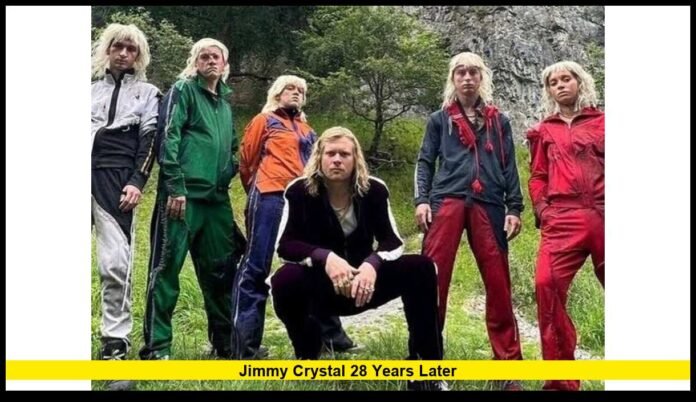

Jimmy Crystal 28 Years Later has become a defining topic in modern horror as audiences absorb the impact of 28 Years Later: The Bone Temple, the latest chapter in the long-running post-apocalyptic saga. The character of Jimmy Crystal, brought to life by Jack O’Connell, stands at the center of this renewed attention, not as an infected monster, but as a fully conscious human threat shaped by decades of societal collapse, fear, and twisted belief.
In a franchise once dominated by sprinting infected and viral terror, Jimmy Crystal represents a darker evolution: the rise of ideology, cult power, and psychological control in a world that never recovered.
The Emergence of a New Kind of Villain
Jimmy Crystal enters the story as the self-styled “Sir Lord Jimmy Crystal,” a title that immediately signals his obsession with authority and symbolic dominance. He leads a group known as the Jimmies, a cult that has formed around his vision of order through submission. His followers dress, speak, and act according to his doctrine, surrendering individual identity in exchange for protection and purpose.
Unlike many antagonists in survival horror, Crystal does not rely on physical mutation. His weapon is belief. His strength comes from the way he reshapes fear into loyalty and obedience. In a world stripped of governments and institutions, he fills the vacuum with ritual, hierarchy, and ruthless enforcement.
A World Ready for Cult Power
By the time the events of The Bone Temple unfold, the Rage Virus has existed for nearly three decades. Generations have grown up knowing nothing but ruins, scarcity, and constant threat. In such conditions, charismatic leadership becomes dangerously attractive.
Jimmy Crystal exploits this vulnerability. He offers structure in chaos and meaning in suffering. His followers are not mindless. They are people broken by loss, seeking certainty in a world where survival is never guaranteed. Crystal’s genius lies in presenting himself as both savior and judge.
His cult operates with:
- Rigid ranks and titles
- Ritualized obedience
- Harsh punishment for dissent
- A belief that violence is purification
This system transforms trauma into devotion, creating a closed society that mirrors the darkest aspects of historical cult movements.
Jack O’Connell’s Performance and Physical Transformation
Jack O’Connell delivers a performance that avoids exaggeration and instead leans into quiet intensity. His Jimmy Crystal speaks calmly, often softly, which makes his commands more unsettling. The stillness of his posture contrasts with the brutality he orders, creating an emotional dissonance that keeps viewers uneasy.
Visually, Crystal’s appearance reinforces his authority. His controlled movements, fixed gaze, and deliberate pacing suggest someone who believes he is chosen, not merely powerful. This is not a man reacting to the apocalypse. He has shaped it into his personal kingdom.
The performance emphasizes:
- Measured speech instead of shouting
- Unblinking confidence in moments of violence
- A sense of spiritual delusion rather than raw rage
- The charisma of a leader who never doubts himself
This approach makes Crystal feel disturbingly plausible, not fantastical.
The Bone Temple as a Symbol of His Mind
Crystal’s stronghold, the Bone Temple, functions as more than a hideout. It is a physical expression of his worldview. Built from remnants of the old world and decorated with symbolic structures, it blends religious imagery with survivalist brutality.
The location reflects:
- Worship through fear
- Power expressed through architecture
- The merging of sacred space and execution ground
- A belief that order must be carved from destruction
Within its walls, followers are indoctrinated, punished, and rewarded. The temple becomes both sanctuary and prison, reinforcing the idea that Crystal’s protection and control are inseparable.
Human Evil Versus Viral Chaos
Earlier installments in the franchise focused on speed, panic, and uncontrollable infection. Jimmy Crystal changes the nature of danger. He represents deliberate cruelty, not instinctive violence.
This distinction is critical. The infected kill because they are driven by disease. Crystal kills because he believes it is necessary. That belief makes him more unpredictable and morally complex.
The contrast highlights:
- Biology versus ideology
- Survival versus domination
- Fear of infection versus fear of control
- Random violence versus organized terror
Through Crystal, the story argues that rebuilding society may introduce new horrors even worse than the old.
Psychological Warfare and Manipulation
One of Crystal’s most disturbing traits is his ability to reframe suffering as purpose. He tells his followers that pain is proof of devotion and that obedience is the only path to safety. This logic traps them in a cycle of dependency.
His leadership relies on:
- Isolation from outside groups
- Repetition of doctrine
- Public punishment to enforce loyalty
- Emotional bonding through shared trauma
These tactics mirror real-world patterns of cult psychology, grounding the horror in recognizable human behavior rather than supernatural elements.
Why Jimmy Crystal Resonates in Modern Culture
For U.S. audiences, the character strikes a nerve because he reflects contemporary fears about charismatic figures rising during times of instability. The story taps into anxieties about how easily people may surrender freedom for security.
Viewers see in Crystal:
- The danger of unchecked authority
- The seduction of certainty during chaos
- The vulnerability of fractured communities
- The thin line between leadership and tyranny
His cult does not feel like fiction alone. It feels like a warning.
Impact on the Franchise’s Direction
With the introduction of Jimmy Crystal, the 28 Years Later universe shifts its focus. The infected remain a threat, but the narrative now gives equal weight to human power structures.
Future storylines are shaped by questions such as:
- What happens when societies rebuild under extremist control?
- Can moral order survive when survival demands brutality?
- Will future generations inherit fear or faith?
Crystal’s existence opens the door to conflicts driven by ideology rather than infection alone.
A Villain Built on Belief, Not Mutation
What ultimately defines Jimmy Crystal is conviction. He does not see himself as cruel. He sees himself as necessary. In his mind, the old world failed, and only absolute control can prevent chaos from returning.
This self-justification makes him more frightening than any monster. He is not driven by hunger or rage, but by a philosophy that justifies domination in the name of order.
His worldview rests on:
- The idea that weakness invites destruction
- The belief that fear creates unity
- The assumption that obedience equals survival
- The conviction that he alone understands the future
Such thinking turns leadership into divinity and dissent into heresy.
Legacy Within the 28 Years Later Universe
Even beyond his immediate actions, Jimmy Crystal leaves a lasting imprint on the world around him. His cult alters trade routes, survivor alliances, and regional power balances. His influence spreads not only through violence but through the fear of his reputation.
Survivors speak of him as:
- A ruler rather than a raider
- A prophet rather than a warlord
- A symbol of organized human darkness
This reputation ensures that his shadow looms over the narrative long after individual battles end.
Why Jimmy Crystal 28 Years Later Marks a Turning Point
The character’s significance lies in what he represents: the next stage of post-apocalyptic evolution. When society collapses, infection is only the beginning. Power, belief, and control rise to replace it.
Jimmy Crystal is the embodiment of that transformation. He is not the end of civilization. He is what grows in its ruins.
The story no longer asks only how people survive. It asks what they become.
What are your thoughts on the rise of Jimmy Crystal and the direction he sets for the future of the 28 Years Later saga? Join the discussion and stay connected as this haunting world continues to evolve.