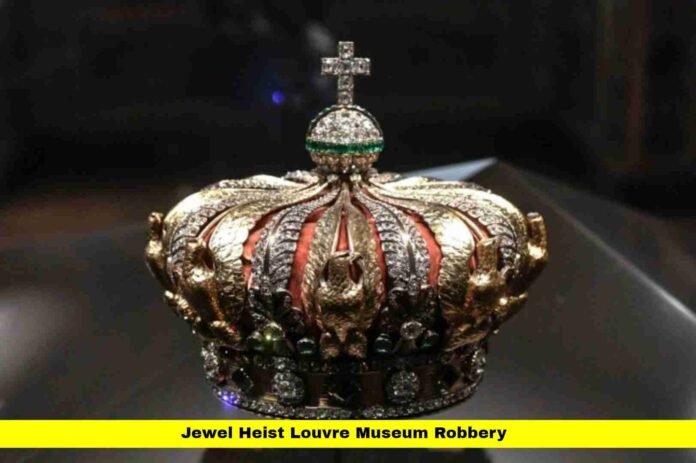

The jewel heist Louvre Museum robbery shocked Paris and the world when eight priceless pieces from the French Crown Jewels were stolen in broad daylight on October 19, 2025. The meticulously planned theft stunned authorities and art lovers alike, highlighting vulnerabilities in one of the world’s most visited cultural institutions.
Key Points Summary
The robbery occurred on the morning of October 19, 2025, at approximately 9:30 a.m. in the Galerie d’Apollon at the Louvre Museum in Paris. The thieves targeted eight pieces, including Empress Eugénie’s diamond tiara, a necklace gifted by Napoleon I, and a sapphire tiara. They gained entry using a mechanical lift to reach a window and cut through the glass before smashing display cases. The operation was extremely fast, lasting less than eight minutes, and the thieves escaped on motorbikes. Two suspects were arrested on October 25—one at Charles de Gaulle Airport attempting to flee to Algeria, and another in the Paris region planning travel to Mali. The investigation is ongoing, and the stolen items have been added to INTERPOL’s Stolen Works of Art database.
Introduction
The jewel heist at the Louvre Museum represents one of the boldest and most carefully executed robberies in recent history. In under eight minutes, the thieves executed a flawless operation, making off with some of France’s most historically significant treasures. The daylight theft raised serious questions about museum security and left both authorities and the public grappling with the audacity of the crime.
The Robbery: A Detailed Account
The heist was carried out by four individuals disguised as maintenance workers to avoid suspicion. They accessed a window on the Seine-facing side of the Louvre using a mechanical lift. Once inside, they used power tools to cut through the glass and smashed the display cases in the Galerie d’Apollon, where the French Crown Jewels are exhibited. The operation lasted less than eight minutes, with the thieves spending approximately four minutes inside the museum. Among the stolen items were Empress Eugénie’s diamond tiara, a necklace gifted by Napoleon I, a sapphire tiara, necklace, and earring set worn by Queen Marie-Amélie and Queen Hortense, an emerald necklace and earrings from Empress Marie Louise’s collection, and a reliquary brooch and corsage bow brooch from Empress Eugénie’s collection. The Crown of Empress Eugénie was left behind but damaged during the thieves’ escape.
The Aftermath
Immediately after the robbery, the Louvre Museum was evacuated and closed to the public. Forensic teams were dispatched to collect evidence, and authorities began reviewing security protocols. Despite the alarms, a blind spot in the museum’s security enabled the thieves to execute the heist successfully. On October 25, two suspects were arrested. One suspect was caught at Charles de Gaulle Airport attempting to fly to Algeria, while the other was detained in the Paris region while preparing to travel to Mali. Both are in their 30s and have prior robbery convictions. Investigators used DNA traces and fingerprints found on abandoned equipment at the scene to identify the suspects.
Security Concerns
The robbery exposed serious weaknesses in the Louvre Museum’s security system. Despite recent technological upgrades, the thieves exploited a blind spot to gain entry. This incident has prompted officials and experts to call for a comprehensive review of security measures at cultural institutions throughout France. Authorities are now focused on preventing similar audacious crimes in the future while ensuring the protection of priceless national treasures.
Cultural and Economic Impact
The stolen jewels hold immense historical and cultural significance, dating back to the 19th century and associated with notable figures such as Napoleon I, Empress Eugénie, and Queen Marie-Amélie. The theft represents a profound loss to France’s national heritage. Financially, the stolen items are valued at approximately €88 million. Beyond the monetary value, the incident could have far-reaching economic consequences, affecting tourism and the global reputation of the Louvre Museum, which relies on visitor trust and confidence in its security measures.
Legal and International Dimensions
INTERPOL has added the stolen jewels to its Stolen Works of Art database to prevent their illicit sale and facilitate global tracking. The arrested suspects face charges including theft, vandalism, and conspiracy. French authorities are coordinating with international law enforcement agencies to apprehend anyone else involved and ensure that justice is served. The robbery highlights the importance of international collaboration in recovering stolen cultural property and preventing similar crimes worldwide.
Public Reaction and Media Coverage
The heist has generated global attention, with extensive media coverage highlighting the boldness and precision of the thieves. Public reaction has been one of shock and concern, especially regarding the safety of cultural institutions. Politically, the incident has sparked debates in France over the government’s oversight of museums and the adequacy of security measures. President Emmanuel Macron has ordered an expedited review and implementation of recommendations from a previous audit of museum security to prevent future breaches.
Looking Forward
Efforts to recover the stolen jewels continue, and experts are evaluating the damaged Crown of Empress Eugénie for possible restoration. The Louvre Museum is reviewing and upgrading its security protocols, considering the implementation of advanced surveillance technologies to safeguard its collections. These measures aim to prevent future incidents and ensure that France’s cultural treasures are protected for generations to come.
Conclusion
The jewel heist Louvre Museum robbery serves as a stark reminder of the vulnerabilities even prestigious cultural institutions face. While the arrest of two suspects offers hope for recovering the stolen artifacts, the incident underscores the critical need for continuous vigilance, advanced security measures, and international cooperation. Protecting shared cultural heritage is not only a matter of law enforcement but also of preserving history for future generations.