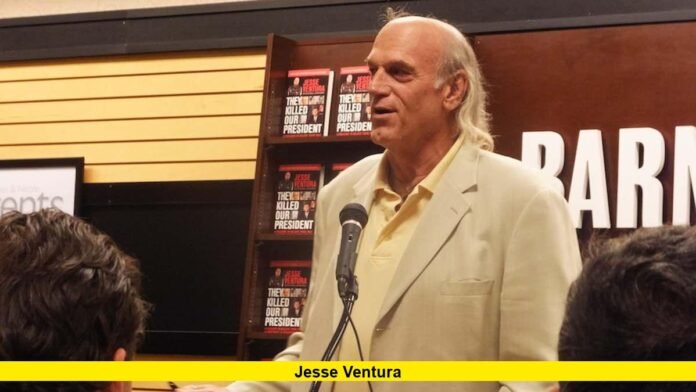

In early January 2026, jesse ventura once again placed himself at the center of the national political conversation after delivering a series of sharp, emotionally charged statements that quickly spread across the country. His comments followed a tense federal law enforcement incident near a Minneapolis high school and touched on deeper frustrations about political leadership, constitutional responsibility, and the direction of the United States.
Known for his blunt language and refusal to soften his opinions, Ventura’s remarks reignited debates about federal power, civil liberties, and the role of outspoken public figures during moments of social tension.
Why Jesse Ventura Still Commands Attention
Jesse Ventura’s political relevance has endured long after his single term as Minnesota’s governor ended in the early 2000s. Before politics, he built fame as a professional wrestler and media personality, giving him a direct, confrontational communication style that still defines his public presence today.
Unlike traditional politicians, Ventura has never aligned himself fully with either major political party. Instead, he has consistently portrayed himself as an independent voice willing to criticize power wherever he sees abuse or hypocrisy. That positioning has earned him loyal supporters and vocal critics, often in equal measure.
In 2026, his influence remains strong because his commentary taps into widespread public unease about government authority, political polarization, and the erosion of trust in national institutions.
The Minneapolis Incident That Triggered a Broader Debate
The renewed attention on Ventura followed a highly charged federal law enforcement operation near a public high school in Minneapolis. The incident unfolded outside the school during regular hours, with students and staff nearby. Federal agents deployed chemical irritants as tensions escalated, and several individuals were detained during the chaos.
The school district responded by canceling classes for the remainder of the week and launching an internal review. Community members expressed concern about student safety and questioned why enforcement actions occurred so close to an active campus.
The event quickly became a flashpoint for national discussion, blending local outrage with broader concerns about immigration enforcement, federal authority, and the limits of force in civilian spaces.
Ventura’s Visit and Message of Support
The day after the confrontation, Ventura appeared at the school to publicly address the situation. He spoke with staff members and community figures, positioning his visit as an act of solidarity rather than political theater.
During his remarks, Ventura condemned what he described as unnecessary aggression by federal authorities. He emphasized that schools should be protected spaces, insulated from enforcement actions that could traumatize students or disrupt education.
He also referenced a separate fatal shooting involving a federal agent elsewhere in the city, describing the overall environment as one of escalating force and shrinking accountability. According to Ventura, these events reflected a deeper systemic problem rather than isolated mistakes.
Declaring Republicans a Threat to the Constitution
Ventura’s most explosive comments came when he turned his attention to national politics. He stated that he considers the Republican Party to be “domestic enemies to our Constitution,” arguing that its leadership has repeatedly undermined democratic principles.
He framed his criticism around past efforts to challenge election outcomes and weaken institutional checks and balances. In his view, loyalty to party has replaced loyalty to the Constitution, creating long-term damage to democratic norms.
The statement immediately ignited backlash from Republican figures and commentators, while supporters applauded Ventura for voicing what they see as an uncomfortable truth.
America Labeled a “Third World Country”
Ventura escalated his critique by describing the United States as resembling a “third world country,” citing militarized law enforcement tactics, internal instability, and declining trust in government institutions.
He argued that aggressive enforcement methods, particularly in civilian settings like schools, reflect a departure from the values America claims to uphold. Ventura contrasted these conditions with his experiences abroad, stating that the U.S. increasingly mirrors the instability it once criticized elsewhere.
While critics dismissed the comparison as exaggerated and inflammatory, supporters argued that the comment was meant to provoke reflection rather than insult.
Renewed Attacks on Political Leadership
Ventura also revisited his long-standing criticism of former President Donald Trump, again labeling him a “draft-dodging coward.” This language has been part of Ventura’s rhetoric for years and stems from Trump’s military deferments during the Vietnam War era.
By reviving these comments, Ventura reinforced his broader argument that political leaders should be held to personal and constitutional standards, not shielded by party loyalty or celebrity status.
Public Reaction: Applause, Anger, and Unease
The response to Ventura’s remarks was swift and divided.
Supporters praised his willingness to speak plainly about issues they believe mainstream politicians avoid. Many viewed his comments as a necessary wake-up call about federal power, constitutional erosion, and political hypocrisy.
Critics accused Ventura of using reckless language that deepens polarization and undermines confidence in democratic institutions. Some argued that his rhetoric risks inflaming tensions during an already volatile moment.
Community leaders and educators, meanwhile, focused on the practical impact of the Minneapolis incident, emphasizing student safety and the need for transparency as reviews continue.
A Consistent Pattern of Confrontation
Ventura’s latest remarks did not emerge in isolation. Throughout his career, he has portrayed both major parties as self-serving and disconnected from ordinary Americans. He has repeatedly warned about unchecked authority, whether exercised by corporations, political parties, or the federal government.
What has changed over time is the intensity of his language. In recent years, Ventura’s critiques have become sharper, reflecting a broader national climate marked by distrust, anger, and ideological division.
The Minneapolis appearance fits squarely within this trajectory, reinforcing his role as a confrontational outsider rather than a consensus builder.
The Role of Language in Political Crisis
Ventura’s statements have renewed debate about how public figures should communicate during moments of crisis. Strong language can draw attention to urgent issues, but it can also escalate tensions and harden divisions.
Legal scholars and civic educators often stress that criticism of government is a democratic right, yet they also warn that labeling entire groups as enemies can have lasting consequences. Ventura’s approach challenges Americans to consider where the line lies between accountability and provocation.
What Happens Next
As of now, investigations into the Minneapolis school incident are ongoing, and no further actions involving Ventura have been announced. His remarks continue to circulate widely, ensuring that the controversy remains part of the national conversation.
Whether this moment leads to further activism, public engagement, or renewed political involvement from Ventura remains uncertain. What is clear is that his voice continues to resonate in a country grappling with questions of power, rights, and identity.
The Bigger Picture
The reaction to Ventura’s comments highlights a deeper national struggle over how Americans define patriotism, accountability, and constitutional loyalty. His critics see a provocateur who fuels division, while his supporters see a truth-teller unwilling to compromise.
Either way, the episode demonstrates how quickly local events can evolve into national flashpoints when amplified by a figure known for unfiltered speech.
Final Perspective
Jesse Ventura’s latest public appearance and uncompromising remarks have once again forced uncomfortable questions into the spotlight. His condemnation of federal enforcement actions, his harsh assessment of Republican leadership, and his bleak view of America’s political direction have struck a nerve across the country.
Whether viewed as necessary criticism or dangerous rhetoric, his words have ensured that debates about constitutional integrity and government power remain impossible to ignore.
How Americans respond to voices like Ventura’s may shape the tone of political discourse moving forward—share your thoughts and stay connected as this story continues to develop.