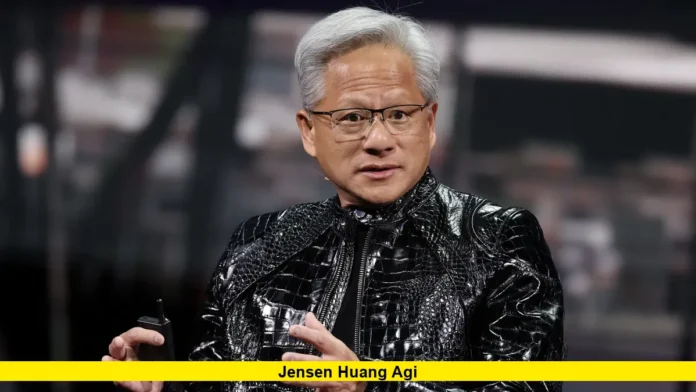

The artificial intelligence world woke up this week to a statement that stopped the industry in its tracks. Nvidia CEO Jensen Huang — the man whose chips power nearly every major AI system on the planet — declared plainly and without hesitation that artificial general intelligence, better known as AGI, has already been achieved. The declaration came during a wide-ranging appearance on the Lex Fridman Podcast, and the fallout has been immediate. Jensen Huang’s AGI claim is not a fringe opinion from a futurist on the sidelines. It comes from the most influential hardware executive in the world, and it is forcing every corner of the tech industry to reconsider where the goalposts actually stand.
Whether you believe him or think he is dramatically moving the finish line, this is a moment that demands attention. The debate around AGI touches everything — investment strategies, government policy, job markets, and the long-term direction of human civilization itself.
If you care about the future of technology and where artificial intelligence is headed, keep reading — this is the conversation that defines our era.
What Jensen Huang Said — In His Own Words
During his appearance on the Lex Fridman Podcast, Huang was asked directly about the timeline for an AI system capable of starting, growing, and running a successful technology company from scratch. His response was immediate and unambiguous.
“I think it’s now,” Huang said. “I think we’ve achieved AGI.”
He went on to elaborate, suggesting it is entirely plausible that an AI system could build a web service, attract billions of users for a brief window, generate revenue, and then wind down — all with minimal sustained human direction. He pointed to the emergence of open-source agent platforms and the growing capability of AI systems to take autonomous action in the real world as evidence that this threshold has already been crossed.
This framing is both significant and controversial. Huang is essentially defining AGI not as a persistent, all-knowing superintelligence, but as a system capable of a one-time commercial flash — a viral moment that generates real-world economic value. That interpretation sits far from what most researchers and AI theorists have traditionally meant when using the term.
A Definition That Has Always Been Contested
The term artificial general intelligence has never had a universally agreed-upon definition, and that ambiguity is at the heart of why Huang’s comment is generating such intense debate.
For many researchers, AGI implies a system that can reliably generalize across wildly different domains, pursue long-term goals, continuously learn from new environments, and operate with human-level competence in open-ended, unpredictable situations. By that standard, the AI systems available today — however impressive — still hallucinate facts, struggle with basic logic under adversarial conditions, and lack genuine comprehension of the world they are processing.
Huang himself has used different definitions at different times. At a major tech conference back in 2023, he described AGI as software capable of passing rigorous human-level exams — legal bar exams, logic assessments, pre-med qualifications — and placed that milestone roughly five years away. On the Fridman show, he effectively collapsed that timeline to the present by adopting a significantly lower bar: an AI-driven startup moment that briefly achieves a billion dollars in value.
That shift is not a minor nuance. It is a fundamental redefinition of what the industry’s most consequential milestone means.
Why Huang’s Opinion Carries So Much Weight
It would be easy to dismiss this as a tech CEO generating headlines. But Jensen Huang is not just any executive. Nvidia controls roughly 80 percent of the AI chip market. The company’s graphics processing units are the foundational infrastructure on which every major AI model — from OpenAI’s GPT series to Google’s Gemini to Anthropic’s Claude — is trained and run. When Huang speaks about where AI stands, it lands differently than when almost anyone else makes the same claim.
His declaration also arrives at an extraordinarily powerful moment for Nvidia as a company. The firm recently posted its highest annual revenue in its history, with data center sales alone reaching figures that would have seemed implausible just a few years ago. This is not a company hedging its bets — it is an organization at the absolute center of the AI economy, and its leader has just declared the industry’s ultimate milestone achieved.
That context matters. An AGI declaration from Nvidia is not a philosophical observation. It is a statement with enormous commercial and strategic implications.
The Vision of AI Agents and the Future of Work
Huang’s AGI comments did not exist in isolation. They came alongside a sweeping vision of how the workplace will transform over the coming decade — a vision he shared in detail at the Nvidia GTC conference in San Jose earlier this month.
Speaking to reporters and media, Huang described a future version of Nvidia that has roughly 75,000 employees — nearly double its current headcount — each working alongside approximately 100 AI agents. That is a ratio of 7.5 million AI agents for every 75,000 human workers. He made clear that these agents will not replace human employees but will handle the repetitive, around-the-clock tasks that currently consume enormous amounts of human time and energy.
Huang also unveiled the Nvidia Agent Toolkit at GTC — an open platform designed to let enterprises build and deploy their own AI agents at scale. Major companies including Adobe, Palantir, and Cisco are already using early versions of this infrastructure. The message is consistent: the era of AI agents acting autonomously in the world is not approaching. According to Huang, it is already here.
He also introduced the concept of token economics — a framework in which the number of AI tokens a company or employee has access to becomes a measure of computational power, productivity, and even compensation. He floated the idea that future job offers at tech companies could include an annual token budget, giving engineers the computational resources to amplify their output many times over. In Silicon Valley, he noted, this is already starting to influence how talent is recruited and retained.
The Infrastructure Behind the Confidence
Huang’s certainty about AGI is not built on wishful thinking. It rests on a foundation of hardware development that has no precedent in the history of computing.
Earlier this year, Nvidia introduced the Vera Rubin AI platform — a next-generation computing system that dramatically reduces the cost of AI inference and cuts the number of chips required to train large models by a substantial margin compared to previous-generation systems. The platform represents a leap in raw computational efficiency that makes more powerful, more autonomous AI systems not just possible but economically viable at scale.
Global data center electricity demand is expected to roughly double by the end of 2026, with AI representing one of the primary drivers of that growth. The physical and energy infrastructure required to sustain this level of AI development is being built out at a pace that reflects genuine belief — not just marketing — that transformative AI capability is imminent or already present.
Where Researchers Push Back
Not everyone in the AI community is ready to accept Huang’s framing, and the pushback is substantive.
Critics point out that current AI systems, regardless of their benchmark performance, still operate within significant limitations. They produce confident but incorrect answers. They cannot reliably maintain coherent goals across long, complex tasks. They lack the kind of persistent learning that would allow them to grow and adapt in the way a human professional does over years of experience.
For these researchers, Huang’s definition of AGI — an AI system that creates something viral and briefly profitable — is not a milestone so much as a relabeling. Calling a one-time commercial success AGI, in their view, moves the goalpost rather than reaching it.
There is also a legal dimension to this debate that goes beyond semantics. Several major technology agreements — including partnerships involving some of the biggest names in AI — contain specific contractual language that is triggered if and when AGI is formally declared to have been reached. What counts as AGI is, in some cases, a legal question with multi-billion-dollar implications.
What This Means for Everyday Americans
For most people outside the tech industry, the AGI debate can feel abstract and distant. But its downstream consequences are anything but.
The growth of AI agents — autonomous software systems that can take real actions in the world — is already reshaping industries from healthcare and finance to logistics and customer service. A survey from late 2025 found that a significant majority of organizations were experimenting with AI agents in some form, though most had not yet begun scaling those experiments broadly. That gap between experimentation and full deployment is where the most significant workplace disruption is likely to unfold over the next several years.
For workers, investors, and policymakers, the question is not whether AI will change the economy. That is already happening. The question is how quickly, and whether the systems being built are as capable as their creators claim.
Jensen Huang has offered his answer. The rest of the world is still working out how to respond.
If you have thoughts on whether AGI has truly arrived or whether Huang is rewriting the rules, share them in the comments — this is one of the most important debates of our time, and your perspective matters.