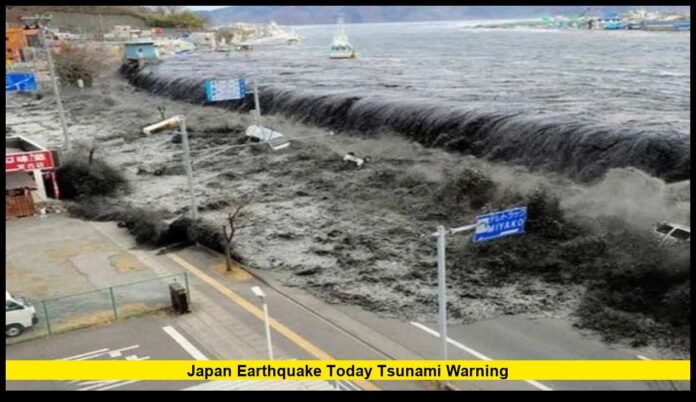

The Japan earthquake today tsunami warning has drawn national attention after a strong offshore quake rattled northeastern Japan, prompting urgent advisories and emergency responses across coastal towns. While no major tsunami has struck, officials remain cautious as the region monitors sea levels and potential aftershocks through the night.
Strong Earthquake Shakes Northeastern Japan
In the late afternoon, a magnitude 6.8 earthquake struck off the eastern coastline of Honshu, Japan’s largest island. The tremor occurred near the Pacific Ocean, with shaking felt across the Miyagi, Iwate, and Fukushima prefectures. Residents in several cities reported books falling from shelves, swaying light fixtures, and minor structural vibrations.
The quake’s depth was shallow, which intensified the shaking in areas closest to the epicenter. Many people immediately received alerts on their phones and through public broadcast systems, allowing them to take cover before the strongest motion hit.
Japan’s robust early warning system once again proved its effectiveness, providing precious seconds for citizens to react. Sirens sounded along coastal zones shortly after the earthquake, and local officials quickly initiated safety procedures.
Tsunami Advisory Issued for Pacific Coast
Following the quake, meteorological authorities issued a tsunami advisory for parts of northeastern Japan. The advisory covered several Pacific-facing prefectures, warning of possible waves up to one meter (around three feet). Though this does not constitute a full tsunami warning, the advisory urged residents to exercise caution and stay away from coastal areas.
Communities along the Tohoku coastline—a region that remains vigilant after past natural disasters—responded immediately. Coastal residents were advised to move to higher ground or head to local evacuation centers as a precaution.
Public transportation systems along the eastern seaboard temporarily suspended operations while safety checks were conducted. Local officials also ordered ports to halt operations, ensuring fishing vessels and cargo ships remained secured.
So far, no destructive tsunami waves have been observed. Monitoring equipment registered minor changes in sea level, but water surges remained below the dangerous threshold. Authorities continue to observe tidal patterns overnight before officially lifting the advisory.
Calm but Cautious Response
Despite the strength of the earthquake, initial reports indicate no significant damage or casualties. Power outages occurred briefly in parts of Miyagi and Iwate Prefectures but were restored within hours. Emergency services confirmed that hospitals, schools, and transportation networks were functioning normally by early evening.
Trains, including the shinkansen high-speed network, automatically halted as part of safety protocols. Inspections found no major track damage, and limited services resumed later in the evening. Several flights departing from northern airports experienced short delays but resumed once seismic safety assessments were completed.
The quick and orderly public response reflected Japan’s high level of preparedness. People calmly evacuated coastal areas and gathered at pre-designated meeting points. Evacuation shelters opened their doors, distributing water, blankets, and emergency food supplies for those choosing to remain inland overnight.
Residents Describe the Shaking
Residents throughout the region described the quake as short but powerful. In Sendai, the largest city near the epicenter, many people reported hearing low rumbling before the shaking intensified. Office workers ducked under desks, and families took refuge in doorways and under sturdy tables.
Supermarkets and train stations temporarily stopped operations as safety inspections were performed. Some store shelves toppled, and a few older buildings sustained cracked walls and ceilings, though there were no reports of structural collapses.
People living near the coastline acted swiftly, gathering essentials and moving to elevated areas. Along small fishing towns, residents who experienced the 2011 disaster decades earlier said the rapid warnings and improved communication systems gave them confidence in today’s response.
Tsunami Risk Appears Low but Not Over
Throughout the evening, monitoring stations along the Pacific coast recorded minor sea-level fluctuations, though nothing approaching the level of a destructive tsunami. Authorities reminded the public that smaller waves could continue for several hours following an offshore quake.
Coastal communities were asked to remain on alert until the advisory was officially canceled. Some harbors temporarily closed, and fishing boats were moved to deeper waters to prevent collisions or damage from smaller surges.
The government emphasized that the advisory was purely precautionary. However, experience has shown that even small tsunamis can pose risks to swimmers, boaters, and people near river mouths connected to the ocean.
Residents were urged to stay indoors, avoid coastal routes, and remain informed through official public broadcast systems throughout the night.
No Widespread Damage Detected
As evening turned to night, assessments from across the region confirmed that Japan’s infrastructure sustained minimal impact. Bridges, tunnels, and expressways remained open, with inspectors verifying structural integrity.
Public buildings and schools reported no major issues. Some older residential structures experienced minor cracks or dislodged roof tiles, but repairs are expected to be swift.
Emergency crews continued to monitor potential aftershocks, which are common following large offshore earthquakes. Smaller tremors were detected but caused no new damage.
Japan’s advanced seismic engineering once again played a crucial role in minimizing destruction. The country’s modern building codes require structures to withstand strong shaking, ensuring public safety even during high-magnitude quakes.
Public Transportation Returns to Service
By nightfall, most public transportation systems were operating normally. Train services that had paused for safety inspections resumed limited runs, and highways reopened after short closures.
Airports in Sendai, Hanamaki, and nearby regions reported no damage to runways or terminals. Flights continued throughout the evening with minimal delays.
Local authorities confirmed that water, gas, and communication services were functioning across most areas. Only isolated power outages were reported, primarily in small coastal towns where systems automatically shut down to prevent electrical fires.
Residents Express Gratitude and Relief
As reports of minimal damage spread, relief replaced early anxiety. Families reunited after briefly evacuating, and coastal residents who had fled inland began returning to their homes once given the all-clear to do so.
Communities expressed gratitude for the efficiency of warning systems and emergency responders. Many residents credited years of training drills and education programs for the calm, organized response witnessed today.
Volunteers and community leaders distributed hot meals and supplies to evacuation centers, ensuring everyone remained comfortable overnight. For many, the event served as a reminder of the country’s ongoing commitment to preparedness.
A Night of Vigilance
Despite improving conditions, officials have urged caution overnight. Aftershocks can sometimes trigger minor landslides or small tidal movements, especially in regions with soft soil or steep terrain.
Emergency headquarters in northeastern Japan remain staffed, monitoring seismic activity and issuing real-time updates through public broadcasting channels. Authorities have reassured the public that the situation remains under control but continue to encourage vigilance.
Residents have been asked to keep flashlights, emergency kits, and radios within reach in case of unexpected tremors. Many families, particularly those living near the coastline, have chosen to stay in inland shelters until sunrise.
Japan’s Earthquake Readiness
Japan is one of the most earthquake-prepared nations in the world. Its sophisticated warning systems, strict building codes, and comprehensive public education campaigns have made it a global leader in disaster resilience.
Every school, business, and government office regularly conducts drills simulating both earthquakes and tsunamis. Many homes are equipped with emergency kits and predetermined evacuation routes. These measures, combined with technological advancements in early detection, save countless lives each year.
Today’s rapid emergency alerts, public cooperation, and orderly response demonstrated how far the country has come in its ability to handle major seismic events safely.
What Comes Next
Authorities continue to monitor sea levels and seismic patterns overnight. While conditions remain stable, the Japan earthquake today tsunami warning remains in place for selected coastal zones until all risks have passed.
Experts are analyzing the quake’s data to determine whether it was linked to broader tectonic shifts in the Pacific region. Smaller aftershocks are expected to continue for several days, though most are likely to be weak.
Emergency management teams plan to issue a comprehensive update by morning, once the situation has been fully evaluated. Local governments are also reviewing the day’s response to identify areas for further improvement, ensuring preparedness remains strong in future events.
A Reminder of Japan’s Resilience
Once again, Japan has demonstrated its ability to face nature’s challenges with discipline, unity, and calm. The country’s blend of advanced technology and public readiness turned what could have been a dangerous situation into a controlled and manageable event.
Residents across the nation are resting a bit easier tonight, knowing that while the earth beneath them may tremble, their systems and spirit remain unshaken. The precautionary measures taken today reflect a nation that learns, adapts, and leads in the face of uncertainty.
Japan stands steady tonight, proving that resilience is not just a response—it’s a way of life. Stay alert, stay informed, and stay safe as the situation continues to be monitored.