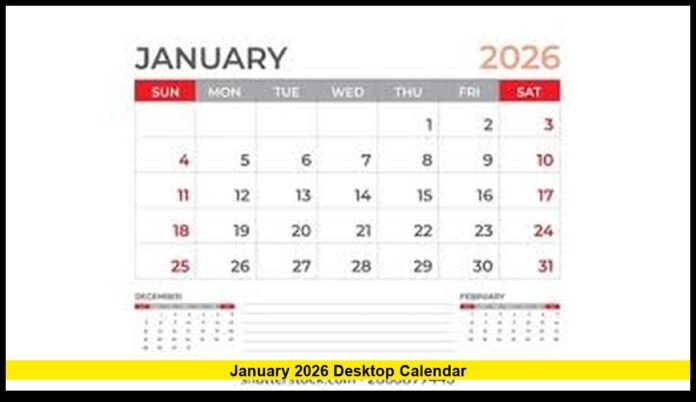

January 2026 desktop calendar usage is already widespread across the United States as individuals and organizations rely on fully confirmed dates, holidays, and workweek structures to begin the year with clear planning and organization.
January has long been the most structured and goal-driven month on the U.S. calendar, and January 2026 continues that pattern. With all dates finalized and no pending adjustments to federal holidays or weekday alignment, the January 2026 desktop calendar provides a dependable framework for daily scheduling, professional planning, and personal productivity.
This article explores how the January 2026 desktop calendar is structured, why it matters, and how it is being used across work, education, and everyday life in the United States.
Confirmed January 2026 Calendar Structure
January 2026 contains 31 days, beginning on Thursday, January 1, and concluding on Saturday, January 31. This structure is fixed and applies uniformly nationwide.
Because the month opens on a Thursday, the first few days create a short initial work period before the first complete Monday-through-Friday week begins. This alignment shapes how businesses schedule meetings, how schools reopen, and how individuals organize their routines.
January 2026 at a Glance
- Total days: 31
- First weekday: Thursday
- Last weekday: Saturday
- Saturdays: 5
- Sundays: 4
- Mondays: 4
For many organizations, Monday, January 5, 2026, marks the practical start of full operations for the year.
Federal Holidays Displayed on the January 2026 Desktop Calendar
The January 2026 desktop calendar includes two official federal holidays observed across the United States. These dates are confirmed and appear consistently in digital and printed calendars.
New Year’s Day
- Thursday, January 1, 2026
New Year’s Day opens the month and is observed nationwide. Federal offices, banks, and many private employers close for the day, while others operate on limited schedules.
Martin Luther King Jr. Day
- Monday, January 19, 2026
Observed on the third Monday of January, this holiday creates a long weekend and affects government services, schools, financial institutions, and many workplaces.
Both holidays play an important role in how the January 2026 desktop calendar is used for planning and scheduling.
Why January Desktop Calendars Receive the Most Attention
January consistently stands out as the most actively used calendar month in the U.S. The start of a new year naturally encourages planning, organization, and routine building.
Americans use January calendars to:
- Reset work priorities
- Establish annual goals
- Organize school and academic schedules
- Track financial deadlines
- Plan health and fitness routines
Because of this, desktop calendars for January tend to prioritize clarity, structure, and easy reference.
Popular January 2026 Desktop Calendar Layouts
Although all January 2026 desktop calendars share the same date structure, users choose layouts based on how they plan their time.
Full Monthly Grid Layout
This layout displays all 31 days in a single view.
- Ideal for deadline tracking
- Easy to visualize the entire month
- Common in offices and schools
Minimal Desktop Design
Minimal designs focus on simplicity.
- Large, readable numbers
- Clean backgrounds
- Reduced distractions
These are often preferred by professionals and creatives who want a calm visual workspace.
Workweek-Centered Layout
This format emphasizes weekdays.
- Monday through Friday highlighted
- Weekends visually separated
- Useful for business planning
This layout aligns well with corporate scheduling needs.
Screen Resolution and Device Compatibility
Most January 2026 desktop calendars are designed to fit common screen resolutions used in the United States.
Typical formats include:
- 1920×1080 (Full HD)
- 2560×1440 (QHD)
- 3840×2160 (4K)
These resolutions ensure sharp text and balanced spacing on desktops, laptops, and external monitors.
January 2026 Workweek Breakdown
Understanding how workweeks fall within the month is essential for payroll, meetings, and productivity planning.
Week 1
- January 1–2
- Short opening week due to New Year’s Day
Week 2
- January 5–9
- First full workweek of the year
Week 3
- January 12–16
- Standard five-day workweek
Week 4
- January 19–23
- Shortened by Martin Luther King Jr. Day
Week 5
- January 26–30
- Final full workweek
January 31 falls on a Saturday, completing the month.
Use in Schools and Universities
January is a key month for education in the United States. Many schools and colleges resume classes after winter break, making desktop calendars essential tools.
Educators and students use January calendars to:
- Track semester start dates
- Organize class schedules
- Plan exams and assignments
Academic versions often visually mark holidays and important academic milestones.
Remote Work and Home Office Planning
Remote and hybrid work remains common across the U.S., increasing reliance on desktop calendars.
The January 2026 desktop calendar supports:
- Time-blocking for focused work
- Scheduling virtual meetings
- Separating work and personal time
Clear weekday alignment helps remote workers maintain consistent routines.
Personal Organization and Goal Setting
January is closely associated with habit formation and goal tracking. Many desktop calendars are designed with productivity in mind.
Common features include:
- Daily task spaces
- Weekly goal sections
- Habit-tracking areas
The confirmed January 2026 calendar structure allows users to plan confidently without interruptions.
Design Trends for January 2026
Visual style plays an important role in calendar usability.
Current January desktop calendar trends include:
- Neutral and winter-inspired colors
- High-contrast text
- Clean spacing
These designs support both professional and personal use.
Accessibility and Ease of Reading
Accessibility continues to shape how calendars are designed.
Many January 2026 desktop calendars include:
- Larger fonts
- Clear weekday labels
- Strong color contrast
These features make calendars easier to read for a broad audience.
Digital and Printed Calendar Use
Although desktop calendars are designed for screens, many users also print them.
Printed uses include:
- Desk reference sheets
- Home office displays
- Classroom planning boards
Because January 2026 dates are finalized, printed calendars remain accurate throughout the month.
Importance of Accuracy in January Calendars
Errors in calendars can lead to missed deadlines, payroll issues, and scheduling conflicts. The January 2026 desktop calendar benefits from:
- Finalized weekday placement
- Confirmed federal holidays
- Stable date alignment
This accuracy is especially important during the first month of the year.
Business Planning and First-Quarter Goals
January sets the foundation for the first quarter. Businesses use desktop calendars to:
- Plan project timelines
- Schedule team meetings
- Track performance goals
The January 2026 calendar supports structured planning from the first full workweek onward.
Customization and Personal Use
Many users personalize their January 2026 desktop calendar by adding:
- Color-coded reminders
- Notes and highlights
- Custom time blocks
Personalization improves usability while keeping the official date structure intact.
Common Mistakes Users Avoid With January 2026 Calendars
Even simple calendar errors can cause confusion.
Using a correct January 2026 desktop calendar helps avoid:
- Misplacing Martin Luther King Jr. Day
- Using outdated templates
- Assuming January begins on a Monday
Accurate calendars reduce scheduling stress.
File Formats and Distribution
January desktop calendars are commonly available in:
- PNG or JPG image formats
- PDF files
- Wallpaper-optimized layouts
These formats work across major operating systems used in the U.S.
Why January Continues to Lead Calendar Engagement
January consistently generates higher calendar usage than any other month due to:
- New-year planning behavior
- Workplace resets
- Increased focus on productivity
January 2026 follows this long-standing pattern, supported by a clear and reliable calendar structure.
Confirmed Status for January 2026
All dates, holidays, and weekday alignments for January 2026 are finalized and verified in the United States. There are no pending changes that would affect how the month appears on desktop calendars.
From professional scheduling to personal organization, the January 2026 desktop calendar provides Americans with a dependable way to start the year with clarity and control—share how you plan to organize your January or stay informed as the calendar year unfolds.