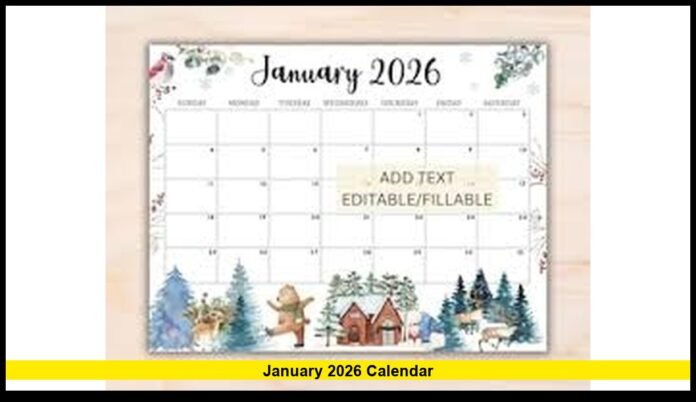

January 2026 calendar information is now fully settled, giving Americans a clear and reliable view of how the year begins, including confirmed dates, weekdays, weekends, and federal holidays that shape work, school, and personal schedules nationwide.
January opens 2026 on a Thursday and closes on a Saturday, creating a structured month that supports early-year planning across households, businesses, and institutions. With all dates finalized, this calendar serves as a dependable reference point for anyone organizing the first month of the year.
January 2026 Calendar Overview
January is traditionally associated with fresh starts, goal setting, and schedule resets. In 2026, the month offers a practical layout that aligns well with both professional operations and family routines.
Key calendar details include:
- Month: January
- Year: 2026
- Total days: 31
- First day of the month: Thursday, January 1
- Last day of the month: Saturday, January 31
- Total weekdays: 22
- Total weekend days: 9
This balance makes January 2026 efficient for planning payroll cycles, academic schedules, and project timelines.
Why January 2026 Calendar Searches Are Increasing
Interest in January calendars typically begins rising well before the start of a new year, driven by the need for accurate dates that shape early planning decisions. As 2026 approaches, searches for the January 2026 calendar are increasing as households, businesses, schools, and government offices look to lock in schedules tied to work, travel, academic terms, and financial timelines.
The January 2026 calendar is drawing heightened attention because its structure plays a direct role in how the year officially begins across multiple sectors. Several key factors are contributing to the surge in interest:
- Begins later in the week, altering how New Year’s Day is observed and reshaping the first full workweek of the year. This affects return-to-office timelines, school reopening schedules, and travel patterns following the holiday season.
- Includes a widely observed federal holiday on a Monday, creating an early long weekend that influences staffing plans, payroll cycles, public services, and leisure travel demand.
- Marks the operational start of the first quarter, when businesses activate budgets, government agencies begin fiscal execution, and organizations roll out annual strategies and performance goals.
- Aligns with financial, academic, and workplace resets, as new semesters begin, reporting periods open, and employers set expectations for the year ahead, making precise calendar confirmation especially important.
With so many planning decisions tied to January’s layout, early access to verified dates helps reduce scheduling conflicts, improves coordination across departments and households, and allows both individuals and institutions to enter 2026 with greater clarity and confidence.
Confirmed U.S. Federal Holidays in January 2026
January 2026 includes two federally recognized holidays observed nationwide across the United States. These dates are fixed and consistent across all states, making them key reference points for government operations, business planning, school calendars, and travel scheduling.
New Year’s Day — Thursday, January 1
New Year’s Day marks the official start of the calendar year and is recognized as a federal holiday across the country.
On this date, federal government offices, banks, and many private-sector employers are closed. Schools typically remain closed as well, and public services may operate on limited schedules. Because the holiday falls on a Thursday in 2026, some organizations extend time off into Friday or the weekend, depending on internal policies.
This midweek placement influences several early-January planning factors, including:
- Office reopening and return-to-work timelines
- Payroll processing and benefits administration
- Domestic and international travel schedules
- School district calendars and academic planning
The Thursday observance can also affect productivity during the first full workweek of the year, as some employees stagger returns or use additional leave.
Martin Luther King Jr. Day — Monday, January 19
Observed on the third Monday of January each year, Martin Luther King Jr. Day falls on Monday, January 19, 2026.
Federal offices close nationwide, and many schools, financial institutions, and private employers observe the holiday. The day is also marked by community service projects, educational programs, and public events across the country.
The Monday observance creates a three-day weekend that has broad operational and economic impacts, including:
- Increased travel volume and hospitality demand
- Adjustments to staffing and shift schedules
- Changes to retail hours and promotional activity
- Temporary pauses in government and court operations
Together, these two federal holidays shape how January 2026 unfolds, influencing everything from workplace schedules to consumer behavior during the opening weeks of the year.
Weekday Distribution Across January 2026
Understanding how weekdays are distributed within a month is an important factor in operational, financial, and staffing planning. The structure of January 2026 plays a role in how organizations schedule workweeks, manage payroll cycles, and close reporting periods during the first month of the year.
January 2026 includes the following weekday distribution:
- Mondays: 4
- Tuesdays: 4
- Wednesdays: 4
- Thursdays: 5
- Fridays: 5
The presence of five Thursdays and five Fridays is particularly relevant for businesses and institutions that align reporting deadlines, payroll processing, or financial closeouts with the end of the workweek. Many organizations finalize weekly or monthly tasks on Thursdays and Fridays, making the additional occurrences useful for spreading workloads and reducing end-of-period congestion.
This distribution also affects employee scheduling, shift rotations, and deadline planning, especially during a month that already includes federal holidays and the launch of first-quarter operations.
Weekend Structure in January 2026
The weekend layout of January 2026 plays an important role in personal scheduling, business operations, and event planning, particularly for organizations that structure timelines around weekend cycles.
January 2026 contains five Saturdays and four Sundays, creating an extended run of weekend planning opportunities toward the end of the month.
Saturdays:
- January 3
- January 10
- January 17
- January 24
- January 31
Sundays:
- January 4
- January 11
- January 18
- January 25
Ending the month on a Saturday allows for a clean transition into February, which can simplify calendar alignment for payroll periods, shift scheduling, and monthly planning cycles. This structure is especially useful for organizations and individuals who anchor schedules, deadlines, or recurring activities around weekends rather than midweek dates.
Week-by-Week Look at January 2026
Breaking January 2026 into weekly segments provides valuable clarity for scheduling deadlines, staffing plans, payroll processing, and reporting cycles. The month’s structure reflects a gradual operational ramp-up following the holidays, followed by a steady rhythm through the end of the month.
Week 1:
Thursday, January 1 – Saturday, January 3
The opening days of January form a shortened operational period due to New Year’s Day falling on Thursday. Many offices remain closed or operate with limited staffing, and some organizations extend time off into Friday. Planning activity during this week is often minimal, with full operations resuming the following week.
Week 2:
Sunday, January 4 – Saturday, January 10
This marks the first full workweek of the year. Businesses, schools, and government offices typically return to standard schedules. Budget execution, project launches, and academic instruction commonly begin during this week, making it a key transition point into regular operations.
Week 3:
Sunday, January 11 – Saturday, January 17
A standard planning week with no federal holidays. Many organizations use this period to stabilize workflows, finalize first-quarter timelines, and assess early performance benchmarks following the start-of-year reset.
Week 4:
Sunday, January 18 – Saturday, January 24
This week includes Martin Luther King Jr. Day on Monday, resulting in a federal holiday and a three-day weekend. Staffing schedules, payroll timelines, and service availability are often adjusted, while travel activity and community events increase nationwide.
Week 5:
Sunday, January 25 – Saturday, January 31
The final week closes the month on a weekend, allowing for a clean transition into February. End-of-month reporting, payroll reconciliation, and scheduling adjustments are commonly finalized during this period.
Overall, this week-by-week structure supports accurate planning across payroll, production, education, and reporting cycles, helping organizations manage the opening month of 2026 with greater consistency and fewer disruptions.
School and Academic Scheduling in January 2026
January serves as a key transition period for schools, colleges, and universities across the United States as students and educators move from winter break into the second half of the academic year. The January 2026 calendar plays an important role in shaping attendance, instruction, and assessment planning during this shift.
Common academic activities during January include:
- Returning to classrooms following winter break
- Beginning new semesters, terms, or grading periods
- Scheduling exams, placement tests, and early assessments
- Adjusting instructional calendars around federal holidays
Many school districts and higher education institutions observe closures on January 1 for New Year’s Day and January 19 for Martin Luther King Jr. Day. These closures affect instructional days, transportation schedules, and childcare planning.
Because January often sets the tone for the remainder of the academic term, parents, teachers, and administrators rely on accurate calendar alignment to manage attendance requirements, coursework deadlines, and extracurricular activities with minimal disruption.
Business and Workplace Planning
January plays a central role in business organization, acting as the starting point for annual strategy, operational execution, and performance measurement. For many organizations, the January 2026 calendar helps determine how quickly teams move from holiday downtime into full productivity.
The structure of the January 2026 calendar supports a wide range of workplace activities that typically define the opening weeks of the year, including:
- Annual goal setting and strategic alignment, as leadership teams finalize priorities, performance metrics, and departmental objectives for the year ahead
- New project and initiative launches, with many organizations using January to roll out programs, campaigns, or operational changes planned during the previous quarter
- Hiring and onboarding schedules, as companies begin filling approved roles and integrating new employees into teams and workflows
- Departmental planning meetings and budget coordination, ensuring that resources, timelines, and responsibilities are clearly established across the organization
Because January 2026 begins on a Thursday, many businesses treat the first few days as a transition period rather than a full operational week. Staffing levels may be lighter, meetings are often limited, and onboarding or major launches are delayed until the second week of the month. By allowing a gradual ramp-up, organizations reduce disruption, improve coordination, and create a more structured start to the year once full operations resume in week two.
Financial and Administrative Planning
January is closely tied to financial organization and administrative recordkeeping, as individuals, businesses, and institutions begin setting the financial framework for the year ahead. The January 2026 calendar serves as a reference point for aligning timelines, obligations, and reporting requirements during this critical period.
The January 2026 calendar is commonly used for several essential financial and administrative tasks, including:
- Budget planning and allocation, as organizations finalize annual budgets, adjust forecasts, and distribute funds across departments
- Tax document preparation, including the organization and issuance of required forms and the collection of financial records needed for filing
- Payment scheduling, such as vendor payments, loan installments, rent cycles, and subscription renewals
- Financial goal tracking, allowing individuals and businesses to establish benchmarks for savings, revenue targets, and expense management
Accurate date alignment in January helps prevent missed deadlines, reduces administrative delays, and supports smoother financial operations as the year gets underway. For many organizations, early calendar clarity in January 2026 is essential to maintaining compliance and operational efficiency throughout the first quarter.
Health, Fitness, and Lifestyle Scheduling
January is a peak month for health, fitness, and lifestyle planning as many Americans set wellness goals at the start of the year. The January 2026 calendar plays an important role in helping individuals establish routines and maintain consistency during the early weeks of behavior change.
Calendar-based planning supports a range of wellness-focused activities, including:
- Fitness routines, such as gym schedules, workout programs, and training plans that rely on predictable weekly patterns
- Appointment scheduling, including medical checkups, therapy sessions, and preventive care visits often booked early in the year
- Habit tracking, allowing individuals to monitor progress on goals like exercise, sleep, hydration, and stress management
- Meal and lifestyle organization, including meal planning, grocery scheduling, and balancing work-life commitments
Understanding how weekdays and weekends align in January 2026 helps individuals anticipate busy periods, plan rest days, and create realistic schedules. This structure supports stronger follow-through, making it easier to maintain wellness goals beyond the first few weeks of the year.
Travel and Leisure Planning
Although January is typically less crowded than the December holiday season, domestic travel activity across the United States remains steady. The January 2026 calendar provides important guidance for travelers looking to schedule time off, plan trips, and coordinate around work and school commitments.
Travel planning during January often centers on several key periods:
- New Year’s travel around January 1, as travelers return home from holiday destinations or extend trips into the opening days of the year
- Long-weekend trips around January 19, with Martin Luther King Jr. Day creating a three-day weekend that encourages short domestic getaways
- Winter vacations scheduled mid-month, particularly to warm-weather destinations or ski regions, when travel demand stabilizes after early January
Clear calendar alignment in January 2026 helps travelers plan vacation days more effectively, coordinate with employer policies, and avoid conflicts with school schedules. With accurate dates in place, individuals and families can make travel decisions with greater confidence while balancing leisure time and ongoing responsibilities.
Printable and Digital Uses of the January 2026 Calendar
The January 2026 calendar is widely used across both printable and digital formats, offering flexibility for individuals, families, and organizations with different planning needs. Its straightforward layout and predictable weekday structure make it especially adaptable for customization and long-term use.
Common uses of the January 2026 calendar include:
- Printable monthly planners, often used for goal tracking, budgeting, fitness routines, and daily task management
- Office wall calendars, providing at-a-glance visibility for meetings, deadlines, holidays, and staffing schedules
- Digital scheduling apps, where accurate date alignment supports reminders, recurring events, and collaborative planning
- Shared family calendars, helping households coordinate school activities, work commitments, appointments, and travel plans
The clean weekday structure of January 2026 allows users to tailor the calendar to specific needs, whether for professional planning, personal organization, or combined household scheduling. This adaptability makes it a practical tool for managing the year’s opening month across multiple platforms.
How January 2026 Sets the Pace for the Year
January often establishes the rhythm for the months that follow, shaping how individuals and organizations approach planning, scheduling, and execution throughout the year. The structure of January 2026 plays a meaningful role in creating a smooth transition into the rest of the calendar.
Because January 2026 begins on a Thursday:
- February begins on a Sunday, creating a clean monthly transition that simplifies scheduling for schools, businesses, and households
- Quarterly planning remains balanced, allowing first-quarter timelines, reporting cycles, and project milestones to align more evenly
- Monthly transitions feel more organized, with fewer midweek interruptions at the start or end of key planning periods
This alignment supports forward-looking planning, making it easier to coordinate schedules several months in advance. For both individuals and organizations, the structured start provided by January 2026 helps establish consistency and predictability that carries through the remainder of the year.
Common Questions About January 2026
January always has 31 days, and January 2026 follows this fixed structure without exception. The month includes two federally recognized U.S. holidays—New Year’s Day on January 1 and Martin Luther King Jr. Day on January 19—with no election-related observances scheduled. January 2026 contains 22 weekdays and nine weekend days, a distribution that supports stable work and school routines. All dates are officially set and already reflected across major digital calendars, payroll platforms, and academic planning systems, confirming their reliability for both short-term and long-range planning.
Why Accurate Calendar Information Matters
Incorrect calendar information now carries greater consequences as U.S. employers, schools, and service providers increasingly depend on automated scheduling, cloud-based payroll systems, and shared digital calendars. Even a minor date error can trigger payroll delays, incorrect school attendance records, misaligned contract deadlines, or disrupted travel plans. With January marking the start of tax preparation, academic terms, and new employment cycles, precision is especially critical. The January 2026 calendar details presented here reflect finalized, widely adopted date standards already in use across major planning and scheduling platforms, making them dependable for professional, academic, and personal use.
Practical Planning Tips for January 2026
- Reserve January 1 for holiday downtime
- Use the first full week to set goals
- Plan time off around January 19
- Schedule major projects after mid-month
Strong organization in January often supports smoother planning throughout the year.
January represents fresh beginnings and structured routines, and a reliable calendar helps reduce uncertainty during this important transition period.
How are you planning to organize your schedule using the January 2026 calendar? Share your thoughts or check back for more timely updates.