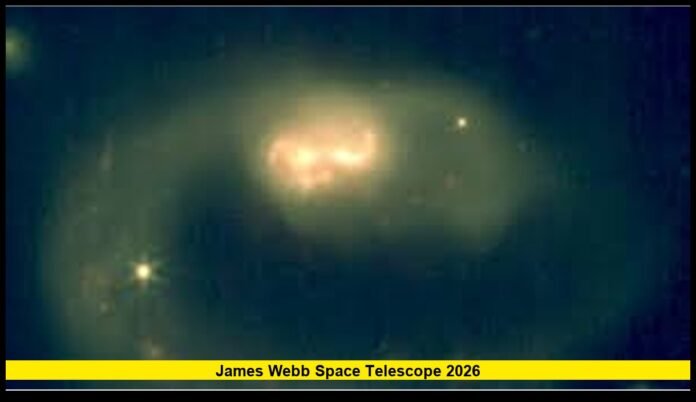

James Webb Space Telescope remains at the forefront of space exploration in 2026, delivering detailed observations of the early universe, distant exoplanets, and star-forming regions. The observatory continues full scientific operations, providing data that reshapes how scientists understand cosmic history and planetary systems.
A Revolutionary Observatory in Deep Space
The James Webb Space Telescope launched on December 25, 2021, marking one of NASA’s most ambitious missions. It reached its operational location at the Sun–Earth L2 point in 2022, about one million miles from Earth.
From this stable position, JWST maintains a constant alignment with Earth while shielding itself from the Sun’s heat. This setup allows its instruments to operate in extremely cold conditions, which are essential for infrared observations.
Unlike earlier telescopes, JWST focuses on infrared light. This capability enables it to detect objects that are too distant, faint, or dust-obscured for visible-light telescopes.
How JWST Is Changing Astronomy
JWST has redefined what scientists can observe. Its sensitivity and resolution surpass previous space telescopes, allowing it to capture details never seen before.
The telescope’s design supports four main scientific goals:
- Observing the first galaxies formed after the Big Bang
- Studying how galaxies evolve over time
- Investigating star and planet formation
- Analyzing atmospheres of exoplanets
Each of these areas has seen major advancements since the telescope began operations.
Recent Discoveries in 2025–2026
JWST continues to produce verified findings that influence both research and public understanding.
Early Universe Observations
One of its most significant achievements involves detecting extremely distant galaxies. These galaxies formed within a few hundred million years after the Big Bang.
The data shows that some galaxies grew larger and more complex earlier than expected. This discovery has led scientists to revisit existing models of galaxy formation.
Exoplanet Atmosphere Analysis
JWST has made major progress in studying planets outside our solar system. Its instruments can analyze the chemical composition of exoplanet atmospheres with high precision.
Recent observations confirmed the presence of:
- Water vapor in multiple exoplanets
- Carbon dioxide signatures in gas giants
- Methane and other organic molecules
These findings help researchers assess planetary environments and potential habitability.
Star Formation and Nebula Imaging
The telescope has captured detailed images of stellar nurseries hidden behind thick clouds of gas and dust.
These images reveal how stars form, evolve, and interact with surrounding material. They also provide insight into how planetary systems begin to develop.
Technology That Powers JWST
JWST represents a major leap in engineering. Its design allows it to observe faint infrared signals from across the universe.
Core Components
- Primary Mirror:
A 6.5-meter mirror made of 18 gold-coated segments that collect light from distant objects - Sunshield:
A five-layer structure the size of a tennis court that blocks heat and light from the Sun - Scientific Instruments:
- NIRCam (Near-Infrared Camera)
- NIRSpec (Near-Infrared Spectrograph)
- MIRI (Mid-Infrared Instrument)
- FGS/NIRISS (Guidance and imaging system)
These components work together to produce highly detailed data across multiple wavelengths.
Why Infrared Observation Matters
Infrared light plays a key role in modern astronomy. As the universe expands, light from distant objects shifts into longer wavelengths.
JWST detects this redshifted light, allowing scientists to observe ancient galaxies and cosmic events.
Infrared observation also penetrates dust clouds, revealing regions that visible-light telescopes cannot see. This makes it possible to study hidden star formation and planetary systems.
U.S. Leadership in Space Science
The James Webb Space Telescope strengthens the United States’ leadership in space exploration. NASA leads the mission, supported by international partners.
American scientists and institutions play a major role in analyzing JWST data. Universities across the country use its findings for research and education.
The telescope supports:
- Advanced scientific studies
- Collaboration among research institutions
- Development of future space missions
Its success reflects decades of investment in space technology.
Recent Images Capturing Global Attention
JWST images continue to captivate audiences worldwide. These visuals combine scientific value with striking clarity.
Notable Visual Discoveries
- Deep field images showing thousands of galaxies in a single frame
- Detailed views of nebulae with complex structures
- Observations of galaxy clusters and gravitational lensing effects
These images provide both scientific insight and a deeper appreciation of the universe.
Comparing JWST With Earlier Telescopes
JWST builds on the legacy of missions like the Hubble Space Telescope and the Spitzer Space Telescope.
| Feature | Hubble | Spitzer | JWST |
|---|---|---|---|
| Launch Year | 1990 | 2003 | 2021 |
| Wavelength Focus | Visible/UV | Infrared | Infrared |
| Mirror Size | 2.4 m | 0.85 m | 6.5 m |
| Orbit | Low Earth | Solar orbit | L2 point |
This comparison shows how JWST extends capabilities far beyond earlier missions.
Mission Performance and Longevity
JWST continues to perform reliably. Engineers designed it for a mission life of at least 10 years.
Efficient fuel usage may allow operations to extend beyond that timeframe. Regular calibrations and adjustments keep the telescope functioning at peak performance.
As of 2026, there have been no major issues affecting its scientific output.
Scientific Collaboration and Data Access
JWST operates as a global scientific resource. Data collected by the telescope is shared with researchers worldwide.
This open approach accelerates discovery and encourages collaboration. Scientists in the U.S. play a leading role in analyzing and publishing results.
The telescope has already contributed to a growing number of scientific studies and discoveries.
Educational Impact Across the United States
JWST has become a powerful educational tool. Schools and universities use its images and data to teach astronomy and physics.
Students gain access to real observations, helping them understand complex concepts. The telescope also inspires interest in science, technology, engineering, and mathematics.
Its influence extends beyond research, shaping how people learn about the universe.
Future Research Goals
JWST’s mission continues to evolve. Upcoming observations will focus on deeper and more detailed studies.
Areas of Focus
- Detecting even earlier galaxies
- Refining measurements of cosmic expansion
- Studying the role of dark matter
- Exploring potentially habitable exoplanets
Each new dataset brings scientists closer to answering fundamental questions about the universe.
The Broader Impact on Science
The James Webb Space Telescope has already changed how scientists approach space research. Its discoveries challenge existing theories and open new areas of study.
It also sets the stage for future missions that will build on its findings.
The telescope’s success demonstrates the value of long-term investment in scientific exploration.
Conclusion
The James Webb Space Telescope continues to lead a new era of discovery in 2026. Its advanced technology and ongoing observations provide unmatched insight into the universe.
From the earliest galaxies to distant exoplanets, JWST is helping scientists answer some of the most important questions in astronomy.
Its impact reaches far beyond the scientific community, inspiring curiosity and expanding knowledge across the United States and beyond.
What discovery from the James Webb Space Telescope has impressed you the most? Share your thoughts and stay connected for more space updates.