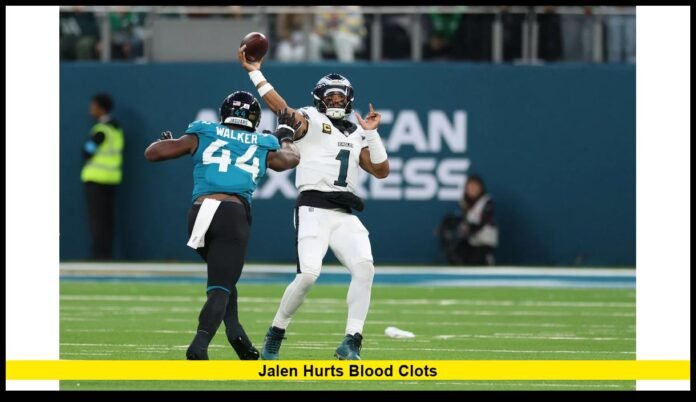

Jalen Hurts blood clots became a major concern for Philadelphia Eagles fans after the team confirmed that its starting quarterback had a superficial blood clot in his left calf. The Eagles ruled him out against the Carolina Panthers on October 15, 2026, and placed him on injured reserve two days later. The decision followed a second ultrasound that revealed movement in the clot, prompting further medical consultations and a change in his playing status. As of the latest update, Hurts must miss at least four games, and the team has not announced a confirmed return date.
The diagnosis has raised questions about Hurts’ health, the seriousness of his condition and Philadelphia’s plans for the remainder of the 2026 NFL season. The quarterback had continued practicing and played against the Jacksonville Jaguars in London after doctors reviewed his initial examination. However, the subsequent scan changed the team’s approach.
Philadelphia has made it clear that Hurts’ health and safety take priority. The organization must now follow medical guidance while preparing its offense to compete without its regular starter.
What Is the Latest Update on Jalen Hurts’ Blood Clot?
The latest confirmed development is Hurts’ placement on injured reserve on October 17. The Eagles made the roster move after receiving additional medical opinions about his superficial blood clot.
The team first announced the diagnosis on October 15, when it confirmed that Hurts would miss the upcoming game against Carolina. The decision followed a follow-up ultrasound conducted after his return from London.
That examination revealed movement in the clot. The team consequently removed him from the lineup while determining the appropriate course of treatment.
Hurts did not play in Philadelphia’s October 18 matchup against the Panthers. Backup quarterback Tanner McKee started in his place, but the Eagles lost 25-14.
The injured-reserve designation requires Hurts to miss at least four games. His expected absence includes the games against Carolina, Dallas, Washington and the New York Giants.
The Eagles have not established a definite date for his return. His availability will depend on medical progress and the requirements for resuming football activities.
How Did Jalen Hurts Develop the Calf Problem?
The Eagles’ public account traces the beginning of Hurts’ calf issue to their October 4 game against the Los Angeles Rams.
During that matchup, Hurts took a cleat to the calf. He subsequently continued participating in team activities, including full practices before the Eagles traveled to London.
On October 8, Hurts visited the team’s training room after practice and requested treatment for the calf. He told medical staff about the contact he had sustained during the Rams game.
He received additional treatment on October 9 and practiced that day. The team also added him to its injury report.
The initial calf problem and the later blood clot diagnosis are related events in the medical timeline, but the publicly released information does not establish every detail of how the clot formed.
The team took another step after arriving in London. Medical staff arranged an ultrasound on October 10, before Philadelphia’s international game against Jacksonville.
That examination revealed the superficial blood clot. Doctors reviewed the results and initially concluded that Hurts could safely play.
The medical team also recommended another ultrasound within 72 hours of the game and the return flight to Philadelphia. That follow-up examination ultimately led to a change in his availability.
Why Did the Eagles Initially Allow Hurts to Play?
The Eagles explained that their medical staff and doctors in London reviewed the first ultrasound before making the decision about Hurts’ availability.
According to the team’s statement, doctors concluded that activity and mobility were important and that he could safely participate in the Jacksonville game at that time.
Hurts played on October 11 without a reported limitation related to the clot. He completed 21 of 40 passes for 220 yards and one touchdown as Philadelphia lost 19-17.
After the game, he received treatment on Monday and Tuesday and practiced fully on Wednesday, according to the team’s account.
The follow-up ultrasound on Wednesday night produced a different finding. The scan showed movement in the small clot, and the Eagles decided to rule him out against Carolina.
This sequence demonstrates why medical monitoring can change a player’s status. The first examination informed the original decision, while the subsequent scan provided new information that required another assessment.
The publicly available account does not provide the complete clinical reasoning behind every decision. It would therefore be inappropriate to conclude that the original clearance was necessarily incorrect.
What is confirmed is that the follow-up finding prompted the Eagles to remove Hurts from competition and seek an appropriate treatment plan.
What Is a Superficial Blood Clot?
A superficial blood clot forms in a vein close to the surface of the skin. These veins differ from deep veins, which carry blood through deeper tissues, including the muscles of the legs.
Doctors may use the term superficial venous thrombosis to describe this condition. The precise medical significance depends on factors such as the clot’s location, size, symptoms and relationship to the deeper venous system.
Some superficial clots remain localized. Others require closer monitoring or treatment because they can extend toward deeper veins.
That distinction is important when discussing Hurts’ diagnosis. The Eagles identified a superficial clot in his left calf. Their public statement did not confirm that he had deep vein thrombosis or a pulmonary embolism.
A pulmonary embolism occurs when a clot blocks an artery in the lungs, often after clot material travels from another part of the body. It is a serious medical condition that requires urgent attention.
However, readers should not confuse the general risks associated with blood clots with Hurts’ confirmed diagnosis. The Eagles have not publicly established that he experienced a pulmonary embolism.
The finding of movement on his follow-up ultrasound was enough to prompt further medical evaluation and a change in his playing status. His medical team must determine the appropriate treatment based on his individual condition.
Why Is a Blood Clot a Concern for a Professional Football Player?
Professional football places substantial physical demands on the lower body. Quarterbacks must plant their feet, rotate through throws, change direction, evade defenders and absorb contact.
Hurts also contributes as a runner. His playing style requires repeated acceleration, deceleration and movement under pressure.
A calf condition can affect those activities, but the concern in this case extends beyond ordinary soreness or a muscle strain. The team identified a blood clot and later reported movement on imaging.
Doctors must consider whether the condition can be managed safely during the intense physical demands of an NFL game. Feeling comfortable while walking or practicing does not automatically establish that an athlete can safely participate in full-contact competition.
Treatment choices also matter in a contact sport. Some clotting conditions require anticoagulant medication, which reduces the blood’s ability to form additional clots. Such medication can also increase bleeding risk.
Football involves collisions, tackles and falls, making medical supervision especially important when clinicians assess an athlete’s ability to return.
The Eagles have not publicly disclosed a complete treatment regimen for Hurts. Therefore, it would be inaccurate to claim that he is taking a specific medication or has completed a particular treatment.
The central question remains whether his doctors can manage the condition safely and determine when he can resume the demands of professional football.
Jalen Hurts on Injured Reserve: How Long Will He Be Out?
The Eagles placed Hurts on injured reserve on October 17. Under the applicable NFL rules, he must miss at least four games before he can become eligible to return.
The designation establishes a minimum absence rather than a guaranteed recovery schedule. It does not automatically mean that a player will miss the entire season.
Hurts is expected to miss the following games during the initial required period:
- Carolina Panthers
- Dallas Cowboys
- Washington Commanders
- New York Giants
The Eagles’ Week 10 bye provides a point at which the team can reassess its plans, but it does not guarantee that Hurts will return immediately afterward.
His medical progress will determine whether he can resume football activities. The team must also follow the applicable roster and practice requirements before he can play again.
The Eagles have not announced a confirmed return date as of October 19, 2026. Any precise prediction about his comeback would go beyond the information the organization has released.
Fans should also distinguish between eligibility to return and actual medical clearance. Meeting the minimum injured-reserve requirement does not establish that a player is ready to compete.
The safest conclusion is that Hurts will miss at least four games, with his longer-term availability still undetermined.
Will Jalen Hurts Miss the Entire 2026 NFL Season?
The Eagles have not confirmed a season-ending absence in their public statement about Hurts’ superficial blood clot.
His injured-reserve designation requires him to miss a minimum of four games, but that requirement alone does not determine whether he can return later in the season.
The ultimate timeline depends on medical assessments and the treatment plan. The team has not provided enough information to establish an exact recovery date.
A return also requires more than an improvement in symptoms. Doctors must assess the clot and determine whether the risks associated with professional football have become acceptable.
Philadelphia will need to consider those medical findings before making a decision about practice participation or game availability.
Until the Eagles announce further details, claims that Hurts will definitely return by a specific week or miss the entire season should not be presented as confirmed facts.
How the Eagles Are Adjusting Without Hurts
Hurts’ absence creates an immediate challenge for Philadelphia’s offense. He is the team’s starting quarterback and plays a central role in its passing and running attack.
Tanner McKee started against Carolina on October 18. He completed passes for 215 yards and one touchdown, but the Eagles lost 25-14.
The defeat left Philadelphia with a 2-4 record and four consecutive losses. The team also struggled to sustain drives, collecting 17 first downs and punting eight times.
Those results provide a snapshot of the challenge facing Philadelphia without Hurts. They do not, however, determine how long he will remain unavailable.
The Eagles must prepare their offense around the quarterbacks who can play while maintaining a clear understanding of Hurts’ medical status.
The organization also added quarterback Joe Milton to its active roster after signing him from the Dallas Cowboys’ practice squad on October 16. That move gives Philadelphia another option as it manages its quarterback depth.
McKee’s immediate role and the team’s broader plans will depend on coaching decisions and roster needs. Hurts’ recovery remains a separate medical matter.
Philadelphia must continue preparing for upcoming games without allowing competitive pressure to override medical guidance.
What Have the Eagles Said About Hurts’ Health?
The team’s October 15 statement provides the clearest public timeline of the injury and diagnosis.
The organization explained that Hurts requested calf treatment on October 8 after being cleated during the Rams game. It then described the initial ultrasound in London, the medical review before the Jacksonville matchup and the recommendation for follow-up imaging.
The statement confirmed that the second ultrasound revealed movement in the clot. The team consequently ruled him out against Carolina while determining the appropriate course of treatment.
Head coach Nick Sirianni addressed the matter on October 16 but declined to disclose additional medical details. He emphasized that Hurts’ health was of the utmost importance to the organization.
Those comments reflect the team’s decision to limit public discussion to the information it has chosen to release.
A professional athlete’s health attracts considerable public attention, but the absence of a detailed medical report does not justify filling the gaps with unverified claims.
The most reliable updates will be those that clearly distinguish the confirmed diagnosis, the player’s roster status and any new information the team announces about his recovery.
What Happens Next for Jalen Hurts?
The next stage centers on medical management and continued evaluation. Hurts’ doctors must assess his condition and determine the appropriate treatment before he can safely return to football.
The Eagles have not announced a detailed treatment schedule or a confirmed date for his return.
Several developments will help clarify his outlook:
- Medical assessments: Further examinations may provide information about the clot’s condition.
- Treatment progress: Doctors must determine whether the selected approach is working appropriately.
- Practice readiness: Medical guidance will inform when Hurts can resume football activities.
- Roster eligibility: The Eagles must follow the applicable NFL procedures for an injured-reserve return.
- Game availability: Medical clearance and football readiness will determine when he can compete again.
These steps do not establish a guaranteed timetable. They explain the factors that will influence the next decision.
Philadelphia must balance its need for a competitive offense with its responsibility to protect its starting quarterback. Hurts’ return should depend on medical guidance rather than the team’s record or the pressure to win.
Frequently Asked Questions
Does Jalen Hurts have a blood clot?
Yes. The Eagles confirmed that Hurts has a superficial blood clot in his left calf. A follow-up ultrasound revealed movement in the clot, prompting the team to rule him out and place him on injured reserve.
When was Jalen Hurts’ blood clot discovered?
The Eagles detected the clot during an ultrasound in London on October 10, 2026, before their game against the Jacksonville Jaguars.
What caused Jalen Hurts’ calf injury?
Hurts told the team’s medical staff that he had been cleated in the calf during the October 4 game against the Los Angeles Rams. The team has not publicly established every detail of how the clot formed.
Is Jalen Hurts on injured reserve?
Yes. Philadelphia placed him on injured reserve on October 17, 2026, requiring him to miss at least four games.
When will Jalen Hurts return?
The Eagles have not announced a confirmed return date. His availability will depend on medical progress, clearance and the applicable NFL return procedures.
Will Jalen Hurts miss the rest of the season?
The team has not confirmed a season-ending absence. The four-game minimum does not establish his eventual recovery timeline.
Does Jalen Hurts have deep vein thrombosis?
The Eagles publicly confirmed a superficial blood clot in his calf. Their statement did not confirm deep vein thrombosis or a pulmonary embolism.
Who is replacing Jalen Hurts at quarterback?
Tanner McKee started against Carolina on October 18. Philadelphia also added Joe Milton to its active roster after signing him from the Dallas Cowboys’ practice squad.
Why did Hurts play after doctors found the clot?
Doctors reviewed the initial ultrasound and determined that he could safely play at that time. A later ultrasound revealed movement in the clot, prompting a change in the team’s decision.
How serious is a superficial blood clot?
Its significance depends on the clot’s location, size and risk of extending into deeper veins. Doctors must evaluate each case individually and determine the appropriate treatment.
Conclusion
The latest Jalen Hurts blood clots update confirms that the Philadelphia Eagles quarterback is on injured reserve after a follow-up ultrasound revealed movement in a superficial clot in his left calf. He must miss at least four games, but the team has not announced a definite return date or confirmed that his absence will extend through the entire 2026 season. His medical progress and future team announcements will determine the next steps.
What are your thoughts on the Eagles’ quarterback situation while Hurts recovers? Share your opinion in the comments and follow the latest verified updates on his health and return to the field.