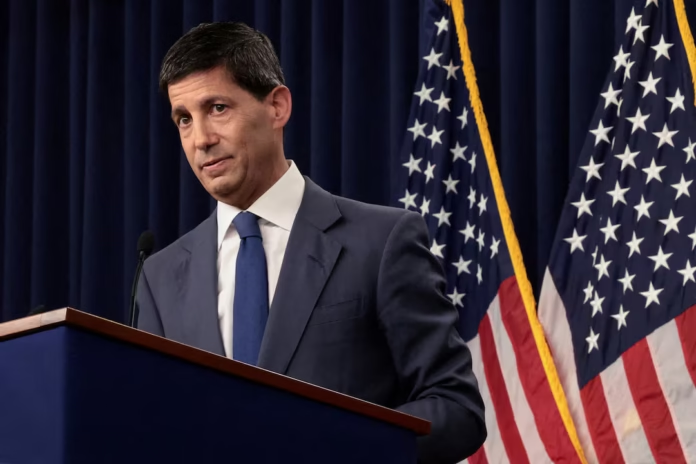

The Jackson Hole Fed meeting is drawing intense attention from investors, economists and financial markets as Federal Reserve Chair Kevin Warsh prepares to deliver his first keynote address at the annual Jackson Hole Economic Policy Symposium.
The 2026 symposium is taking place August 27–29 in Jackson, Wyoming, with this year’s official theme focused on “Financial Innovation — Implications for Payments and Policy.” The Federal Reserve Bank of Kansas City hosts the event, which brings together central bankers, policymakers, academics and economists.
Warsh’s keynote is scheduled for 8 a.m. Mountain Time, or 10 a.m. Eastern Time, on Friday, August 28. Unlike an FOMC meeting, the Jackson Hole event itself does not involve a vote to raise or lower interest rates. Instead, markets are watching Warsh’s remarks for clues about how the Federal Reserve could approach inflation, interest rates and monetary policy in the months ahead.
Key Points Summary
╔════════════════════════════════════════════════════════╗
║ – Fed Chair Kevin Warsh is scheduled to deliver his first Jackson Hole keynote on Friday, August 28. ║
║ – The 2026 Jackson Hole symposium runs August 27–29 in Wyoming and is focused on financial innovation, payments and policy. ║
║ – The Federal Reserve’s current target range for the federal funds rate is 3.50% to 3.75%. ║
║ – July inflation remains well above the Fed’s 2% target, with headline PCE inflation at 3.7% and core PCE at 3.3%. ║
║ – Markets are looking for clues about September’s rate decision, but the Jackson Hole event itself is not an FOMC rate-setting meeting. ║
╚════════════════════════════════════════════════════════╝
NEED TO KNOW
○ Federal Reserve Chair Kevin Warsh is scheduled to speak at 10 a.m. ET on Friday, August 28, during the Jackson Hole Economic Policy Symposium.
□ The Fed last held its policy meeting on July 28–29 and kept the federal funds target range at 3.50% to 3.75% in a 9–3 vote.
◇ Three voting officials — Beth Hammack, Neel Kashkari and Lorie Logan — preferred a quarter-point rate increase at the July meeting.
△ The latest PCE data show inflation remains elevated, with the headline index up 3.7% over the year through July and core PCE up 3.3%.
What Is the Jackson Hole Fed Meeting?
The phrase “Jackson Hole Fed meeting” is commonly used to describe the Federal Reserve’s closely watched annual gathering in Wyoming. Technically, however, Jackson Hole is an economic policy symposium, not a formal Federal Open Market Committee meeting.
The Federal Reserve Bank of Kansas City organizes the event. The symposium has become one of the most important annual gatherings for global central bankers and economists because speeches and discussions can provide insight into the direction of monetary policy.
The 2026 symposium is particularly significant because it marks Kevin Warsh’s first appearance at Jackson Hole as Federal Reserve chair.
Kevin Warsh’s First Jackson Hole Speech
Warsh became Federal Reserve chair in May 2026 and has so far adopted a relatively restrained approach to providing forward guidance on interest rates.
That communication strategy has increased the importance of his Jackson Hole appearance. Investors want to know whether Warsh will provide more information about how he views inflation, economic growth, financial conditions and the appropriate path for monetary policy.
Reuters reported that investors and central bankers are watching the speech closely for indications of how Warsh intends to deal with inflation that remains above the Fed’s 2% target and volatility in the bond market.
Warsh has previously emphasized the Fed’s commitment to restoring price stability. At the July FOMC meeting, he maintained that the central bank has a 2% inflation target and that it would not waver from its commitment to price stability.
Fed Interest Rates Before the Jackson Hole Event
The latest formal interest-rate decision came at the July 28–29 FOMC meeting.
The committee voted 9–3 to maintain the federal funds target range at 3.50% to 3.75%. The Fed said economic activity was expanding at a solid pace, while inflation remained elevated relative to its 2% objective.
The three dissenting members favored a 25-basis-point rate increase, highlighting the disagreement within the policy-setting committee over how aggressively to respond to persistent inflation.
The next scheduled FOMC meeting is September 15–16, 2026, making Warsh’s Jackson Hole remarks an important point of attention before that decision.
Inflation Remains a Major Issue
Fresh economic data released this week show why inflation is likely to remain central to the Jackson Hole discussion.
According to the Bureau of Economic Analysis, the Personal Consumption Expenditures price index increased 3.7% in July from a year earlier. The core PCE index, which excludes food and energy, increased 3.3% over the same period. Both headline and core prices rose 0.2% from June to July.
Those figures remain significantly above the Federal Reserve’s 2% inflation goal.
The inflation data are therefore important for markets trying to determine whether the Fed could eventually move toward tighter policy, maintain the current rate setting or consider reductions if economic conditions change.
Why Investors Are Watching Jackson Hole
Jackson Hole has historically been a major venue for Federal Reserve chairs to discuss the economy and the broader framework guiding monetary policy.
This year’s event is receiving additional attention because Warsh has provided relatively limited forward guidance since becoming chair. AP reported that investors are looking for greater clarity about his position on inflation and future monetary policy, particularly after his limited guidance at the July meeting.
Financial markets can react quickly when expectations for interest rates change. A shift in expectations can affect Treasury yields, the U.S. dollar, stocks, mortgages and other borrowing costs.
That means even without a formal rate vote, a major Jackson Hole speech can have significant market consequences.
Jackson Hole 2026 Theme: Financial Innovation
The formal theme of this year’s symposium is “Financial Innovation — Implications for Payments and Policy.”
The Friday agenda includes discussions about financial innovation and the international monetary system, tokenized finance and payments innovation. The program also includes participants from major international institutions, including the European Central Bank and International Monetary Fund.
The broader theme is important because technological changes in payments and finance are increasingly affecting the way money moves through the economy and how central banks think about monetary policy.
What to Watch From Warsh
Investors are expected to pay particular attention to several areas during Warsh’s remarks:
- Inflation: Whether he provides a stronger signal about the Fed’s response to inflation above 2%.
- Interest rates: Whether he offers any indication about the possible direction of policy before the September FOMC meeting.
- Economic growth: How he assesses the resilience of the U.S. economy.
- Financial markets: Whether he discusses rising Treasury yields and broader financial conditions.
- Fed communication: Whether his approach to forward guidance changes.
- Monetary policy framework: Whether he offers more details about the reviews and task forces underway at the central bank.
Reuters reported that Warsh’s cautious communication style has increased pressure on him to clarify how the Fed would respond if inflation remains persistently above target.
Jackson Hole Fed Meeting vs. September FOMC Meeting
It is important to distinguish the two events.
The Jackson Hole symposium is an economic conference, while the FOMC meeting is where the Federal Reserve formally decides whether to change its target interest rate.
Therefore, readers should not interpret Warsh’s Jackson Hole speech as a new rate decision.
The next formal FOMC meeting is scheduled for September 15–16. The July meeting left rates unchanged at 3.50%–3.75%, with three officials voting for a quarter-point increase.
Warsh’s remarks could nevertheless influence market expectations ahead of that meeting.
Jackson Hole Fed Meeting Latest Update
As of the latest available information on August 28, Kevin Warsh’s Jackson Hole keynote remains the central focus of the symposium.
The event is underway in Wyoming, but there has been no new FOMC rate decision associated with the symposium. The Federal Reserve’s latest official rate decision remains the July 29 decision to hold the target range at 3.50% to 3.75%.
The latest inflation figures also remain a key backdrop: headline PCE inflation was 3.7% in July, while core PCE inflation was 3.3%.
Markets will therefore be listening closely to Warsh for any indication of how he sees the balance between inflation, economic growth and future monetary policy.
Bottom Line
The Jackson Hole Fed meeting is not a formal interest-rate-setting meeting, but the 2026 symposium has become an important market event because it gives Fed Chair Kevin Warsh a major platform to explain his thinking about monetary policy.
With inflation still above the Fed’s 2% target, the federal funds rate at 3.50%–3.75%, and the next FOMC meeting scheduled for September, Warsh’s remarks could provide important context for investors trying to understand the central bank’s next steps.
Stay tuned for the latest Jackson Hole Fed meeting developments and share your thoughts on what Kevin Warsh’s remarks could mean for interest rates and the U.S. economy.