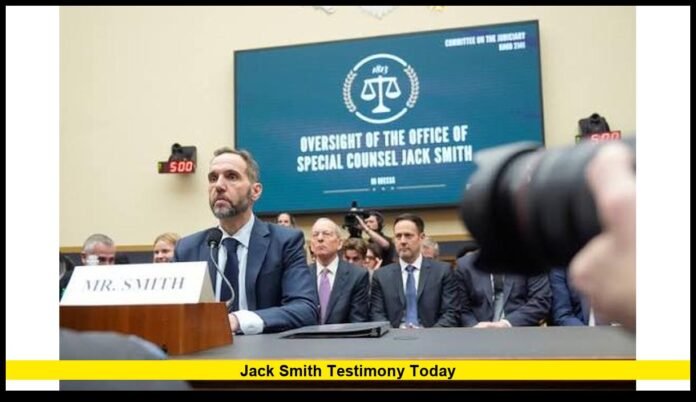

Jack Smith testimony today brought the former special counsel before the Senate Judiciary Committee for a closely watched hearing about his investigations of President Donald Trump and the investigative methods used by his team. Smith appeared in Washington on September 29, 2026, to answer senators’ questions about his handling of the federal investigations and the collection of communications involving members of Congress.
The hearing began at 9 a.m. Eastern time in Room 216 of the Hart Senate Office Building. The Senate Judiciary Committee listed Smith as the sole witness and identified him as a former special counsel at the Department of Justice.
Republican senators questioned Smith about whether his office exceeded its authority while investigating Trump and people connected to the effort surrounding the 2020 presidential election. They also focused on records involving lawmakers, including text messages and phone records obtained during the investigation.
Smith defended the work of his office. He rejected claims that his decisions were driven by political considerations and maintained that prosecutors acted based on evidence and applicable law. Reuters reported that Smith also said threats of prosecution would not silence him.
The testimony represents another major congressional examination of Smith’s work after his office brought two federal criminal cases against Trump. Neither case reached a trial.
Why Jack Smith testified before the Senate
The Senate Judiciary Committee scheduled the hearing after months of Republican scrutiny of Smith’s former investigative operation.
The committee’s official hearing title is “Oversight of Jack Smith’s Abuse of Authority and the Targeting of Republicans and Related Matters.” That wording reflects the committee’s stated oversight focus. It is not itself a judicial finding against Smith.
Republican senators have raised questions about investigative steps taken during Smith’s election-related investigation. A major issue involves communications records connected to members of Congress.
Committee Republicans said records showed that Smith’s team obtained and reviewed text messages involving 44 members of Congress. The records covered both Republicans and Democrats.
The Senate investigation has examined whether investigators followed Justice Department procedures for handling potentially privileged congressional material.
Smith’s testimony gave him an opportunity to respond directly to those concerns.
What senators asked Smith about
Questions during the hearing focused heavily on the investigative methods used by Smith’s team.
Republican senators challenged Smith over the collection of congressional communications. They questioned why investigators sought the information, how it was handled and whether appropriate protections were used.
The controversy involves communications gathered as investigators examined events surrounding the 2020 presidential election and January 6, 2021.
According to records released by Senate Republicans, investigators obtained text messages involving 44 members of Congress. The group included 40 Republicans and four Democrats, according to the records described by Reuters and the Senate Judiciary Committee.
Republican senators have argued that investigators should have used additional safeguards before reviewing communications involving lawmakers.
Smith defended the investigative decisions.
He argued that investigators had legitimate reasons to examine communications relevant to the events under investigation.
That disagreement became one of the central subjects of the Senate hearing.
The 44 members of Congress at the center of the dispute
The number 44 has become a major part of the congressional investigation into Smith’s former office.
Senate records released in July said Smith’s investigative team obtained and reviewed text messages from 44 current and former members of Congress.
The communications came from government-issued phones and covered a period surrounding the 2020 presidential election.
The records included communications involving lawmakers from both political parties. However, Republicans represented the large majority of the lawmakers identified in the Senate’s release.
Senate investigators have questioned whether the process used to obtain and review those messages complied with Justice Department protocols.
The Senate Judiciary Committee has described the matter as part of its broader Arctic Frost oversight investigation.
Smith has disputed the broader characterization that his team targeted Republicans because of their political affiliation.
The distinction matters because obtaining communications during a criminal investigation and intentionally targeting people because of their political affiliation are separate allegations. The Senate hearing examined those competing claims but did not turn the congressional hearing into a criminal trial.
Smith defends his investigations
Smith also faced questions about the two major federal investigations he supervised.
Attorney General Merrick Garland appointed Smith as special counsel in November 2022. His mandate included investigating Trump’s efforts to interfere with the transfer of presidential power after the 2020 election and Trump’s handling of highly classified government documents.
Smith’s office ultimately charged Trump in both investigations.
The election-related case involved four counts.
The classified-documents case involved 40 counts.
Those cases ended before a trial could take place.
The election case ended after Trump won the 2024 presidential election and prepared to return to office. The Justice Department’s longstanding position bars the federal prosecution of a sitting president.
Smith’s classified-documents case also ended without a trial.
Smith continued to defend the decisions behind both cases during his congressional testimony.
He maintained that the investigations were based on evidence and law rather than political considerations. Reuters reported that Smith said he would not allow threats of prosecution to silence his defense of the work.
Smith rejects claims of political motivation
A major disagreement during the hearing concerned the motivation behind Smith’s investigations.
Republican senators have accused Smith and his former investigative team of using federal law enforcement against political opponents.
Smith rejected that characterization.
He has maintained that the investigations were conducted by career prosecutors and investigators who followed evidence developed during their work.
The disagreement is important because the Senate hearing examines both investigative conduct and the underlying cases.
Republican lawmakers are examining whether Smith’s office crossed legal or procedural boundaries.
Democratic senators have defended Smith’s investigations and argued that the cases involved serious allegations that prosecutors had a responsibility to investigate.
The two sides therefore presented very different interpretations of Smith’s record.
The testimony itself provides Smith’s direct response to those allegations.
The role of the 2020 election investigation
Smith’s election investigation focused on efforts to interfere with the transfer of presidential power following the 2020 election.
The investigation examined events that occurred before and after January 6, 2021.
Smith eventually charged Trump with four federal counts.
The case never reached trial.
After Trump returned to the presidency, the Justice Department ended the federal prosecution under its position concerning the prosecution of a sitting president.
Smith later completed his work as special counsel and left the Justice Department.
The Senate hearing does not reopen the criminal case.
Instead, senators are examining how the investigation was conducted and whether Smith’s team properly exercised its authority.
That distinction is important when evaluating what the September 29 testimony actually changes.
The classified-documents investigation
Smith’s second major investigation concerned classified documents retained by Trump after he left the White House.
The case resulted in 40 federal counts.
Smith’s office alleged that Trump unlawfully retained classified government documents and obstructed efforts to recover them.
The case did not reach a jury trial.
A federal judge separately questioned Smith’s appointment as special counsel, and the Justice Department eventually ended the prosecution after Trump returned to office.
Smith defended his handling of the matter during his congressional testimony.
The Senate hearing, however, focused more broadly on Smith’s conduct and investigative procedures rather than reopening the criminal case itself.
Why congressional records became such a major issue
The dispute over congressional communications involves a constitutional question as well as investigative procedure.
Members of Congress have protections under the Speech or Debate Clause for certain legislative activities.
Those protections do not create blanket immunity from criminal investigations.
Instead, disputes can arise over whether investigators improperly obtained or examined material connected to legislative activity.
That issue has become a central part of the Senate Judiciary Committee’s investigation.
Republican lawmakers argue that Smith’s team failed to provide sufficient safeguards for congressional communications.
Smith has defended the investigative process and the relevance of the records.
The 44-member figure comes from records released by Senate Republicans in July. Those records formed part of the material that lawmakers used in questioning Smith.
Smith faces questions about earlier congressional testimony
The September hearing was not Smith’s first appearance before Congress.
He previously testified before the House Judiciary Committee.
His earlier testimony has also become part of the political and legal dispute surrounding his work.
House Judiciary Chairman Jim Jordan accused Smith of making misleading statements concerning the collection of congressional phone records.
Smith’s legal team has rejected those allegations.
A congressional referral or accusation does not establish that a crime occurred.
Any criminal investigation would require a separate process involving federal prosecutors and applicable legal standards.
That distinction remains relevant as lawmakers continue examining Smith’s previous testimony.
What Democrats said about the hearing
Democratic members of the Senate Judiciary Committee have taken a different view of the controversy.
Sen. Dick Durbin, the committee’s ranking Democrat, had repeatedly supported allowing Smith to testify publicly under oath.
Before the September hearing, Durbin argued that Smith should have an opportunity to answer questions directly rather than having lawmakers rely solely on documents and testimony from other witnesses.
Democrats have also defended the underlying investigations.
Their argument has been that federal prosecutors were examining allegations involving an attempt to interfere with the transfer of presidential power and the retention of classified government documents.
During the Senate hearing, Democrats challenged Republican accusations about Smith’s motives and conduct.
The result was a sharply divided hearing, with senators disagreeing about both Smith’s investigations and the meaning of the records released during the congressional inquiry.
What the testimony means for Smith
Smith’s testimony puts his own explanation directly into the congressional record.
That matters because many of the allegations against his former investigative team have developed through congressional reports and document releases.
Smith was able to address those allegations personally.
He defended the investigative decisions made by his office and rejected claims that his work was politically motivated.
He also challenged the idea that threats of prosecution should determine whether he discusses his former investigations.
Reuters reported that Smith said he would not be silenced by threats of prosecution.
The testimony does not, however, resolve the disputes between Smith and his congressional critics.
The Senate Judiciary Committee can continue its oversight work.
The Justice Department can separately consider matters referred to it.
Those are distinct processes.
Does the hearing reopen Trump’s federal cases?
No.
The Senate hearing does not reopen either federal criminal case that Smith brought against Trump.
The election case ended after Trump returned to the presidency.
The classified-documents case also ended before trial.
Smith’s testimony concerns congressional oversight of his former investigations and the conduct of his investigative team.
It does not constitute a new criminal proceeding against Trump.
Likewise, the Senate hearing does not determine whether Smith violated criminal law.
Those issues would require separate legal proceedings.
What happens after Jack Smith testimony today?
The Senate Judiciary Committee can continue examining the records associated with Smith’s investigations.
Lawmakers may review additional documents and seek further information from the Justice Department.
The committee’s work may also continue to focus on how investigators handled congressional communications.
The criminal referral involving Smith is a separate matter.
A referral does not automatically result in criminal charges. Federal prosecutors must independently evaluate the evidence and applicable law before taking any action.
For Smith, the immediate significance of the September 29 hearing is that he has publicly defended his investigative record before the Senate committee overseeing the inquiry.
The testimony also gives senators an opportunity to challenge him directly rather than relying only on documents released earlier.
Key details from the September 29 hearing
- Witness: Jack Smith, former special counsel
- Committee: Senate Judiciary Committee
- Date: September 29, 2026
- Start time: 9 a.m. Eastern time
- Location: Hart Senate Office Building, Room 216
- Main subject: Oversight of Smith’s former investigations
- Major controversy: Collection and review of congressional communications
- Number of lawmakers identified in released records: 44
- Trump investigations led by Smith: Election-related investigation and classified-documents investigation
- Current status of those cases: Both ended without a trial
- Current status of Smith: Former Justice Department special counsel
The Senate Judiciary Committee officially listed Smith as the witness for the September 29 hearing.
Why today’s testimony is receiving attention
The hearing brings together several disputes that have developed around Smith’s time as special counsel.
His investigations produced federal charges against Trump.
Those prosecutions ended without trials.
Congress later began examining how Smith’s investigative team obtained records involving lawmakers.
The Senate’s release concerning 44 members of Congress became a major part of that investigation.
Smith now has given senators his own account of those events.
Republicans have continued to argue that the investigation involved improper targeting and investigative overreach.
Democrats have defended the legitimacy of the investigations and Smith’s prosecutorial decisions.
Those competing positions remain central to the congressional debate.
For readers following the developments, the most important confirmed fact is that Smith appeared before the Senate Judiciary Committee on September 29 and answered questions about his former work.
The hearing does not itself establish criminal wrongdoing.
It also does not change the status of the federal cases that Smith previously brought against Trump.
Instead, it adds his testimony to an ongoing congressional examination of his conduct and investigative methods.
What to know about Jack Smith testimony today
Jack Smith’s appearance before the Senate Judiciary Committee has placed his former Trump investigations under renewed congressional scrutiny.
The hearing focused on the way his team investigated the 2020 election, the classified-documents case and communications involving members of Congress.
Smith defended the investigations and rejected allegations that his decisions were driven by partisan motives.
Republican senators continued to challenge his authority and investigative methods.
Democratic senators defended his work and emphasized the allegations that originally prompted the federal investigations.
The Senate’s review is continuing, while any potential Justice Department action involving Smith would follow a separate process.
For now, Smith’s September 29 testimony stands as the latest major public examination of his work as special counsel.
Stay with the latest verified developments and share your thoughts as the Senate’s review of Jack Smith’s former investigations continues.