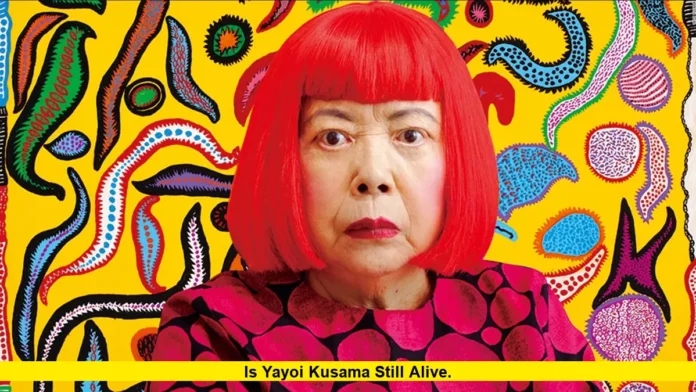

Yayoi Kusama, one of the most recognizable contemporary artists of the modern era, has died at the age of 97, meaning the answer to is yayoi kusama still alive is no. Her death was announced by the Yayoi Kusama Museum and Yayoi Kusama Foundation on August 27, 2026, confirming that the celebrated Japanese artist died at a hospital in Tokyo on August 14, 2026. The announcement said Kusama continued painting until her final days and remained dedicated to her artistic work throughout her life.
Yayoi Kusama’s Death Confirmed
The latest update provides official confirmation that Yayoi Kusama is no longer alive. According to the announcement from institutions associated with the artist, Kusama died in a Tokyo hospital on August 14, 2026. She was 97.
The news ended uncertainty surrounding the status of the artist, whose public presence had remained significant even in her later years. Kusama had continued to be represented through exhibitions, new works, museum programs and major international retrospectives.
Her death was announced publicly on August 27, more than a week after she died. The official statement celebrated a lifetime devoted to artistic creation and noted that she continued working until the end of her life.
No cause of death was provided in the official announcement. As a result, there is no confirmed public information establishing what caused Kusama’s death.
The announcement also emphasized that Kusama’s artistic philosophy would continue through her work. The institutions connected to her said they intended to carry forward her wishes and use art to bring hope and strength to people around the world.
Who Was Yayoi Kusama?
Yayoi Kusama was a Japanese avant-garde artist whose career stretched across painting, sculpture, installation art, performance, fiction and poetry. She became internationally famous for her repetitive patterns, polka dots, mirrored environments and distinctive visual language.
Born in Matsumoto, Japan, in 1929, Kusama began creating art at a young age. Her childhood experiences, including vivid hallucinations, became an important influence on her artistic development. She transformed those experiences into repeated patterns, dots, nets and expansive visual environments.
Kusama eventually moved to the United States in 1957 and arrived in New York the following year. There, she became part of the city’s experimental art scene during a period of major artistic change.
Her early work included the celebrated Infinity Net paintings, which featured thousands of repeated marks across large canvases. These works helped establish the artistic ideas that would later become central to her career.
Over subsequent decades, Kusama developed an unmistakable style that combined repetition, infinity, bright colors, mirrors and immersive spaces.
Kusama’s Rise to International Fame
Kusama’s career was unusually long and went through several distinct phases. Although she gained attention in New York during the 1960s, she did not immediately receive the level of recognition that would eventually define her legacy.
She experimented with paintings, sculptures, installations and performance art while challenging conventional ideas about art and society. Her work often explored themes of infinity, identity, repetition, sexuality and self-obliteration.
One of her best-known early projects was Narcissus Garden, which she presented at the 1966 Venice Biennale. The installation consisted of hundreds of reflective spheres arranged to create a striking visual environment.
Kusama later returned to Japan and continued developing her work. She eventually established a routine centered on her studio practice in Tokyo, producing art for decades.
Her international reputation grew substantially in the late 20th and early 21st centuries. Major museums began presenting retrospectives of her work, introducing new generations of audiences to her paintings and installations.
The Infinity Mirror Rooms Became a Global Phenomenon
For many people, the name Yayoi Kusama is closely associated with the Infinity Mirror Rooms.
These immersive installations use mirrors, lights and repeated objects to create the impression of seemingly endless space. Visitors are surrounded by reflections, producing an experience that can make a relatively small room appear limitless.
The concept reflects one of Kusama’s central artistic interests: infinity.
Her installations became particularly popular with younger audiences as museums increasingly shared photographs and videos of the experiences online. The combination of mirrors, lights, pumpkins, dots and vivid colors helped make Kusama one of the most recognizable contemporary artists in popular culture.
Her work became especially prominent on social media, where visitors frequently photographed themselves inside the installations.
That popularity also brought a new level of attention to Kusama’s broader artistic career. People who encountered her work through an Infinity Mirror Room often became interested in her paintings, sculptures, pumpkins and earlier experimental projects.
Her Signature Polka Dots and Pumpkins
Polka dots are among the most recognizable elements of Kusama’s artistic identity.
She used repeated dots across canvases, sculptures, rooms and outdoor environments, transforming a simple visual motif into an artistic language. The repetition could make individual objects appear to merge with their surroundings.
Pumpkins became another important recurring symbol.
Kusama’s pumpkin sculptures are among her most widely recognized works, particularly the bright yellow pumpkin with black dots associated with her installations. Pumpkins appeared repeatedly in her later career and became closely linked with her public image.
The combination of dots, pumpkins, mirrors and vivid colors made Kusama’s work instantly recognizable across museums, galleries and public exhibitions.
Kusama Continued Working Into Her Later Years
One of the most remarkable aspects of Kusama’s career was the length of time she remained creatively active.
Even as she approached her 90s and later her 97th year, Kusama remained associated with new exhibitions and continuing artistic projects. Her official institutions stated after her death that she continued painting until her final days.
That detail is particularly significant because Kusama’s career was not simply a retrospective story during her final years. Her work continued to be exhibited internationally, and her artistic output remained part of the contemporary art conversation.
In 2026 alone, her work appeared in major exhibitions in several countries. A large presentation at Museum Ludwig in Cologne ran from March through August, while another exhibition, KUSAMA’s POP, was held at the Yayoi Kusama Museum in Tokyo during 2026.
Her official exhibition schedule had also listed a major presentation at the Stedelijk Museum Amsterdam beginning in September 2026. Following her death, the status and interpretation of future exhibitions may change, but the planned programs demonstrate how active her international artistic legacy remained.
Why People Are Searching for “Is Yayoi Kusama Still Alive”
Search interest surrounding is yayoi kusama still alive is understandable because Kusama remained a major public figure for decades.
She lived far beyond the age at which many artists from her generation had retired, while continuing to produce and exhibit work. Her distinctive appearance, including her signature red hairstyle and brightly colored clothing, also made her unusually recognizable outside traditional art circles.
Another reason for public interest is the continued appearance of Kusama exhibitions around the world. Even when Kusama herself was not physically present at an exhibition, her name remained prominently associated with new museum shows and installations.
The latest announcement now provides a definitive answer. Kusama died on August 14, 2026, and her death was officially announced on August 27.
Kusama’s Influence on Contemporary Art
Kusama’s influence extends well beyond her famous Infinity Mirror Rooms.
Her use of repetition, immersive environments and large-scale installations helped shape the way audiences experience contemporary art. Rather than simply viewing an artwork from outside, visitors to many Kusama installations become part of the environment.
Her career also demonstrated how an artist could develop a highly distinctive visual identity while moving between different artistic forms.
She worked across:
- Painting and drawing
- Sculpture
- Installation art
- Performance
- Literature and fiction
- Poetry
- Public and outdoor artworks
The consistency of her themes helped connect these different forms. Dots, infinity, repetition and the dissolution of individual boundaries appeared throughout many periods of her career.
A Career That Spanned Nearly a Century
Kusama’s life covered an extraordinary period of artistic and cultural change.
She began making art before World War II, developed her career in postwar Japan, moved to New York during the late 1950s and participated in the experimental art world of the 1960s. Her career then continued through periods when her work received less mainstream attention before experiencing a remarkable resurgence.
By the 21st century, Kusama had become a global cultural figure.
Her exhibitions attracted large audiences, her installations became major museum attractions and her visual motifs appeared in popular culture around the world.
Her late-career success was especially notable because it came after decades of artistic experimentation and periods when she had received considerably less recognition than she later achieved.
What Happened to Kusama’s Exhibitions After Her Death?
Kusama’s death does not mean that her existing artwork or exhibitions immediately disappear.
The Yayoi Kusama Museum announced that its KUSAMA’s POP exhibition would continue as scheduled through August 30, 2026. Museums and galleries can continue displaying artworks created during an artist’s lifetime, and Kusama’s extensive body of work is expected to remain an important part of international museum collections.
Future exhibitions may also continue to present her work. However, individual institutions can make their own decisions regarding scheduling, programming and memorial presentations.
The planned posthumous exhibition activity underscores the scale of Kusama’s artistic legacy. Her work was already scheduled to remain visible internationally beyond her lifetime.
Yayoi Kusama’s Legacy
Kusama leaves behind one of the most distinctive artistic legacies of the modern era.
Her influence can be seen in contemporary installation art, immersive museum experiences and the increasing relationship between visual art and digital culture. Her ability to turn personal experiences and recurring visual ideas into globally recognizable artworks helped establish a career unlike almost any other.
The significance of Kusama’s work also extends beyond popularity. Her career challenged conventional boundaries between avant-garde art and mass culture.
She transformed simple visual elements such as dots and mirrors into complex artistic environments while maintaining a recognizable identity across decades of changing artistic trends.
Her work will continue to be studied, exhibited and interpreted by museums, artists, scholars and audiences around the world.
The Final Answer on Yayoi Kusama’s Status
For anyone searching is yayoi kusama still alive, the latest verified information is definitive: Yayoi Kusama died on August 14, 2026, at a hospital in Tokyo, at the age of 97.
Her death was officially announced on August 27, 2026, by the Yayoi Kusama Museum and Yayoi Kusama Foundation. The official announcement did not provide a cause of death, so any claims about the specific cause should not be treated as confirmed.
Kusama’s passing marks the end of the life of an artist whose career lasted nearly a century. Yet her work is expected to remain highly visible. Her Infinity Mirror Rooms, polka-dot paintings, pumpkin sculptures and other creations continue to shape how millions of people encounter contemporary art.
The fact that Kusama continued painting until her final days makes her career particularly remarkable. Rather than simply leaving behind a historical body of work, she remained creatively engaged until the end of her life.
Final Thoughts
Yayoi Kusama’s death at 97 closes an extraordinary chapter in contemporary art, but it does not diminish the continuing presence of her work. From her early Infinity Net paintings to her globally recognized mirrored installations and pumpkin sculptures, Kusama developed an artistic vocabulary that became instantly identifiable across generations.
The latest official information confirms that she died in Tokyo on August 14, 2026. While there is no publicly confirmed cause of death, her artistic institutions have emphasized her lifelong commitment to creativity and her continued painting until the end.
Her legacy will continue through museums, exhibitions, collections and the countless people who encounter her art. For an artist so deeply interested in infinity, the continued life of her work may be one of the most fitting parts of her enduring legacy.
What do you think Yayoi Kusama’s greatest contribution to contemporary art will be remembered as? Share your thoughts in the comments and stay updated for further developments about her legacy and exhibitions.