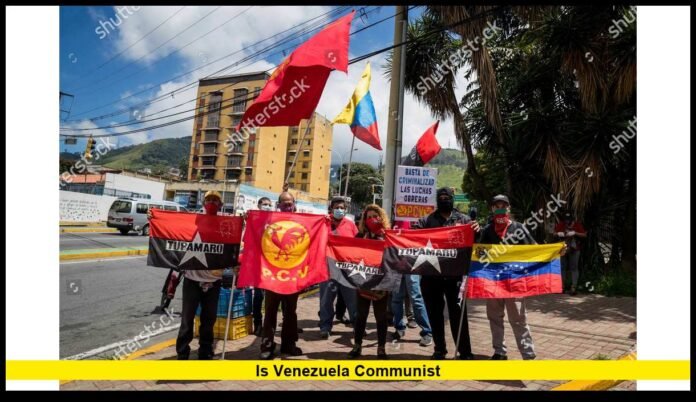

Is Venezuela communist is a question that continues to dominate political discussions in the United States, especially as Venezuela remains locked in economic hardship, political centralization, and global scrutiny. As of today, Venezuela is not legally or constitutionally a communist country, even though it is governed under a rigid socialist framework that places extraordinary power in the hands of the state. Understanding this distinction requires moving beyond slogans and examining how Venezuela actually operates in law, governance, economics, and daily life.
For American readers, the difference between communism and socialism is often blurred. In Venezuela’s case, that confusion is understandable. The country’s leadership frequently uses revolutionary language, rejects free-market capitalism, and enforces strong government control over major industries. Yet Venezuela does not meet the formal criteria that define a communist state. The truth lies in the details of its political system, economic structure, and legal foundations.
What Communism Means in Practical Terms
Communism is not simply a government that controls large parts of the economy. It is a specific political and economic model built around several core principles. In a communist system, all means of production are owned by the state, private property is abolished, and economic activity is centrally planned. The government determines what is produced, how it is distributed, and who receives it. Political power is concentrated in a single ruling party, and opposition parties are not allowed to compete.
In such systems, elections either do not exist or function only symbolically. Media outlets operate as state instruments, and independent civic organizations are prohibited. The ruling ideology is embedded into the constitution, and the state openly defines itself as communist.
These elements must all exist together for a country to be accurately described as communist.
Venezuela’s Constitutional and Legal Identity
Venezuela’s constitution does not declare the country communist. Instead, it defines Venezuela as a democratic and social state committed to social justice, equality, and national sovereignty. While the constitution allows for strong state intervention in the economy, it also explicitly recognizes private property, private enterprise, and individual economic rights.
This legal framework is one of the clearest reasons Venezuela cannot be classified as communist. Private ownership still exists in housing, agriculture, retail, services, and manufacturing. While the government regulates these sectors heavily, it has not abolished them outright.
Even under intense state control, Venezuelan law continues to distinguish between public and private ownership, a distinction that disappears entirely under communism.
The Ideological Roots of Venezuela’s Socialist Model
Venezuela’s current political system emerged from decades of dissatisfaction with inequality, corruption, and economic dependence on oil revenues. Socialist ideology gained traction as a response to these challenges, promising redistribution, national control of resources, and expanded social programs.
Under this model, the government increased public spending on healthcare, education, housing, and food assistance. Strategic industries were nationalized to fund these programs, especially oil, electricity, and heavy manufacturing. The goal was not to eliminate all private economic activity, but to place the state at the center of national development.
This approach aligns with socialism rather than communism, even though the scale of state involvement is unusually large.
Why Venezuela Is Often Labeled Communist
Despite these distinctions, many people continue to describe Venezuela as communist. This perception is driven by lived reality rather than legal definitions. Power in Venezuela is highly centralized, with the executive branch exercising control over courts, electoral bodies, and security forces.
Political opposition exists but operates under severe constraints. Media outlets face censorship, licensing pressures, and economic limitations. Protest activity is restricted, and dissent carries legal risk.
For citizens experiencing these conditions, the system feels indistinguishable from communism, even if it is not formally defined as such.
State Control of the Economy
Venezuela’s economy is best described as state-dominated but not state-exclusive. The government controls oil production, which remains the backbone of national revenue. It also manages utilities, fuel distribution, and major infrastructure projects.
At the same time, millions of Venezuelans work outside the state sector. Small businesses, informal markets, private transport services, and family-owned enterprises continue to operate. These activities would not exist legally under a communist economy.
The presence of widespread informal trade underscores the limits of state control and highlights Venezuela’s departure from full central planning.
Currency Controls and Market Distortions
Government intervention has deeply affected Venezuela’s currency system. Exchange controls, price caps, and import restrictions have distorted markets and reduced purchasing power. Inflation has reshaped daily life, forcing households to adapt through informal economic activity.
Rather than eliminating markets entirely, these policies have fragmented them. Multiple pricing systems exist simultaneously, and survival often depends on adaptability rather than state allocation.
This outcome differs from communist systems, where the state distributes goods directly according to centralized plans.
Political Parties and Electoral Structure
Venezuela continues to hold elections, including presidential, legislative, and regional contests. Multiple political parties are legally registered, and opposition candidates appear on ballots. Voters technically retain the right to choose their leaders.
However, the electoral environment is highly unequal. Institutional bias, legal obstacles, and limited media access undermine competitiveness. These conditions weaken democracy but do not eliminate it.
Communist states typically ban opposition parties entirely. Venezuela’s allowance of restricted pluralism places it outside that category.
Media Environment and Information Access
State-aligned media outlets dominate traditional broadcasting, shaping public narratives and limiting critical coverage. Independent journalism faces legal, financial, and regulatory pressure.
Despite these challenges, independent voices persist, particularly online. Social media platforms and digital outlets provide spaces for alternative perspectives, even under surveillance.
This partial openness contrasts with communist systems, where all media functions as a government mouthpiece.
Foreign Policy and Ideological Alignment
Venezuela maintains close relationships with governments that oppose Western influence and promote socialist or revolutionary ideals. These alliances contribute to perceptions of communist alignment, especially in U.S. political debates.
However, diplomatic partnerships alone do not define internal political systems. Venezuela’s foreign policy reflects strategic positioning rather than constitutional ideology.
Comparing Venezuela to Communist States
A direct comparison clarifies the issue:
- Venezuela allows private property; communist states do not
- Venezuela holds elections; communist states do not allow competition
- Venezuela permits private business; communist states ban it
- Venezuela lacks full central planning; communist states enforce it
These differences are substantial and decisive.
Daily Life for Venezuelan Citizens
For ordinary Venezuelans, ideological labels matter less than daily survival. Citizens navigate shortages, fluctuating prices, and limited public services. Government assistance programs provide some relief but are often insufficient.
Family networks, informal trade, and community cooperation fill the gaps. This decentralized coping system differs fundamentally from communist societies, where the state controls distribution.
Ideology Versus Implementation
Much confusion stems from political rhetoric. Leaders often use language that echoes communist themes, including anti-capitalism and revolutionary struggle. These messages shape international perceptions.
However, rhetoric does not equal structure. Laws, institutions, and economic behavior reveal a more complex reality.
Is Venezuela Communist in Reality?
Is Venezuela communist can be answered with clarity when definitions are applied accurately. Venezuela is not a communist country. It is an authoritarian socialist state with extensive government control, weakened democratic institutions, and a mixed economy.
This distinction is not semantic. It affects how policies are analyzed, how responsibility is assigned, and how solutions are discussed.
Why This Question Matters to Americans
In U.S. discourse, Venezuela is often cited as a warning or comparison in debates about economic policy and government power. Accuracy matters. Mislabeling Venezuela oversimplifies the causes of its crisis and misrepresents political realities.
Understanding the difference between socialism, authoritarianism, and communism leads to more informed discussion and better policy analysis.
The Road Ahead
Venezuela’s future remains uncertain. Political reforms, economic adjustments, or leadership changes could alter the system again. For now, the country remains firmly socialist in policy, authoritarian in governance, and non-communist in structure.
Do you believe political systems should be judged by ideology or by lived experience? Share your thoughts and stay engaged as Venezuela’s story continues to unfold.