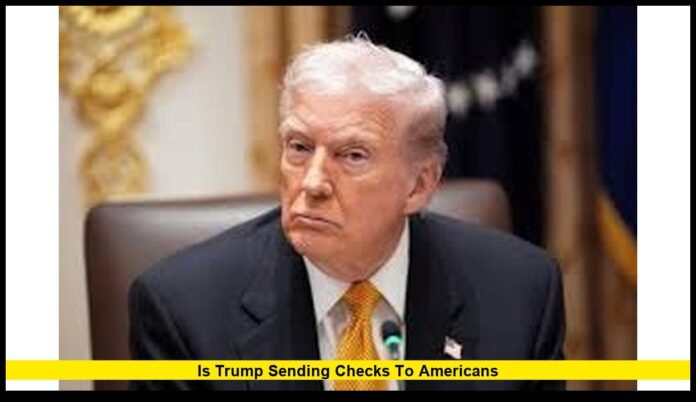

Trump Proposes $2,000 “Tariff Dividend” Payments Amid Economic Debate and Policy Discussions
If you are asking is Trump sending checks to Americans, the answer is that, as of now, no payments have been distributed. However, former President Donald Trump has proposed giving Americans $2,000 each through what he calls a “tariff dividend,” leveraging revenue collected from import tariffs. This idea has drawn considerable attention across the country, reigniting debates over economic stimulus, direct cash payments, and the role of tariffs in government funding. While Trump’s proposal is not yet law, it reflects his ongoing political and economic strategy, particularly in light of rising living costs and continued public interest in stimulus measures.
Understanding the Proposal
Trump’s plan centers on providing $2,000 payments to most Americans, excluding higher-income earners, funded specifically through federal tariff revenue rather than general tax revenue. Key elements include:
- Eligibility: Broadly targeted at U.S. citizens, with exclusion criteria for high earners, though exact thresholds have not been defined.
- Funding Source: Revenue collected from tariffs on imported goods, which Trump claims has accumulated to trillions of dollars over time.
- Purpose: The payments are intended to offer immediate financial relief to Americans struggling with inflation, high energy costs, and rising prices for basic goods.
- Status: No payments have been made. Congress has not passed legislation, and the Treasury Department has not implemented a distribution mechanism.
This means the question is Trump sending checks to Americans remains theoretical at this stage — the proposal is under discussion and has not yet moved into action.
How This Compares to Previous Stimulus Programs
Trump’s $2,000 check proposal draws parallels to previous direct cash relief efforts:
- COVID‑19 Stimulus Checks (2020–2021): The federal government issued payments ranging from $600 to $1,400 per individual, totaling over $800 billion. These payments were aimed at boosting consumer spending during the pandemic.
- Economic Impact: Past stimulus checks had measurable effects on consumer demand, helping to sustain retail, travel, and service sectors.
- Differences: Trump’s current proposal differs in funding methodology, relying on tariff revenue rather than legislative appropriations or deficit spending. This approach is unique in U.S. history, as tariffs are typically used as trade policy tools rather than direct revenue streams for household distribution.
The idea reflects a combination of policy innovation and political messaging, linking trade policy to domestic economic benefits.
Economic Considerations and Potential Impact
Tariff Revenue as a Funding Mechanism
Trump claims that tariffs imposed during his administration and continued policies have generated substantial revenue. While the revenue stream is significant, economic analysts caution that it may not be sufficient to fund widespread $2,000 payments to all eligible Americans.
- Estimated Costs: Distributing $2,000 per individual could cost approximately $300 billion.
- Available Tariff Revenue: Current estimates suggest the actual revenue from tariffs may be closer to $90–120 billion annually, creating a shortfall if the plan is implemented as proposed.
Consumer Spending and Inflation
- Supporters argue that the payments could increase consumer spending, providing a boost to retail and service sectors during a period of economic uncertainty.
- Critics caution that large-scale cash payments could exacerbate inflationary pressures, particularly when combined with existing price increases in housing, energy, and food.
Fiscal Policy Considerations
- Utilizing tariffs to fund direct payments is unconventional and may have broader implications for trade relations.
- Economists also note potential conflicts with deficit targets and monetary policy goals if such a large-scale payment program is enacted without accompanying fiscal adjustments.
Political Dimensions of the Proposal
Trump’s proposal is significant not only for its economic implications but also for its political messaging:
- Supporter Appeal: Direct cash payments are a highly visible policy action that resonates with voters seeking immediate financial relief.
- Policy Consistency: The plan reinforces Trump’s longstanding emphasis on tariffs as a tool to protect U.S. industries and generate domestic revenue.
- Partisan Debate: Critics argue that the checks could be seen as politically motivated, serving to strengthen support among Trump’s base ahead of future elections.
- Congressional Approval: While Trump can propose the plan, implementation would likely require legislative action, meaning it could face opposition or modification before becoming law.
This political angle is central to the ongoing discussion about whether Trump is actually in a position to send checks to Americans in the near future.
Implementation Challenges and Uncertainties
Even if the plan moves forward, several logistical and legal challenges remain:
- Legislative Authorization: Congress would need to pass a bill permitting the Treasury to distribute payments funded by tariff revenue.
- Distribution Mechanism: Determining how the checks would reach millions of Americans — via direct deposit, mailed checks, or tax credits — is a critical step.
- Eligibility Definition: Clear criteria for excluding high-income earners and ensuring fairness would need to be established.
- Economic Feasibility: Analysts warn that the scale of payments could exceed the revenue generated by tariffs, requiring supplemental funding.
- Timing: Without formal legislation and an established mechanism, there is no confirmed timeline for any payments.
These factors illustrate why the plan is still a proposal and not yet a practical program delivering funds to Americans.
Public and Media Reactions
The proposal has sparked mixed reactions from the public and media:
- Supporters: Many Americans express enthusiasm for immediate relief, particularly those facing financial strain. The idea of receiving $2,000 directly appeals to households with high expenses or mounting debt.
- Critics: Some question whether the plan is economically sound, noting that reliance on tariffs may raise costs for consumers and businesses. Others argue that the program is largely symbolic until Congress formally acts.
- Media Coverage: News outlets have debated the feasibility of using tariffs as a funding source and analyzed potential inflationary impacts. Public discourse often revolves around the likelihood of the payments actually reaching citizens.
This ongoing discussion highlights that while the proposal exists, the question is Trump sending checks to Americans remains speculative.
Potential Economic and Social Benefits
If implemented effectively, the proposed $2,000 payments could provide:
- Immediate Financial Relief: Support for families struggling with rent, utilities, food, and healthcare.
- Boost to Consumer Spending: A short-term surge in demand could stimulate retail, travel, and services.
- Political Engagement: Demonstrates tangible action to the public, influencing voter perception and participation.
- Economic Equity: Targeting middle- and lower-income households could help reduce financial disparities exacerbated by inflation.
However, these benefits would depend on proper implementation, congressional approval, and the actual availability of tariff revenue.
Next Steps and What to Watch
Key developments that will determine whether Trump’s proposal transitions from idea to action include:
- Congressional Response: Will a bill be introduced and passed to authorize payments?
- Funding Confirmation: Can the Treasury verify that tariff revenues are sufficient to fund $2,000 per eligible person?
- Implementation Plan: How will payments be distributed quickly and efficiently?
- Economic Monitoring: Analysts will evaluate potential inflation impacts, consumer response, and broader economic consequences.
- Public Communication: Updates from Trump and policy advisors will clarify eligibility, timing, and payment methods.
Monitoring these factors will provide a clear answer to the question is Trump sending checks to Americans.
Conclusion
At this time, Trump is not sending checks to Americans, but the proposal for $2,000 tariff-funded payments has generated significant discussion. The plan remains in a conceptual stage, requiring congressional action, clear eligibility rules, and a distribution system before it can be realized. While supporters view it as immediate economic relief, critics question the funding feasibility and potential inflationary effects.
Will Trump’s proposed checks become a reality, and how would they impact American households and the economy? Share your thoughts below and stay updated as this story continues to develop.