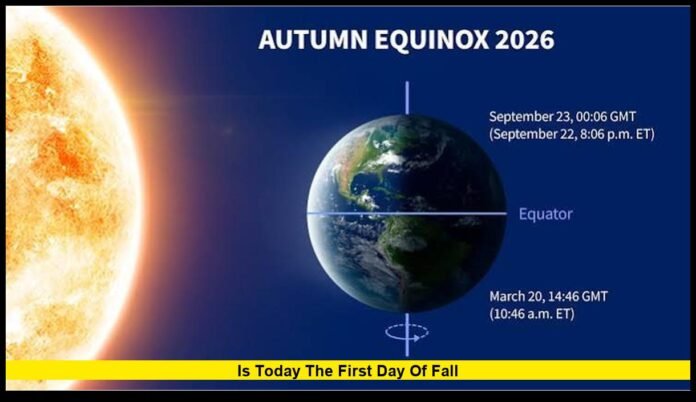

Is today the first day of fall? For people across the United States, the answer is yes if you are using the astronomical definition of the season. The autumnal equinox arrives on Tuesday, September 22, 2026, at 8:05 p.m. EDT, marking the official astronomical beginning of autumn in the Northern Hemisphere.
The timing is especially important this year because the same global event occurs on September 23 in Coordinated Universal Time. In the United States, however, the equinox occurs on September 22 because of the country’s position west of the prime reference time zone.
That means Americans looking at the calendar today are reaching the astronomical transition from summer to fall.
The change does not mean temperatures will suddenly drop tonight. It also does not mean every tree will immediately turn orange, red or yellow. Instead, the date represents a precise point in Earth’s yearly movement around the Sun.
When Does Fall Begin in 2026?
The 2026 autumnal equinox occurs at 8:05 p.m. Eastern Daylight Time on September 22.
The exact same astronomical event occurs at different local clock times across the country.
Here is how the timing translates across major U.S. time zones:
| U.S. time zone | Equinox time |
|---|---|
| Eastern | 8:05 p.m. EDT |
| Central | 7:05 p.m. CDT |
| Mountain | 6:05 p.m. MDT |
| Pacific | 5:05 p.m. PDT |
| Alaska | 4:05 p.m. AKDT |
| Hawaii | 2:05 p.m. HST |
The equinox itself is one global moment. The different times simply reflect the way the world divides that moment across time zones.
In UTC, the 2026 September equinox occurs at 00:05 on September 23. That is why international calendars can display September 23 while U.S. calendars show September 22.
For the United States, September 22 is the relevant date.
Why September 22 Is the First Day of Fall in the U.S.
The astronomical seasons begin with either an equinox or a solstice.
The September equinox marks the transition into autumn in the Northern Hemisphere. At that moment, the center of the Sun crosses the plane of Earth’s equator as the Sun appears to move southward across the celestial equator.
Earth’s axis is tilted by about 23.4 degrees. That tilt plays a central role in the changing seasons.
During Northern Hemisphere summer, this half of Earth receives more direct sunlight and experiences longer days. As Earth continues through its orbit, the seasonal geometry changes.
The September equinox marks the point when the Sun crosses the celestial equator toward the Southern Hemisphere.
Afterward, the Northern Hemisphere continues moving toward shorter daylight periods and longer nights.
This is why the September equinox serves as the astronomical boundary between summer and fall.
The Difference Between Astronomical and Meteorological Fall
There are two widely used ways to define the seasons.
The astronomical system uses Earth’s relationship with the Sun. Under that system, the September equinox begins fall in the Northern Hemisphere.
Meteorologists use a calendar-based system instead. Their seasons are divided into three complete months.
Under the meteorological system, fall began on September 1, 2026.
That means both September 1 and September 22 can appear in discussions about the beginning of fall, but they describe different systems.
The distinction can be summarized simply:
- Meteorological fall: September 1 through November 30
- Astronomical fall: Begins with the September equinox
- 2026 U.S. astronomical start: September 22
- 2026 equinox time: 8:05 p.m. EDT
There is no conflict between the two dates. They serve different purposes.
Weather professionals use fixed calendar seasons because they make climate statistics easier to organize and compare. Astronomers use equinoxes and solstices because those events correspond to Earth’s changing position relative to the Sun.
What Exactly Happens During the Autumnal Equinox?
An equinox occurs twice each year.
The March equinox marks spring in the Northern Hemisphere. The September equinox marks fall.
During the September event, the Sun crosses the celestial equator from north to south.
The celestial equator is an imaginary line that extends Earth’s equator into the sky.
From Earth’s surface, the Sun appears to move through the sky along a changing path throughout the year. Its apparent position reaches its northernmost point around the June solstice before moving southward.
The September equinox represents the point where that apparent path crosses the celestial equator.
The Sun continues southward until the December solstice.
This movement is part of the astronomical cycle that produces the seasons.
Does the Equinox Give Everyone Exactly 12 Hours of Daylight?
No.
One of the most common misunderstandings about the equinox is that everyone experiences exactly 12 hours of daylight and 12 hours of darkness.
The reality is more complicated.
The word equinox comes from Latin roots associated with equal night. However, sunrise and sunset calculations account for the visible edge of the Sun rather than only its geometric center.
Earth’s atmosphere also bends sunlight. This atmospheric refraction can make the Sun appear above the horizon even when its geometric position is already below it.
As a result, the actual period of visible daylight can exceed 12 hours on the date of the equinox.
The precise balance between daylight and darkness also varies by location.
For some places, the day with nearly equal daylight and nighttime occurs several days before or after the equinox itself.
So, the equinox should not be interpreted as a worldwide switch that creates exactly equal periods of light and darkness.
Why Days Start Getting Shorter After the Equinox
The arrival of fall begins a noticeable astronomical trend across the Northern Hemisphere.
Daylight continues to decrease after the September equinox.
Sunrise gradually becomes later, while sunset becomes earlier. The amount of change varies based on latitude.
People farther north generally experience much larger seasonal changes in daylight than people closer to the equator.
The process continues until the December solstice.
That solstice marks the astronomical beginning of winter in the Northern Hemisphere and occurs on December 21, 2026.
After the December solstice, daylight begins increasing again.
The cycle is gradual. September 22 does not cause an immediate dramatic change in the number of daylight hours.
Instead, it marks the point in the annual cycle when the Northern Hemisphere begins moving deeper into the part of Earth’s orbit associated with winter.
Will Temperatures Drop Immediately?
Not necessarily.
The astronomical start of fall and the weather on a particular day are separate things.
A location can experience summer-like temperatures even after the September equinox. Likewise, some areas can experience cool weather before the astronomical season begins.
Weather depends on atmospheric patterns, regional geography, ocean temperatures, air masses and other short-term and long-term factors.
That is why the first day of astronomical fall does not guarantee a nationwide cooldown.
The seasonal change becomes more apparent over time rather than happening all at once.
When Will Fall Colors Begin?
The arrival of the equinox does not automatically trigger fall foliage.
Trees respond to seasonal changes in daylight and temperature, but the timing varies across the country.
Northern states and higher elevations can begin seeing color changes earlier than many southern areas.
Tree species also respond differently.
Some trees change color relatively early, while others remain green for weeks after the astronomical beginning of fall.
Weather conditions can also influence the timing and intensity of foliage changes.
Therefore, September 22 should not be treated as a nationwide deadline for changing leaves.
It is an astronomical milestone, not a foliage forecast.
Why the Date Can Change From Year to Year
The first day of astronomical fall does not always occur on the same calendar date.
The September equinox can fall on September 22 or September 23 in many years. In rare cases, it can occur on September 21 or September 24.
One reason is that Earth’s orbital period does not fit perfectly into a 365-day calendar year.
Earth takes about 365.24 days to complete its orbit around the Sun.
The Gregorian calendar uses 365 days in a standard year and 366 days in a leap year.
Leap years help keep the calendar synchronized with Earth’s orbit, but the exact timing of equinoxes still shifts.
Time zones create another reason for different calendar dates.
The 2026 equinox occurs at 00:05 UTC on September 23. Because the United States is west of UTC, the event occurs during September 22 across the country.
A location east of UTC can already be on September 23 when the same event occurs.
So, September 22 and September 23 are not competing answers. They describe the same astronomical moment from different time zones.
What Does the Start of Fall Mean for Daylight in the U.S.?
The change in daylight will become increasingly noticeable during the weeks following the equinox.
People living in northern parts of the country generally see a larger difference in daylight from one season to another.
Southern locations experience a smaller seasonal shift.
The difference is caused by Earth’s tilted axis and the changing angle at which sunlight reaches different parts of the planet.
As the Northern Hemisphere moves toward winter, the Sun’s apparent daily path becomes lower in the sky.
That produces shorter days and longer nights.
The trend will continue until the December solstice.
Is September 22 the First Day of Fall Everywhere?
No.
The date depends on location and the definition being used.
In the United States, the 2026 astronomical fall season begins on September 22 because the equinox occurs at 8:05 p.m. EDT.
In UTC, the same event occurs on September 23.
Countries farther east of the United States can therefore record the event as September 23.
The Southern Hemisphere experiences the opposite seasonal transition. The September equinox marks the beginning of astronomical spring south of the equator.
This means the same astronomical event represents different seasons depending on which hemisphere someone occupies.
What Happens After September 22?
Once the equinox passes, the Northern Hemisphere continues toward the December solstice.
Daylight will continue to decline.
The Sun’s apparent path will continue shifting southward, and the Northern Hemisphere will receive less direct sunlight over the course of the season.
Eventually, the December solstice will bring the shortest day of the year for many locations in the Northern Hemisphere.
After that point, daylight begins increasing again.
The process highlights why seasons are measured over months rather than by a sudden change on one particular day.
The equinox establishes the beginning of the astronomical season, while the physical effects unfold gradually.
Why the 2026 Date Matters for U.S. Readers
For Americans checking the calendar on September 22, the answer is straightforward.
The astronomical transition takes place today.
The exact moment arrives at 8:05 p.m. EDT, making it 7:05 p.m. Central, 6:05 p.m. Mountain and 5:05 p.m. Pacific.
Alaska reaches the moment at 4:05 p.m. AKDT, while Hawaii reaches it at 2:05 p.m. HST.
That timing means people throughout the United States can identify September 22 as the local date of the 2026 September equinox.
The event will occur during daylight or evening hours depending on location.
For people on the West Coast, the equinox arrives at 5:05 p.m. Pacific time. On the East Coast, it arrives at 8:05 p.m. Eastern time.
What Should You Expect as Fall Begins?
The most important change is not an immediate temperature drop. It is the continuing shift in daylight.
The Northern Hemisphere is moving toward shorter days.
That gradual change affects the amount of sunlight available each day and accompanies the broader seasonal transition.
Weather patterns will vary from region to region. Some communities may feel distinctly autumnal, while others may remain warm for some time.
Foliage will also develop on its own schedule.
The calendar date establishes the astronomical season, but local conditions determine how quickly people experience its familiar signs.
That is why fall can feel very different in Seattle, Chicago, New York, Denver, Atlanta and other parts of the country.
The Answer for September 22, 2026
For U.S. readers using the astronomical definition, September 22, 2026, is the first day of fall.
The defining event is the September equinox, which occurs at 8:05 p.m. EDT.
The moment is equivalent to 7:05 p.m. Central, 6:05 p.m. Mountain and 5:05 p.m. Pacific.
The event occurs on September 23 at 00:05 UTC, explaining why international sources can show a different date.
Meteorological fall began on September 1, but the astronomical season begins with the equinox.
After today’s transition, daylight will gradually decrease across the Northern Hemisphere as the planet continues its journey toward the December solstice.
The change is precise in astronomical terms but gradual in everyday life. Cooler temperatures, shorter afternoons and changing foliage will develop according to local conditions rather than appearing at exactly the moment the equinox occurs.
What does fall look like where you live today? Share your local seasonal changes in the comments and stay informed as the season continues.