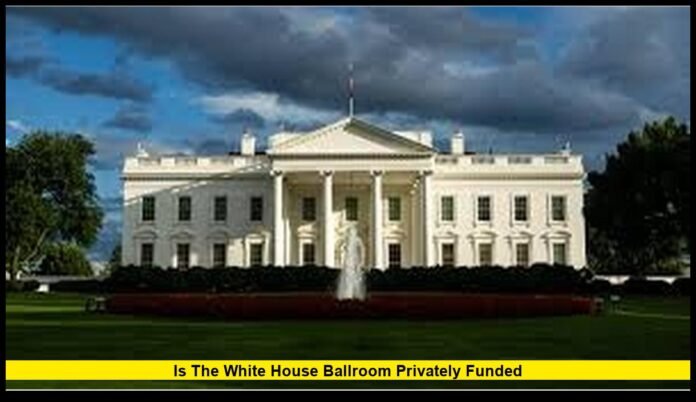

The question is the White House ballroom privately funded has taken center stage as the plan for a major ballroom addition to the White House’s East Wing moves forward. In mid-2025 the administration announced that the estimated $200 million project, later revised upward, would rely exclusively on private donations, with no taxpayer funding involved.
Scope and Purpose of the Ballroom Addition
The new ballroom is set to be a 90,000-square-foot facility in the East Wing of the White House complex. Originally announced in July 2025 at about $200 million, by October the cost estimate had climbed to roughly $300 million. The allowance for more than 900 guests makes it the largest structural addition to the White House since the Truman era.
The stated intent is to provide the Executive Mansion with a large-scale event space—state dinners, diplomatic receptions, major cultural functions—that up until now have often required tents on the South Lawn or other temporary venues.
Funding Model: Private Only, According to Officials
From the beginning the administration declared the ballroom would be funded through private donations. That means:
- No appropriated federal funds or taxpayer dollars would go toward construction or outfitting.
- The president and other “patriot donors” would contribute, alongside corporate pledges.
- Because the project is funded privately, construction can continue even during a federal government shutdown.
As of October 2025, the demolition of the existing East Wing had begun, and White House officials reiterated that funding remained private. The project’s independence from the federal budget has been a highlighted feature.
Why the Funding Approach Matters
This funding choice matters for several reasons:
- Budgetary implications: By claiming no tax dollars are used, the administration avoids direct Congressional appropriation debate and budget scrutiny.
- Transparency and ethics: When corporations or individuals contribute large sums to a project at the nation’s key executive residence, questions arise about influence, disclosure, and accountability.
- Precedent setting: If a major federal residence addition can proceed via private funding, it may create a model for future executive-branch infrastructure projects.
- Public trust: The White House is officially public property; private funding for structural additions challenges conventional understanding of ownership, oversight and public interest.
Construction Timeline & What’s Already Happening
Key milestones to date include:
- July 31 2025: The White House announced the ballroom project officially, with construction scheduled to begin in September.
- September 2025: Demolition and site work of the East Wing began, ahead of full structural construction.
- October 2025: The cost estimate increased to around $300 million and the seating capacity target rose to nearly 900–1,000 guests.
- Throughout: Officials emphasized that because of private funding, the project proceeds independent of federal budget cycles or shutdowns.
The fact that demolition began before the full approval process from design review commissions had concluded has spurred commentary about oversight. Still, funding remains private, according to official statements.
Challenges and Criticisms of the Private Funding Claim
While the assertion that the ballroom is privately funded is clear, a number of concerns persist:
- Incomplete donor transparency: Although corporate donors have been named in media reports, the full breakdown of who is giving and how much has not been publicly verified in detail.
- Cost escalation: The jump from $200 million to $300 million raises questions about budget management and whether the original private funding plan will cover all overruns.
- Oversight blurring: A privately funded project on federal property still faces regulatory, preservation and safety oversight—but critics argue that the “private funding” label may reduce perceived scrutiny.
- Public vs. private space: Because the ballroom will exist inside a federal building and serve state functions, some argue private funding effectively gives private interests access to a public asset.
In short, even though the funding is claimed to be private, the implications of that funding model are under significant public and expert review.
What This Means for Public Infrastructure and Future Projects
The decision to fund the White House ballroom privately could influence broader policy and precedent in these ways:
- Other executive-branch infrastructure projects may follow a similar private-funding model, especially if taxpayer funds remain constrained.
- The demand for donor transparency and ethics regulations could intensify, given the scale and symbolic relevance of the project.
- Historic-preservation and design review bodies may tighten requirements for privately funded projects on federal grounds to maintain public oversight.
- Media and public interest are likely to focus on how donor influence correlates with access or recognition when projects of this nature use private funds.
For American citizens, the ballroom project serves as a high-visibility example of how public buildings may be funded and the implications of that choice.
Key Facts at a Glance
- Area: Approximately 90,000 sq ft (expanded capacity plus additional modernized space).
- Estimated cost: Initially $200 million, later estimates around $300 million.
- Seating capacity: Initially up to 650, now revised toward 900–1,000 guests.
- Location: East Wing of the White House, with the existing structure being demolished and replaced.
- Funding model: Officially 100% privately funded (president plus donor corporations/individuals).
- Purpose: To provide large-scale event space for state dinners and other major functions, shifting away from tents or smaller rooms.
Why You Should Care
Though it’s a high-profile project, the implications extend to everyday governance and public infrastructure:
- If taxpayer funds truly are not used, the project shows how public-purpose facilities can be funded without federal spending.
- Conversely, if private funding becomes common for major public buildings, questions about influence and fairness come into sharper focus.
- The process tests regulatory oversight—especially when structural changes occur on one of the country’s most symbolic public buildings.
- As a citizen, understanding how large federal landmarks are maintained, expanded or altered matters for transparency and public interest.
Looking Forward
With construction well underway, the next milestones include:
- Donor disclosure updates: The public will be watching to see comprehensive, verified lists of contributions and amounts.
- Completion and unveiling: The project is targeted to be finished well within the current term, though timelines may shift with cost increases.
- Review of functionality: Once operational, the ballroom’s actual use for state events and its impact on White House event capacity will attract attention.
- Legacy assessment: Whether the project enhances or detracts from the White House’s historic character will be debated among historians, preservationists and the public.
In the end, the ballroom’s success or failure will highlight whether the private-funding model and construction pace align with public expectations for a building that belongs to the American people.
So, is the White House ballroom privately funded? According to every official statement to date, yes—it is being paid for entirely by private donations and the president’s own contribution. But as the project unfolds and questions arise about transparency, cost and oversight, the story is far from over.
We invite your thoughts—do you believe privately funded additions to landmark public buildings are appropriate? Feel free to share your view below!