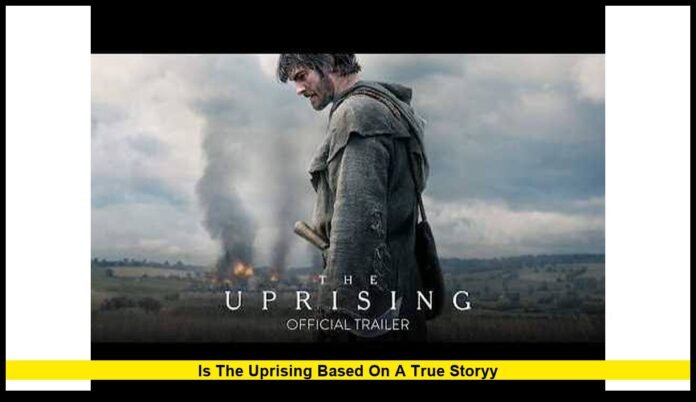

If you are asking is the uprising based on a true story, the answer is yes—with an important qualification. Paul Greengrass’ The Uprising is built around the real events of England’s 1381 Peasants’ Revolt, a major rebellion against the government of the young King Richard II. The film uses that historical crisis as its foundation while creating a dramatic story around its characters and conflicts.
Starring Andrew Garfield, Cosmo Jarvis, Jamie Bell, Stephen Dillane, Tom Hollander and Thomasin McKenzie, the movie brings one of medieval England’s most turbulent periods to the big screen. Its U.S. theatrical release is scheduled for September 10, 2026, with Focus Features also listing September 11 in its earlier domestic release announcement.
For viewers expecting a straightforward historical account, however, there is more to understand. The movie is not a documentary reconstruction of the revolt. It combines genuine historical figures and events with fictional characters and dramatized storytelling. The recent marketing surrounding Robin Hood has also added another intriguing dimension to the film.
The Historical Event at the Center of The Uprising
The central historical event is the Peasants’ Revolt of 1381, sometimes known as the Great Rising.
England in the late 14th century was experiencing profound social and economic changes. The Black Death had killed a huge portion of the population, dramatically reducing the number of available workers. That demographic crisis changed the relationship between laborers and landowners.
Workers could potentially demand better wages and conditions because their labor had become more valuable. Authorities, however, attempted to maintain existing social and economic controls.
At the same time, England was spending enormous amounts of money on warfare, particularly its long-running conflict with France. The government needed revenue, and ordinary people increasingly felt the weight of taxation.
These circumstances created an explosive environment.
The introduction and collection of the poll tax became the immediate catalyst for the rebellion, but the anger behind the uprising was considerably broader. It included resentment over taxation, labor restrictions, inequality, corruption and the privileges enjoyed by powerful members of medieval society.
That complicated mixture of grievances is an important part of understanding what Greengrass is attempting to portray.
Why Did the Peasants Revolt?
It would be misleading to suggest that the 1381 rebellion happened because of one single tax.
The poll tax was certainly crucial, but it became the final pressure point in a society already experiencing enormous tension.
The Poll Tax Created Widespread Anger
Unlike taxes based primarily on wealth or property, the poll tax placed a financial burden on individuals.
Collection became particularly controversial when officials attempted to determine whether people had properly paid. Reports of aggressive collection practices helped fuel anger in communities across southeastern England.
Resistance first became particularly serious in Essex and Kent before spreading.
The Black Death Changed Medieval England
The plague had transformed the country decades earlier.
Millions of people across Europe died during the Black Death, and England suffered enormous population losses. The shortage of workers altered the traditional feudal economy.
Laborers had greater leverage, but authorities attempted to prevent wages from rising too far and restricted workers’ ability to move freely between employers.
For many ordinary people, these restrictions became symbols of an unfair system.
England Was Paying for War
The English crown had major financial demands because of its military campaigns.
War was expensive, and taxation was one of the government’s principal ways of raising money. For people already struggling with economic uncertainty, additional taxes were increasingly difficult to accept.
The result was a growing divide between those who controlled political power and the people expected to finance the kingdom.
Wat Tyler Was a Real Historical Figure
One of the most important real people associated with the revolt was Wat Tyler, played by Cosmo Jarvis in the film.
Tyler became a leading figure among the rebels as the movement grew. Although historians have limited reliable information about his personal life, his role in the uprising is well established.
His leadership became especially significant when the rebels moved toward London.
The film therefore has an opportunity to place a genuine historical personality alongside fictionalized characters. This allows the story to explore the rebellion through both documented history and individual drama.
Tyler’s ultimate fate is also one of the most dramatic moments in the historical record.
King Richard II Was Also Real
The other central historical figure is King Richard II.
Richard became king in 1377 following the death of his grandfather, Edward III. He was still a teenager when the Peasants’ Revolt erupted.
That detail makes the historical situation particularly remarkable.
England was experiencing a major popular rebellion while its monarch was extremely young. The rebels eventually entered London, creating a direct threat to royal authority.
Richard’s interactions with the rebels became an important part of the uprising, and his meeting with Wat Tyler at Smithfield remains one of the most famous episodes associated with the revolt.
What Happened at Smithfield?
The confrontation at Smithfield in London became a decisive turning point.
Wat Tyler met King Richard II while negotiations were taking place. Historical accounts differ in their details, but Tyler was ultimately attacked and killed.
The young king then managed to persuade the assembled rebels to disperse.
Although the rebellion was effectively brought under control, the government’s response afterward was harsh. Promises made to the rebels were not permanently honored, and authorities pursued those who had participated in the uprising.
Many rebels were executed.
The suppression of the movement demonstrated that the English monarchy had survived the crisis, but the rebellion had exposed deep problems within medieval society.
Is Andrew Garfield Playing Wat Tyler?
No. This is one of the most important distinctions to make when discussing the movie.
Andrew Garfield plays a character credited as Ploughman, rather than Wat Tyler. Cosmo Jarvis portrays Wat Tyler.
That means the film is not simply putting Garfield into the historical role of Tyler.
Instead, Garfield’s character provides a fictionalized perspective through which audiences can experience the rebellion. The use of a fictional protagonist gives Greengrass more freedom to create personal relationships, emotional conflicts and dramatic developments that cannot be reconstructed with certainty from surviving medieval records.
This approach is common in historical cinema. A movie can remain grounded in a genuine historical event while using fictional characters to tell a more intimate story.
What Does the Ploughman Character Represent?
The name “Ploughman” carries significance beyond simply describing a medieval farmer.
The character is associated with the world of ordinary laborers who found themselves caught between economic hardship and political authority.
There is also a literary connection. William Langland’s 14th-century poem Piers Plowman is closely associated with the period and contains an early written reference to Robin Hood.
That literary background has become particularly relevant because of the movie’s recent marketing.
Why Is Robin Hood Suddenly Connected to The Uprising?
This is where the movie’s story has become unexpectedly controversial.
For much of its promotional campaign, The Uprising was presented as a historical drama about the Peasants’ Revolt of 1381.
More recently, U.S. marketing briefly promoted the film with the wording “The Rise of Robin Hood.” Promotional material also depicted Garfield’s character in imagery strongly associated with the legendary outlaw, including a bow and hooded appearance.
The change surprised many movie fans because Robin Hood is traditionally associated with a much earlier period of English history.
The familiar Robin Hood stories are generally placed during the reign of Richard the Lionheart and the era surrounding Prince John. Richard the Lionheart died in 1199, almost two centuries before the Peasants’ Revolt.
That creates an obvious historical complication.
However, the filmmakers appear to be interested in the connection between the historical rebellion and the development of the Robin Hood legend rather than simply presenting the traditional medieval outlaw story.
The U.S. marketing has described the movie as being set against the real uprising that helped inspire the legend.
At the same time, the U.K. distributor has publicly maintained that The Uprising is a historical epic about the Peasants’ Revolt and not a Robin Hood movie.
That distinction is important for audiences trying to understand what they are actually going to see.
So, Is the Robin Hood Story Historically Accurate?
Not in the conventional sense.
There is no historical evidence establishing that the Robin Hood of popular legend was literally a participant in the 1381 Peasants’ Revolt in the manner suggested by traditional movies.
Robin Hood himself is a legendary figure whose origins developed through medieval literature and folklore.
The earliest surviving literary references are complicated and do not provide the kind of definitive biography that exists for documented historical figures such as Richard II.
What makes the connection interesting is that the Robin Hood tradition developed during the broader medieval period in which ordinary people were increasingly represented in stories as resisting powerful authorities.
The movie appears to be playing with that relationship between history and legend.
How Much of The Uprising Is Fiction?
The broad historical framework is real, but individual storytelling elements should be treated differently.
Real Historical Elements
The following aspects are grounded in history:
- The Peasants’ Revolt occurred in 1381.
- Richard II was king of England.
- Wat Tyler was an important rebel leader.
- The revolt was driven partly by opposition to taxation.
- Rebels from Essex and Kent became involved.
- The movement reached London.
- Wat Tyler met Richard II.
- Tyler was killed at Smithfield.
- The rebellion was eventually suppressed.
Dramatized Elements
The film also contains fictional or heavily dramatized material, particularly around Garfield’s Ploughman.
Personal conversations, relationships, emotional motivations and certain action sequences cannot necessarily be verified through historical records.
That does not make the film “untrue.” Instead, it places the movie in the category of historical fiction: a fictional narrative constructed around genuine events.
Why Paul Greengrass Is a Natural Choice for This Story
Director Paul Greengrass is known for filmmaking that puts audiences close to major political and social conflicts.
His previous work has often emphasized urgency, realism and the experiences of individuals caught inside much larger events.
That approach fits the Peasants’ Revolt particularly well.
Instead of treating 1381 simply as a medieval battle, The Uprising can explore why ordinary people were willing to confront the authority of the crown.
The story has plenty of traditional historical spectacle, but its underlying conflict is about power, inequality, taxation and the relationship between rulers and ordinary citizens.
What Makes the 1381 Revolt So Important?
The Peasants’ Revolt did not overthrow the English monarchy, and its immediate demands were largely defeated.
Yet its importance extends far beyond whether the rebels won or lost.
The uprising revealed that medieval society was not as politically stable as those in power might have believed. Ordinary people could organize across communities and bring a major city and royal government under extraordinary pressure.
It also demonstrated the consequences of trying to impose unpopular policies on a population already facing economic and social stress.
For modern audiences, those themes can make the story feel surprisingly contemporary.
When Can U.S. Audiences Watch The Uprising?
The movie is arriving in U.S. theaters in September 2026.
Current movie listings place its wide theatrical opening around September 10, 2026, while the distributor’s earlier announcement gave September 11 as its domestic release date.
The film has an approximately two-hour runtime and carries an R rating for violence and bloody imagery.
At the center of the cast is Andrew Garfield, joined by Cosmo Jarvis as Wat Tyler and Jamie Bell as John Ball.
That combination of historical figures and fictional characters is one of the clearest indications that audiences should approach the movie as a dramatized interpretation rather than a literal retelling.
The Bottom Line
So, is the uprising based on a true story? Yes, the movie is rooted in one of the most important popular rebellions in medieval England: the Peasants’ Revolt of 1381.
The historical foundation includes real events, including the rebellion against taxation and royal authority, the involvement of Wat Tyler, the role of the young Richard II and the dramatic confrontation at Smithfield.
Andrew Garfield’s Ploughman, however, is not simply another name for Wat Tyler. The character gives the filmmakers a fictional vehicle through which to tell the story from the perspective of an ordinary person caught up in extraordinary circumstances.
The Robin Hood connection should also be viewed carefully. Recent U.S. promotional material has linked the film to the legendary outlaw, while other marketing has continued to present it primarily as a historical drama about the 1381 rebellion. The connection appears to involve the evolution of medieval legend rather than a straightforward claim that the traditional Robin Hood lived through the events shown.
Ultimately, The Uprising sits at the intersection of documented history, medieval folklore and modern historical filmmaking. The rebellion really happened, the major political crisis was real, and several of the people depicted were genuine historical figures—but the movie uses dramatic invention to turn those events into a feature-length story.
Key Points Summary
╔════════════════════════════════════════════════════════════════════╗
║ – The Uprising is based on the real Peasants’ Revolt that took place in England in 1381. ║
║ – Andrew Garfield plays a fictional character known as the Ploughman rather than the historical rebel leader Wat Tyler. ║
║ – Cosmo Jarvis portrays Wat Tyler, while the young King Richard II is another major historical figure in the story. ║
║ – Heavy taxation, labor restrictions, economic pressure and social inequality helped create the conditions for the rebellion. ║
║ – Wat Tyler really met Richard II at Smithfield before being killed during the confrontation. ║
║ – The film combines genuine historical events with fictional characters, dialogue and dramatized scenes. ║
║ – Recent U.S. marketing has connected the movie with the Robin Hood legend, creating questions about how history and folklore are combined in the story. ║
╚════════════════════════════════════════════════════════════════════╝