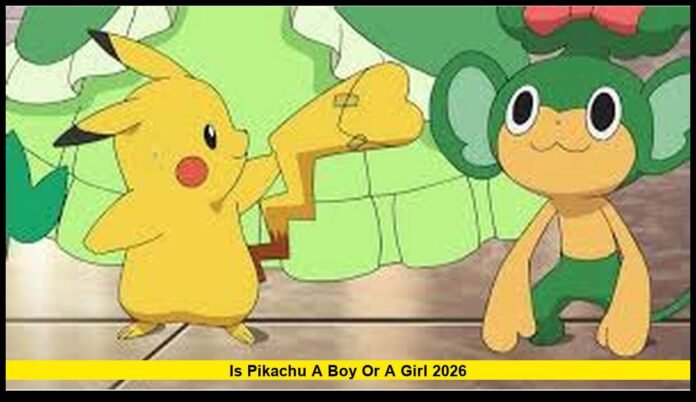

Is Pikachu a boy or a girl? The answer is officially defined within Pokémon canon, and it depends on whether you’re asking about the species or a specific character. As of 2026, Pokémon games, anime episodes, and character profiles confirm that Pikachu can be either male or female, while the franchise’s most famous Pikachu—Ash Ketchum’s longtime partner—is male.
For U.S. audiences who grew up with Pokémon on Nintendo consoles and Saturday morning TV, this question continues to trend online. Social media discussions, streaming revivals of the anime, and new game releases keep the topic relevant. Here’s a clear, fully factual breakdown based on current Pokémon canon.
Pikachu as a Species: Both Male and Female
Pikachu has never been limited to one gender. Since gender differences were introduced to the Pokémon series in Pokémon Gold and Pokémon Silver, the species has included both males and females.
In every modern mainline game on Nintendo Switch, including Pokémon Scarlet and Pokémon Violet, players can encounter:
- Male Pikachu
- Female Pikachu
Each appears in the wild and can be captured, trained, traded, and evolved. The games clearly mark gender on the Pokémon’s summary screen with standard male and female symbols.
This system remains unchanged in the most recent updates and competitive formats. There has been no alteration to Pikachu’s gender distribution.
The Visual Difference: How to Tell Them Apart
Beginning with Pokémon Diamond and Pokémon Pearl, Game Freak introduced visible gender differences for certain Pokémon species. Pikachu received one of the most recognizable distinctions.
Here’s how it works:
- Male Pikachu: The tail ends in a straight-edged lightning bolt shape.
- Female Pikachu: The tail has a heart-shaped notch at the tip.
This difference appears in:
- Mainline Nintendo Switch titles
- Pokémon HOME models
- Anime appearances
- Official artwork
The heart-shaped tail is now widely recognized among fans as the identifying marker of a female Pikachu.
When Pikachu evolves into Raichu, the tail difference disappears. Raichu does not have a gender-based tail variation. That detail often surprises newer players who expect the distinction to carry forward.
Ash Ketchum’s Pikachu: Confirmed Male
When most people ask whether Pikachu is a boy or a girl, they are referring to the animated series character who debuted in 1997.
Ash Ketchum’s Pikachu is male.
Throughout the English-language dub of the anime, characters refer to Pikachu using male pronouns. Official character materials and series documentation also identify Ash’s Pikachu as male.
The anime followed Ash’s journey for over 25 years, concluding his storyline in 2023. Across every season—from the original Indigo League to Pokémon Ultimate Journeys—Pikachu’s gender remained consistent.
There has never been an official storyline change regarding this detail.
Female Pikachu in the Pokémon Anime
Although Ash’s Pikachu is male, the animated series has featured multiple female Pikachu characters.
Female Pikachu are identifiable by:
- The heart-shaped tail
- Occasional storyline references confirming gender
Several episodes have shown Pikachu interacting with female Pikachu owned by other trainers. These appearances match the game design introduced in Generation IV.
The anime consistently aligns its character models with the video games. That continuity helps prevent contradictions across the franchise.
Special Forms and Fixed Genders
Over the years, Pikachu has appeared in special forms that sometimes have fixed gender rules.
Cosplay Pikachu
Introduced in Pokémon Omega Ruby and Alpha Sapphire, Cosplay Pikachu is always female. This version features the heart-shaped tail and cannot evolve into Raichu.
Cosplay Pikachu remains one of the few examples where a Pikachu form has a locked gender.
Partner Pikachu
In Pokémon: Let’s Go, Pikachu!, the partner Pikachu can be either male or female. Players can identify the gender by checking the summary screen.
Gigantamax Pikachu
Gigantamax Pikachu, introduced in Pokémon Sword and Shield, follows standard gender mechanics. Both male and female versions can Gigantamax.
These forms demonstrate that while most Pikachu follow general gender rules, certain variants may be predetermined.
Gameplay Implications of Pikachu’s Gender
For casual players, Pikachu’s gender does not affect battle performance. Base stats, abilities, and move pools remain identical between males and females.
However, gender can influence:
- Breeding outcomes
- Passing down moves
- Certain ability interactions
Female Pikachu can produce Pichu Eggs when bred with compatible Pokémon. Breeding mechanics remain active in current-generation games.
Competitive players sometimes consider gender when building teams, particularly in formats where gender-based abilities might matter. Even so, these cases are situational.
For most fans, the gender difference is cosmetic rather than strategic.
Why the Question Still Trends
Despite clear canon rules, search engines in the United States show consistent interest in Pikachu’s gender. Several factors explain this ongoing curiosity.
1. Voice Acting
In Japan, Pikachu has been voiced by Ikue Ōtani since the anime began. In English-language adaptations, a female voice actor also performs Pikachu’s voice.
Because Pikachu’s voice sounds high-pitched and playful, many viewers assume the character is female. In animation, it is common for female actors to voice young male characters.
2. Gender-Neutral Character Design
Pikachu’s design avoids strongly gendered traits. The character has:
- Rounded facial features
- Bright red cheeks
- A soft body shape
- A cheerful personality
These qualities make Pikachu universally relatable. The design supports its role as the franchise mascot.
3. Marketing Approach
The Pokémon Company presents Pikachu as a global symbol. Merchandise, collaborations, and promotional campaigns rarely emphasize gender.
Pikachu appears on clothing, toys, cereal boxes, theme park attractions, and airline liveries. In most cases, branding focuses on the character’s identity rather than gender.
That broad appeal keeps the debate alive.
Pokémon’s Gender System in 2026
Gender remains a standard mechanic in the Pokémon franchise.
In Pokémon Scarlet and Pokémon Violet:
- Wild Pikachu can be male or female.
- Gender icons appear in battle and summary menus.
- Breeding functions normally through Picnic mechanics.
- Visual tail differences remain intact.
There have been no official announcements removing or changing Pikachu’s gender classification.
The franchise continues to treat gender as part of a Pokémon’s biological data rather than a narrative storyline element.
Clarifying Common Misconceptions
Several myths circulate online about Pikachu’s gender. Here are the facts:
- Pikachu is not exclusively male.
- Pikachu is not exclusively female.
- The mascot version does not override species mechanics.
- The anime and games are consistent with each other.
- There has been no recent retcon.
Another misconception involves evolution. Some fans believe only male Pikachu can evolve into Raichu. That is incorrect. Both male and female Pikachu evolve using a Thunder Stone.
Alolan Raichu also follows the same rule. Gender does not affect evolution eligibility.
Cultural Impact in the United States
Pikachu remains one of the most recognizable fictional characters in America. The character debuted in the late 1990s and quickly became a pop culture icon.
The question about Pikachu’s gender reflects how deeply fans connect with the franchise. People often assign personality traits based on gender expectations, even when canon provides clear answers.
Streaming platforms continue to host Pokémon seasons, allowing new generations to discover the series. Video game sales remain strong, keeping Pikachu in the public spotlight.
As long as Pokémon stays culturally relevant, this question will likely continue trending.
The Definitive Canon Answer
So, is pikachu a boy or a girl?
The official answer remains straightforward:
- Pikachu as a species can be male or female.
- Female Pikachu have a heart-shaped tail.
- Ash Ketchum’s Pikachu is male.
- Game mechanics support both genders.
- Special forms may have fixed genders in specific cases.
There have been no changes to this canon as of 2026.
Why This Detail Still Matters
Understanding Pikachu’s gender classification helps fans:
- Identify characters accurately
- Understand breeding mechanics
- Recognize design differences
- Separate species rules from individual character identity
It also highlights how Pokémon evolved from simple 2D sprites to detailed 3D models with visual distinctions.
Small design elements, such as a tail notch, show how the franchise adds depth without altering core character identity.
Pikachu represents adaptability and universal appeal. Whether male or female, the character continues to connect generations of fans across games, television, movies, and merchandise.
Did you always know the difference between male and female Pikachu? Share your thoughts and join the conversation with fellow Pokémon fans.