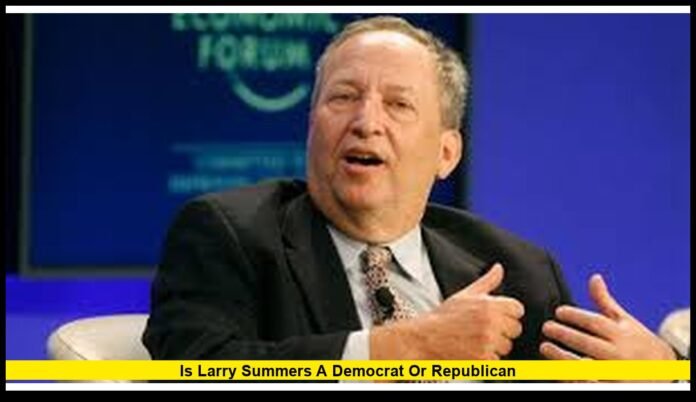

The question “Is Larry Summers a Democrat or Republican?” is answered by his longstanding affiliation with the Democratic Party. Larry Summers has consistently served under Democratic administrations and is formally listed as a Democrat in his public profile.
Background on Party Affiliation
Larry Summers (born 1954) is a prominent American economist, academic, and former public official who has held some of the most influential economic policy roles in the United States government. Over several decades, he has been closely associated with Democratic administrations and policy initiatives, and his publicly stated political affiliation is with the Democratic Party (United States).
Summers built his reputation as a leading economic thinker through academic work at Harvard University and through service in government. His national policy influence expanded significantly during the presidency of Bill Clinton, when he held multiple senior roles at the U.S. Treasury Department, culminating in his appointment as U.S. Secretary of the Treasury from 1999 to 2001. In that position, he played a central role in shaping financial policy, responding to global economic challenges, and advancing the administration’s economic agenda.
Nearly a decade later, Summers returned to a top policy role during the administration of Barack Obama. From 2009 to 2010, he served as Director of the National Economic Council, where he was a key architect of the federal government’s response to the global financial crisis and the economic recovery strategy. His work included advising the president on stimulus measures, financial regulation, and broader economic policy priorities.
Beyond formal government positions, Summers has remained influential in Democratic policy circles, frequently contributing to public debate on inflation, fiscal policy, labor markets, and global economic trends. His commentary, advisory roles, and past service in Democratic administrations reinforce his long-standing association with Democratic economic policy frameworks.
Clarifying Misunderstandings
While Larry Summers is broadly identified with the Democratic Party (United States), discussion about his policy positions has sometimes led to misunderstandings about his ideological placement within the party. This is largely because Summers’ economic views are often described as pragmatic, technocratic, and occasionally more centrist than those of the party’s progressive wing.
Throughout his career, Summers has supported a number of market-oriented and centrist economic approaches, including policies that emphasize financial stability, global trade, and cautious fiscal management. These positions have, at times, placed him closer to the party’s moderate or establishment policymakers rather than to progressive figures who advocate more expansive government intervention, stronger regulation of financial institutions, or aggressive redistribution measures.
As a result, some progressive activists and commentators have criticized Summers, arguing that his policy framework reflects a more traditional, market-friendly economic philosophy. Debates surrounding financial regulation, inflation policy, labor markets, and stimulus strategy have occasionally highlighted these internal Democratic disagreements, contributing to the perception that Summers sits ideologically in the party’s center rather than its left flank.
However, these policy differences do not change his formal political alignment. Summers’ senior roles in Democratic administrations — including service under Bill Clinton and Barack Obama — along with his long-standing participation in Democratic policy circles, clearly associate him with the Democratic Party. In other words, critiques from within the party reflect normal ideological diversity rather than evidence of affiliation with another political party.
In summary, while Larry Summers’ economic views sometimes diverge from progressive priorities, this reflects internal debate within the Democratic coalition. His public record, government service, and institutional ties continue to place him firmly within Democratic political and policy networks.
Current Status
Larry Summers remains an influential voice in economic policy, academia, and public debate, even though he does not currently hold elected office or a formal government position. After his senior roles in federal government, he returned primarily to academic work, research, advisory roles, and public commentary on major economic issues such as inflation, fiscal policy, financial regulation, and global growth.
As of today, Summers continues to be widely associated with the Democratic Party (United States) through his past service, policy networks, and ongoing participation in discussions that shape Democratic economic thinking. He frequently appears in media interviews, writes opinion essays, and speaks at policy forums, where his analysis carries significant weight among policymakers, economists, and market participants.
Importantly, there is no credible public information indicating that Summers has changed his party affiliation or switched to the Republican Party. While his policy positions sometimes generate debate within Democratic circles — particularly between centrist and progressive perspectives — these disagreements reflect ideological diversity within the party rather than a shift in partisan alignment.
Overall, Larry Summers’ current status is best understood as that of a prominent economist and policy commentator with longstanding Democratic ties. His influence today comes less from holding office and more from his expertise, advisory roles, academic leadership, and continued engagement in national and global economic conversations.
Summary Table
| Question | Answer |
|---|---|
| Party affiliation of Larry Summers | Democratic Party |
| Served under Democratic presidents | Yes (Clinton, Obama) |
| Ever identified as Republican | No evidence of this |
| Policy stance | Centrist/moderate within Democratic spectrum |
Conclusion
In short, Larry Summers is a member of the Democratic Party rather than the Republican Party. While his economic views may sit toward the center, his party alignment and public service history clearly anchor him among Democrats.
We’d love to hear your thoughts, so feel free to leave a comment or keep following for future updates.