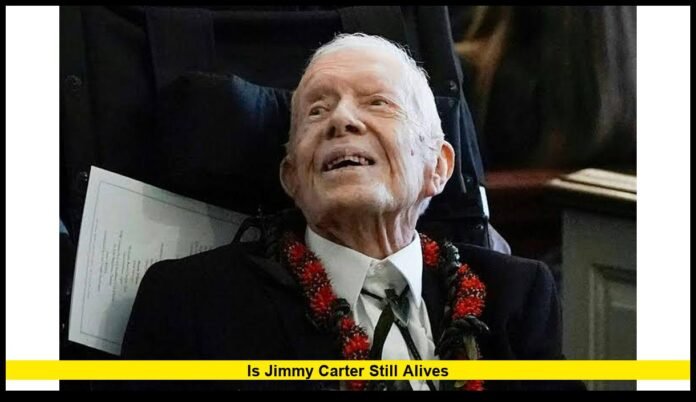

Is Jimmy Carter still alive? No, Jimmy Carter died on December 29, 2024, at the age of 100. The 39th president of the United States passed away at his home in Plains, Georgia, ending a life that spanned a century of American history. Remembered for his presidency, diplomatic achievements, and decades of humanitarian work, Carter remained an influential public figure long after leaving the White House in 1981. His legacy continues through the Carter Center, international peacebuilding efforts, and the public service initiatives he pursued alongside his wife, Rosalynn Carter.
Carter’s death marked the end of an extraordinary journey from a rural Georgia farming community to the highest office in the United States. Although his presidency lasted only one term, his contributions to diplomacy, public health, democracy, and human rights continued for decades. His later achievements earned international recognition and helped shape how Americans understand the role of a former president.
Key Points Summary
╔════════════════════════════════════════════════════════════════════╗
║ – Jimmy Carter died on December 29, 2024, at the age of 100. ║
║ – He was born on October 1, 1924, in Plains, Georgia. ║
║ – Carter served as the 39th U.S. president from 1977 to 1981. ║
║ – He helped negotiate the Camp David Accords between Egypt and Israel. ║
║ – He received the Nobel Peace Prize in 2002 for his peacebuilding and humanitarian efforts. ║
║ – The Carter Center continues initiatives focused on democracy, human rights, and global health. ║
╚════════════════════════════════════════════════════════════════════╝
When Did Jimmy Carter Die?
Jimmy Carter died on December 29, 2024, at his residence in Plains, Georgia. He was 100 years old and had celebrated his centennial birthday less than three months earlier.
The Carter Center announced his death, confirming that he had passed away peacefully at home with his family. His final years were marked by serious health challenges, but he remained surrounded by loved ones in the community where he had spent much of his life.
Carter’s health became a major public concern in his later years. In 2015, he revealed that he had melanoma that had spread to his brain. He subsequently received treatment, including immunotherapy, and announced that medical scans showed no evidence of cancer at that time.
His health challenges continued as he grew older. In February 2023, after a series of hospital stays, Carter decided to stop receiving further hospital interventions and begin hospice care at home. The decision allowed him to spend his remaining time with family rather than continue pursuing hospital-based treatment.
He lived for nearly 22 months after entering hospice care, reaching his 100th birthday in October 2024. His longevity during this period attracted attention across the country, while his family largely maintained a private environment around his final months.
Following his death, tributes highlighted his achievements as president and his long commitment to humanitarian causes. Political leaders, diplomats, nonprofit organizations, and members of the public recognized the breadth of his work across more than seven decades of public life.
How Old Was Jimmy Carter When He Died?
Jimmy Carter was 100 years old when he died. Born on October 1, 1924, he lived through major transformations in American politics, technology, international relations, and society.
He became the longest-lived U.S. president, setting a longevity record among the nation’s presidents. His lifespan extended well beyond his four years in the White House and included more than four decades of post-presidential public service.
Carter’s life began in a farming community in southwestern Georgia. His childhood experiences in a rural environment influenced his later public image and remained important to his personal identity. Before politics, he served in the Navy and later returned to Georgia to help manage his family’s peanut farming business.
His journey to the presidency was not conventional. He did not emerge from one of the country’s most prominent political families, and his initial national profile was relatively limited. However, his experience as a state legislator and governor helped prepare him for a presidential campaign that emphasized integrity, accountability, and government reform.
Reaching 100 years of age also gave Carter a distinctive place in American history. His life connected the early 20th century with the political and humanitarian debates of the 21st century.
Who Was Jimmy Carter Before Becoming President?
James Earl Carter Jr. was born in Plains, Georgia, and grew up in the nearby community of Archery. His father was a businessman and farmer, while his mother, Lillian Carter, worked as a nurse and later became known for her humanitarian activities.
Carter attended the U.S. Naval Academy and graduated in 1946. He subsequently served as a naval officer, including work related to submarines. His military career exposed him to technical responsibilities, organizational discipline, and leadership beyond his hometown.
After his father died in 1953, Carter left active naval service and returned to Georgia to help run the family farming operation. This decision brought him back into the agricultural community and eventually helped launch his political career.
Carter entered state politics in the early 1960s, serving in the Georgia Senate. In 1971, he became governor of Georgia. During his governorship, he emphasized government reorganization and civil rights, and he sought to present himself as a modern Southern political leader.
His 1976 presidential campaign benefited from widespread public concern about trust in government following the Watergate scandal. Carter presented himself as a political outsider who could restore confidence in the presidency.
He defeated Republican incumbent Gerald Ford in the general election and took office on January 20, 1977.
What Did Jimmy Carter Accomplish as President?
Carter served as president from 1977 through 1981. His administration confronted difficult domestic economic conditions and international challenges, but it also produced several lasting diplomatic achievements.
The Camp David Accords
Carter’s most widely recognized presidential achievement was his role in the Camp David Accords of September 1978.
He brought Egyptian President Anwar Sadat and Israeli Prime Minister Menachem Begin together for intensive negotiations at Camp David, the presidential retreat in Maryland. The discussions addressed longstanding tensions between the two countries and established a framework for a peace agreement.
The negotiations led to the Egypt-Israel peace treaty signed in March 1979. The agreement represented a major development in Middle Eastern diplomacy and demonstrated the potential for sustained negotiations to resolve international disputes.
Carter invested substantial personal effort in the process, helping bridge disagreements and encouraging both leaders to reach an agreement. His involvement later became a central part of his diplomatic legacy.
Establishing Diplomatic Relations With China
Another important development occurred in 1979, when the United States formally established diplomatic relations with the People’s Republic of China.
The decision reshaped the relationship between Washington and Beijing and became an important milestone in modern American foreign policy. It reflected broader strategic changes in the international system during the Cold War.
Human Rights in Foreign Policy
Carter placed human rights at the center of his administration’s foreign policy. His government emphasized political freedoms and the treatment of individuals by national governments.
This approach sometimes created tensions with countries considered strategically important to the United States. Nevertheless, the emphasis on human rights became a defining feature of Carter’s political identity and influenced his subsequent humanitarian work.
Energy and Economic Challenges
At home, Carter confronted rising inflation, unemployment concerns, and energy shortages. His administration promoted energy conservation and sought to reduce American dependence on imported oil.
These challenges contributed to public dissatisfaction during his presidency. Economic pressures and the Iran hostage crisis became major issues during the 1980 election, which Carter lost to Republican nominee Ronald Reagan.
Although his presidency ended after one term, his later career substantially broadened his public reputation.
Why Did Jimmy Carter Receive the Nobel Peace Prize?
Jimmy Carter received the Nobel Peace Prize in 2002 in recognition of his sustained efforts to promote peaceful conflict resolution, democracy, human rights, and social and economic development.
The award came more than two decades after he left office. It highlighted the distinction between Carter’s presidential record and the international humanitarian work he pursued during the years that followed.
His activities included diplomatic missions, election observation, conflict mediation, and public health initiatives. He used his experience as a former president to engage with political leaders and communities in places where negotiations, democratic institutions, or health programs faced significant challenges.
Carter’s Nobel recognition also reflected his belief that diplomacy should continue beyond formal government service. Rather than limiting his involvement to speeches or ceremonial appearances, he participated in practical projects intended to address specific international problems.
His post-presidential work became an important example of how former heads of state can continue contributing to global affairs without holding elected office.
What Was the Carter Center, and Why Does It Matter?
Jimmy and Rosalynn Carter founded the Carter Center in Atlanta in 1982. The nonprofit organization was established to advance peace, improve health, and promote human rights around the world.
The center became one of the principal institutions associated with Carter’s post-presidential career. Its programs have addressed election integrity, democratic governance, conflict resolution, and the prevention of neglected diseases.
Promoting Democratic Elections
The Carter Center has observed elections in numerous countries. These missions examine electoral procedures, voter participation, campaign conditions, and the administration of voting.
Election observation does not mean that every election is free from problems. Instead, the work can help document concerns, identify areas for improvement, and support public understanding of democratic standards.
Carter’s involvement reflected his belief that transparent electoral processes and accountable institutions can contribute to political stability.
Fighting Preventable Diseases
The center has also supported international health initiatives, including efforts to eliminate Guinea worm disease. The infection can cause severe pain and disability, particularly in communities with limited access to safe drinking water and medical services.
Programs aimed at prevention, community education, and disease surveillance have contributed to significant progress against the disease.
This work illustrates the practical side of Carter’s humanitarian philosophy: improving lives through sustained cooperation rather than relying exclusively on high-profile diplomatic events.
Supporting Peaceful Conflict Resolution
Carter continued participating in diplomatic initiatives after leaving office. His efforts included discussions with political leaders and involvement in negotiations intended to reduce tensions.
Not every intervention succeeded, but these activities reflected a consistent commitment to dialogue and peaceful solutions.
The Carter Center continues to carry forward this broad mission, ensuring that the institution’s work extends beyond the lifetime of its founders.
Jimmy Carter and Rosalynn Carter: A Lifetime of Service
Jimmy Carter’s personal life was closely connected to his public service. He married Rosalynn Smith on July 7, 1946, and their partnership lasted more than 77 years. Together, they became known for their work on international development, mental health awareness, affordable housing, and humanitarian causes.
Rosalynn Carter played an active role during her husband’s presidency and remained involved in public service after his departure from the White House. She advocated for mental health care and supported initiatives addressing the needs of caregivers and families.
In 1982, the couple established the Carter Center, creating an organization through which they could continue working on issues they considered important. They also became prominent volunteers with Habitat for Humanity, participating in homebuilding projects and helping raise awareness about affordable housing.
Rosalynn died on November 19, 2023, at the age of 96. Her death was a significant loss for Carter and their family. Jimmy Carter died a little more than a year later, in December 2024.
Their partnership remains an important part of their legacy. They demonstrated how personal commitment and organized volunteer work could complement political leadership and continue making a difference long after a presidential term ends.
How Jimmy Carter Changed the Role of Former Presidents
Carter helped demonstrate that leaving the White House does not necessarily mean leaving public service. While many former presidents participate in charitable initiatives, write memoirs, or support their preferred causes, Carter developed an extensive international humanitarian career.
He used his public standing to participate in diplomatic discussions, support election monitoring, and draw attention to neglected public health issues. His work often involved long-term engagement with organizations and communities rather than isolated appearances.
His approach also showed that former presidents can contribute to international affairs without exercising the formal powers of the presidency. Carter’s reputation and diplomatic experience enabled him to communicate with leaders across political and national boundaries.
The Carter Center became the institutional foundation for much of this work. Through its programs, Carter’s interests in peace, democracy, and health were translated into projects that could continue operating beyond his lifetime.
His post-presidential career also influenced public discussions about presidential legacies. Although historians and political observers continue to debate the successes and shortcomings of his administration, his humanitarian achievements remain a major part of how he is remembered.
Where Was Jimmy Carter Buried?
Jimmy Carter was buried at his home in Plains, Georgia, following his state funeral in January 2025. The burial took place on the property associated with his family, reflecting his lifelong connection to his hometown.
Carter’s funeral arrangements included national ceremonies recognizing his service as commander in chief. His remains were transported to Washington, D.C., where he lay in state at the U.S. Capitol before a state funeral at Washington National Cathedral.
The ceremonies brought together political leaders, public officials, and members of the public to commemorate his life. The events recognized both his presidency and his extensive humanitarian activities after leaving office.
His final resting place in Plains reflects the importance of Georgia throughout his life. Although Carter traveled internationally and spent four years in the White House, he maintained a deep connection to the community where he was born and raised.
The area associated with his life is also part of the Jimmy Carter National Historical Park, which preserves important places connected to his upbringing and public career.
Is Jimmy Carter Still Alive? Understanding His Legacy Today
For readers searching is Jimmy Carter still alive, the answer remains no: the former president died on December 29, 2024, at the age of 100. His death was confirmed by the Carter Center, and his passing was followed by national mourning and international tributes.
His influence, however, continues through institutions and initiatives established during his lifetime. The Carter Center remains involved in public health, democratic governance, human rights, and peaceful conflict resolution.
Carter’s historical reputation includes both the challenges of his presidency and the achievements of his later decades. His administration struggled with economic pressures and the Iran hostage crisis, but it also made significant contributions to international diplomacy, including the peace agreement between Egypt and Israel.
His work after leaving office added another dimension to his public record. The Nobel Peace Prize recognized his long-term commitment to humanitarian and peacebuilding efforts, while the Carter Center helped turn those priorities into ongoing programs.
His life also offers an important example of the relationship between political leadership and community service. Carter returned to Georgia after his presidency and maintained a strong connection to his hometown, even as his humanitarian work took him around the world.
Although he is no longer alive, the programs, organizations, and historical records associated with his work continue to preserve his contributions for future generations.
Frequently Asked Questions About Jimmy Carter
When did Jimmy Carter die?
Jimmy Carter died on December 29, 2024, at his home in Plains, Georgia. He was 100 years old.
What was Jimmy Carter’s age at the time of his death?
Carter was 100 when he died. He was born on October 1, 1924, and became the longest-lived president in U.S. history.
What years did Jimmy Carter serve as president?
Carter served as the 39th president of the United States from January 20, 1977, to January 20, 1981.
What is Jimmy Carter most famous for?
Carter is known for his presidency, his role in the Camp David Accords, and his decades of humanitarian work. His efforts to promote peace, democracy, human rights, and public health earned him the Nobel Peace Prize in 2002.
Did Jimmy Carter receive hospice care?
Yes. Carter entered hospice care at home in February 2023 after experiencing several health challenges. He chose to spend his remaining time with his family rather than continue hospital-based interventions.
When did Rosalynn Carter die?
Rosalynn Carter died on November 19, 2023, at the age of 96. She and Jimmy Carter had been married for more than 77 years.
What does the Carter Center do today?
The Carter Center works on initiatives involving democratic elections, conflict resolution, human rights, and global health. It continues the broad humanitarian mission established by Jimmy and Rosalynn Carter.
Where is Jimmy Carter buried?
Carter was buried at his home in Plains, Georgia, following his state funeral in January 2025.
Conclusion
Jimmy Carter’s life extended far beyond his four years as president. From his early years in rural Georgia to his service in the White House and his decades of international humanitarian work, he built a public legacy shaped by diplomacy, community engagement, and a commitment to addressing global challenges.
His death at 100 marked the end of a remarkable personal journey, but the work he supported continues through the Carter Center and other organizations. His presidency remains an important subject of historical discussion, while his later achievements demonstrate the lasting contributions a former president can make to international affairs and public service.
What stands out most to you about Jimmy Carter’s life, presidency, or humanitarian legacy? Share your thoughts in the comments and follow our latest updates for more stories about influential figures in American history.