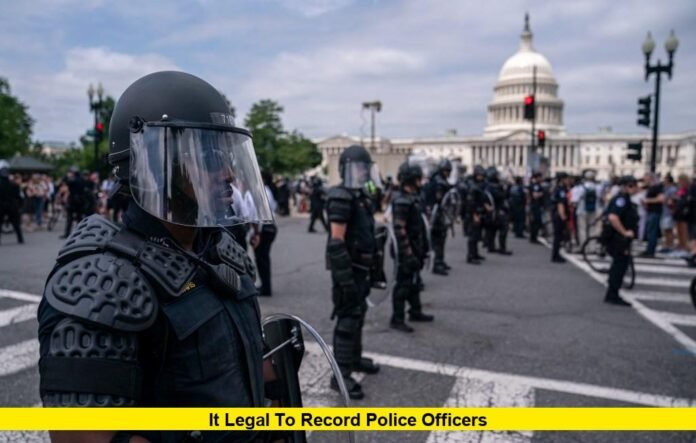

If you’ve ever pulled out your phone during a traffic stop or a public arrest, you’ve probably wondered: am I allowed to do this? The short answer is yes — but the full answer has important limits every American should understand before hitting record.
Here’s a complete, up-to-date breakdown of your rights, the exceptions that apply, and how to protect yourself if an officer tells you to stop filming.
Is It Legal to Record Police Officers in Public?
Yes. Recording on-duty police officers in a public place is protected by the First Amendment. This applies whether you’re a journalist, a bystander, or the person being stopped or arrested.
Every federal circuit court that has ruled on the issue has agreed that the right to record law enforcement is constitutionally protected — generally falling under freedom of speech and the right to gather information about government officials. Eight of the thirteen federal appeals courts have explicitly recognized this right, and none has ever ruled the opposite way.
This protection isn’t limited to police. It also extends to ICE agents, FBI agents, National Guard troops, and any other government official carrying out public duties.
Why Is Recording Police Legally Protected?
The reasoning behind this right comes down to accountability. Courts have repeatedly said that citizen recordings act as a “watchdog” over government activity — a key check on official power. The landmark 2022 case Irizarry v. Yehia, decided by the 10th Circuit, reinforced that filming police performing official duties is a constitutional right, not a privilege officers can revoke at will.
Historic moments like the 1992 Rodney King beating and the 2020 murder of George Floyd were captured by bystanders, not official cameras — and those recordings fundamentally shaped public understanding of police conduct. That’s the core argument courts keep returning to: documentation protects the public interest.
When Can Recording Police Become Illegal?
While the right to record is broad, it isn’t unlimited. Recording can cross into illegal territory in a few specific situations:
You physically interfere with police duties. If your presence or behavior obstructs an arrest, blocks officers, or creates a safety hazard, you can be lawfully ordered to step back or relocate — though officers cannot order you to stop recording altogether if you’re not in the way.
You’re not lawfully present. The right to record only applies if you’re legally allowed to be where you’re standing. Trespassing or entering a restricted area removes that protection.
Your state has stricter wiretapping laws. Some states require all parties to consent before an audio conversation can be recorded. Courts have generally ruled this doesn’t shield police having a public conversation during official duties, but it can complicate certain secret or hidden recordings.
You’re recording a sensitive, non-public operation. Filming an undercover investigation, a confidential informant meeting, or details that could compromise an active case may not be protected.
Your recording resembles stalking or harassment. Documenting an officer’s personal routine — such as tracking when they leave home — can cross into conduct courts may treat as intimidation rather than newsgathering.
One-Party vs. Two-Party Consent States: Does It Matter for Police?
Audio recording laws add a layer of complexity. States fall into two categories:
One-party consent states — the majority of the U.S. — only require that one person involved in the conversation (which can be you) consents to the recording. You don’t need to tell the other party.
Two-party (all-party) consent states require everyone involved in a conversation to agree before it’s recorded. As of 2026, these generally include California, Connecticut, Delaware, Florida, Illinois, Maryland, Massachusetts, Montana, New Hampshire, Oregon, Pennsylvania, and Washington — though a few of these states (like Connecticut and Oregon) draw a distinction between phone calls and in-person conversations.
Here’s the key point for recording police: courts have generally held that on-duty officers performing public duties do not have a reasonable expectation of privacy in their conversations with the public. That means even in two-party consent states, recording police in public is still typically protected — though making your recording device visible rather than hidden is a smart way to reduce legal risk.
Can Police Legally Take or Search Your Phone?
This is one of the most common points of confusion. Here’s what the law actually allows:
- Officers generally cannot order you to delete photos, video, or audio.
- Officers generally cannot search the contents of your phone without a warrant, even if you’re arrested. This was confirmed by the U.S. Supreme Court in Riley v. California (2014).
- Officers may confiscate your device during a lawful arrest or when executing a valid search warrant — but they still need separate legal authority to access what’s on it.
- The government is never permitted to destroy or delete your recordings under any circumstances.
If your phone or footage is seized or deleted unlawfully, that can form the basis of a civil rights claim.
What to Do If an Officer Tells You to Stop Recording
Even with strong legal protections, real-world encounters can get tense. If an officer orders you to stop filming:
Stay calm and avoid escalating. Your tone and body language matter as much as your words.
State your right clearly. Something like: “I’m recording from a public place and I’m not interfering. I have a First Amendment right to do this.”
Don’t physically resist if an officer attempts to take your device or detain you. Comply in the moment, then address it afterward through legal channels.
Keep a record. Note the officer’s name, badge number, time, and location, and try to get contact details from any witnesses.
File a complaint if needed. Options include your local police department’s internal affairs division, the ACLU, or a civil rights attorney.
Being legally correct doesn’t guarantee safety in the moment. If a situation feels physically dangerous, prioritize your safety first and pursue your legal rights afterward — no recording is worth risking serious harm.
What Happens If Your Rights Are Violated?
If an officer unlawfully stops you from recording, seizes your device without cause, or deletes your footage, you may have legal recourse, including:
- An internal affairs complaint against the officer or department.
- A civil rights lawsuit under 42 U.S.C. § 1983, which allows individuals to sue government officials for violating constitutional rights — potentially recovering damages and attorney’s fees.
- Criminal charges against an officer in cases involving evidence tampering or destruction of property.
Some states go further. Colorado, for example, allows individuals whose recording rights were violated to seek reimbursement for damaged equipment plus an additional statutory penalty, with the option to sue if that claim is denied.
Do State Laws Offer Extra Protections?
Yes. While the First Amendment sets a national baseline, some states have gone further by passing their own laws or recognizing the right to record under their state constitutions. Colorado, Hawaii, Illinois, and New York are frequently cited examples of states with additional statutory or constitutional protections beyond the federal standard.
On the flip side, a few states have attempted to pass laws restricting recording — such as requiring a minimum distance from officers. These attempts have generally been struck down or blocked by courts as unconstitutional restrictions on First Amendment rights.
Frequently Asked Questions
Is it illegal to record a police officer without telling them? No. As long as you’re in a public place and not interfering with their duties, you generally don’t need to announce that you’re recording.
Can I record police on my own property? Yes, recording on your own property is generally protected, and you have additional protections against unreasonable searches there as well.
Can police arrest me just for filming them? No — recording alone is not a lawful basis for arrest. However, unlawful arrests do happen, and asserting your rights in the moment doesn’t always prevent one from occurring.
Does this right apply to journalists only? No. Courts have made clear that this is a right held by ordinary citizens, not just credentialed press.
Can I livestream a police encounter? Generally, yes. Officers cannot stop a livestream simply because it’s being broadcast live, provided you’re not interfering with their work.
What if I’m filming my own arrest? You’re still protected. The right to record extends to documenting your own interaction with police, not just bystander footage of others.
Key Points Summary
+----------------------------------------------------------+
|  RECORDING POLICE: QUICK REFERENCE                       |
+----------------------------------------------------------+
|  ✓ Legal in public, protected by the First Amendment     |
|  ✓ Applies to police, ICE, FBI, and other officials      |
|  ✓ Covers bystanders, journalists, and your own arrest   |
|  ✗ Cannot physically interfere with police duties         |
|  ✗ Must be lawfully present where you're recording        |
|  ✗ Phone contents need a warrant to be searched           |
|  ✗ Recordings can never be lawfully deleted by police     |
+----------------------------------------------------------+
Know your rights, but always put safety first — and if you ever face pushback for recording, document everything and consult a civil rights attorney.
Did this clear things up? Drop your questions in the comments, and follow along for more breakdowns of your legal rights as they evolve.