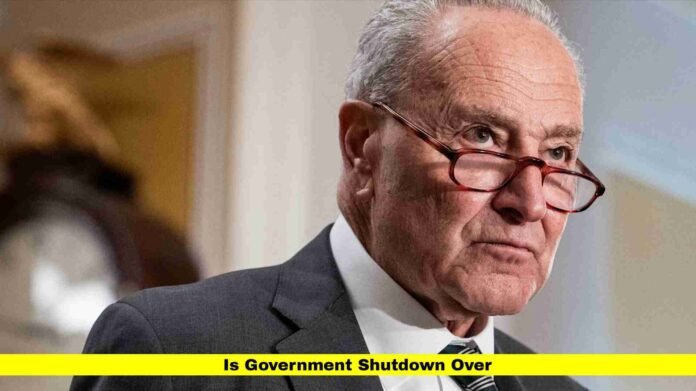

The question “is government shutdown over” has dominated headlines this week as Americans seek clarity on the status of federal agencies, worker pay, and national services. After weeks of tense negotiations in Washington, lawmakers have managed to avert a prolonged crisis by reaching a temporary funding agreement. Here’s a full breakdown of the developments, what they mean for citizens, and what could happen next.
Key Points Summary
- Congress approved a short-term funding bill to end the immediate threat of a government shutdown.
- The stopgap measure extends funding into early 2026, avoiding furloughs and disruptions.
- Federal workers will receive back pay for missed hours, restoring normal operations.
- Partisan divisions remain unresolved, meaning another funding battle looms early next year.
- Essential services like Social Security, air travel, and military pay are back on track.
Congress Reaches Deal to End the Shutdown Threat
After weeks of political standoff, Congress passed a bipartisan stopgap funding bill, effectively ending the shutdown threat that had loomed over millions of Americans. Lawmakers agreed to extend government funding through February 2026, giving both chambers time to finalize a long-term budget.
The agreement came just hours before federal funding was set to expire, marking another narrowly avoided shutdown. President Joe Biden signed the bill into law late last night, calling it a “temporary but necessary step” to keep essential services running while broader fiscal issues are addressed.
How the Deal Was Reached
Negotiations intensified in the final days leading up to the deadline. Disputes over spending priorities, foreign aid, and domestic policy slowed the process significantly.
Senate Majority Leader Chuck Schumer and House Speaker Mike Johnson worked through a complex series of compromises to ensure passage. The measure gained support from both sides, but not without criticism—progressive Democrats argued that the bill didn’t go far enough on social spending, while conservative Republicans claimed it failed to reduce national debt.
Despite these differences, the vote passed with a strong bipartisan margin, signaling the urgency of preventing another shutdown amid global and domestic challenges.
What This Means for Federal Workers
With the funding extension in place, more than 2 million federal employees who faced potential furloughs can now return to normal schedules.
Back pay provisions were included in the final agreement, ensuring workers affected by brief interruptions will be compensated. Agencies such as the Transportation Security Administration (TSA), National Parks Service, and Internal Revenue Service (IRS) have resumed standard operations.
This relief also extends to federal contractors and associated services that rely on government operations to function daily.
Impact on Public Services
The brief uncertainty over funding caused temporary slowdowns across several sectors. Passport processing, small business loan approvals, and federal court cases were among the services most at risk.
Now that the shutdown is over, federal agencies are catching up on pending applications and services. National parks that had closed certain facilities are reopening, and the Department of Agriculture has restarted nutrition programs that were temporarily halted in some states.
Air travel, postal services, and Medicare programs continue to operate without interruption, ensuring citizens experience minimal long-term effects.
Why Shutdowns Keep Happening
The recurring question in recent years has been why the U.S. keeps approaching shutdowns so frequently. The answer lies in deep political polarization and procedural gridlock.
Each fiscal year, Congress must pass 12 appropriations bills to fund government departments. When lawmakers fail to agree on spending levels or policy riders, funding lapses occur, triggering shutdowns or emergency extensions.
Recent shutdowns have often been tied to larger debates, including border security, health care spending, and debt limit negotiations. Despite bipartisan recognition of the economic and social costs, long-term reforms to prevent shutdowns have not gained enough traction.
Economic Consequences of the Shutdown Standoff
Even short-term shutdown threats can have wide-reaching economic impacts. Business confidence dips, federal contracts stall, and consumer spending slows due to uncertainty.
Economists estimate that the near-shutdown in November 2025 cost the economy billions in lost productivity. Federal workers missed paychecks temporarily, and delayed services affected private industries dependent on government contracts.
Financial markets, however, reacted positively after news broke that the funding deal had passed. The Dow Jones and Nasdaq both saw modest gains, reflecting investor relief that another major disruption was avoided.
Political Fallout and Public Reaction
While the shutdown crisis may be over for now, political fallout continues to shape the national conversation. Public opinion polls show frustration among voters toward both parties, with many seeing the repeated standoffs as evidence of dysfunction in Washington.
Republicans argue they’re pushing for fiscal discipline amid growing national debt, while Democrats emphasize the need to protect public services and social safety nets.
With the 2026 midterm elections approaching, both sides are already framing this budget episode as a preview of their broader economic agendas.
Future Deadlines and the Next Budget Battle
The current funding bill runs through early 2026, meaning another deadline is just months away. Lawmakers must now work on a comprehensive spending package that addresses contentious issues, including defense spending, climate policy, and healthcare funding.
Observers warn that without structural reforms, the cycle of shutdown threats could continue indefinitely. Some lawmakers are pushing for a bipartisan commission to propose changes to how budgets are approved, possibly introducing automatic continuing resolutions to prevent future shutdowns.
Reactions from Key Leaders
- President Joe Biden praised the deal but urged Congress to work toward a more stable fiscal framework.
- House Speaker Mike Johnson called the agreement a “responsible compromise” that protects essential services while maintaining conservative priorities.
- Senate Minority Leader Mitch McConnell emphasized that stability is crucial to America’s global standing and economic health.
Outside Washington, labor unions, business associations, and civic groups have all welcomed the end of the shutdown, but many stress that temporary solutions are no substitute for lasting governance.
Public Services Resuming Nationwide
With funding restored, agencies are moving swiftly to resume operations and reduce backlogs. Citizens can now expect smoother access to:
- Social Security and Medicare assistance
- IRS customer support and refunds
- National park access
- Passport and visa processing
- Student financial aid disbursements
This swift recovery reflects lessons learned from past shutdowns, where extended downtime caused significant delays even after funding was restored.
The Broader Message: Stability and Trust
The recurring fiscal standoffs have tested public trust in government efficiency. As agencies reopen and workers return, officials are emphasizing transparency and service recovery.
Experts suggest that consistent governance is not only about budgets—it’s also about maintaining public confidence in national institutions.
The White House has reportedly instructed agencies to prioritize communication with the public and to clear backlogs as quickly as possible to restore normalcy.